
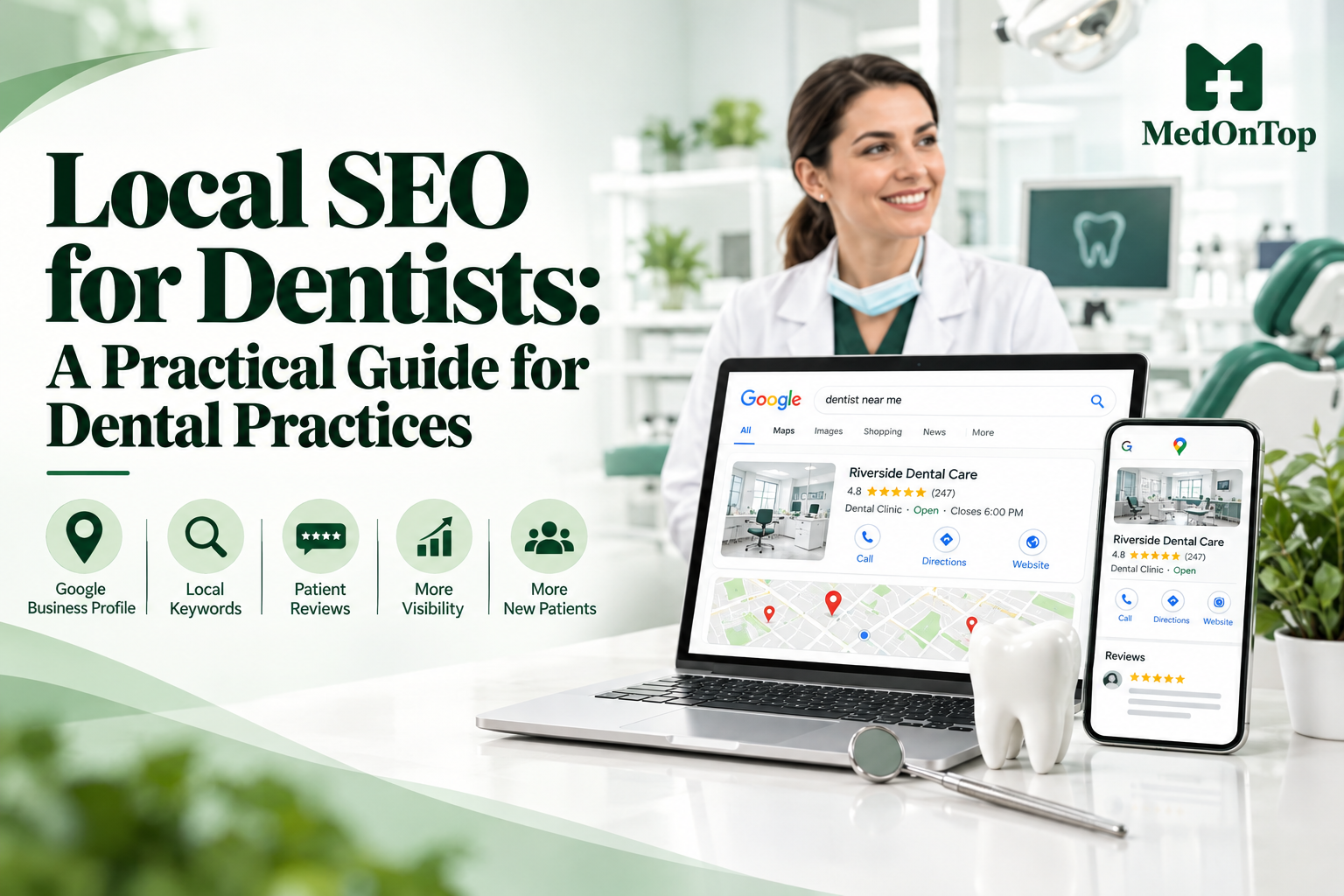
Local SEO for dentists helps dental practices appear in relevant Google Search and Google Maps results when nearby patients look for dental care. It combines Google Business Profile optimization, location-specific website content, technical SEO, and reputation management to improve local discoverability. A successful strategy connects the services a practice actually provides with the searches potential patients perform.
For example, someone searching for an emergency dentist in Austin needs different information from someone comparing dental implant providers.
An effective local SEO for healthcare strategy addresses these differences while maintaining accurate business information and trustworthy clinical content. This practical guide explains how dental practices can improve local visibility, organize treatment pages, optimize Google Business Profiles, and measure qualified patient inquiries without relying on rankings alone.
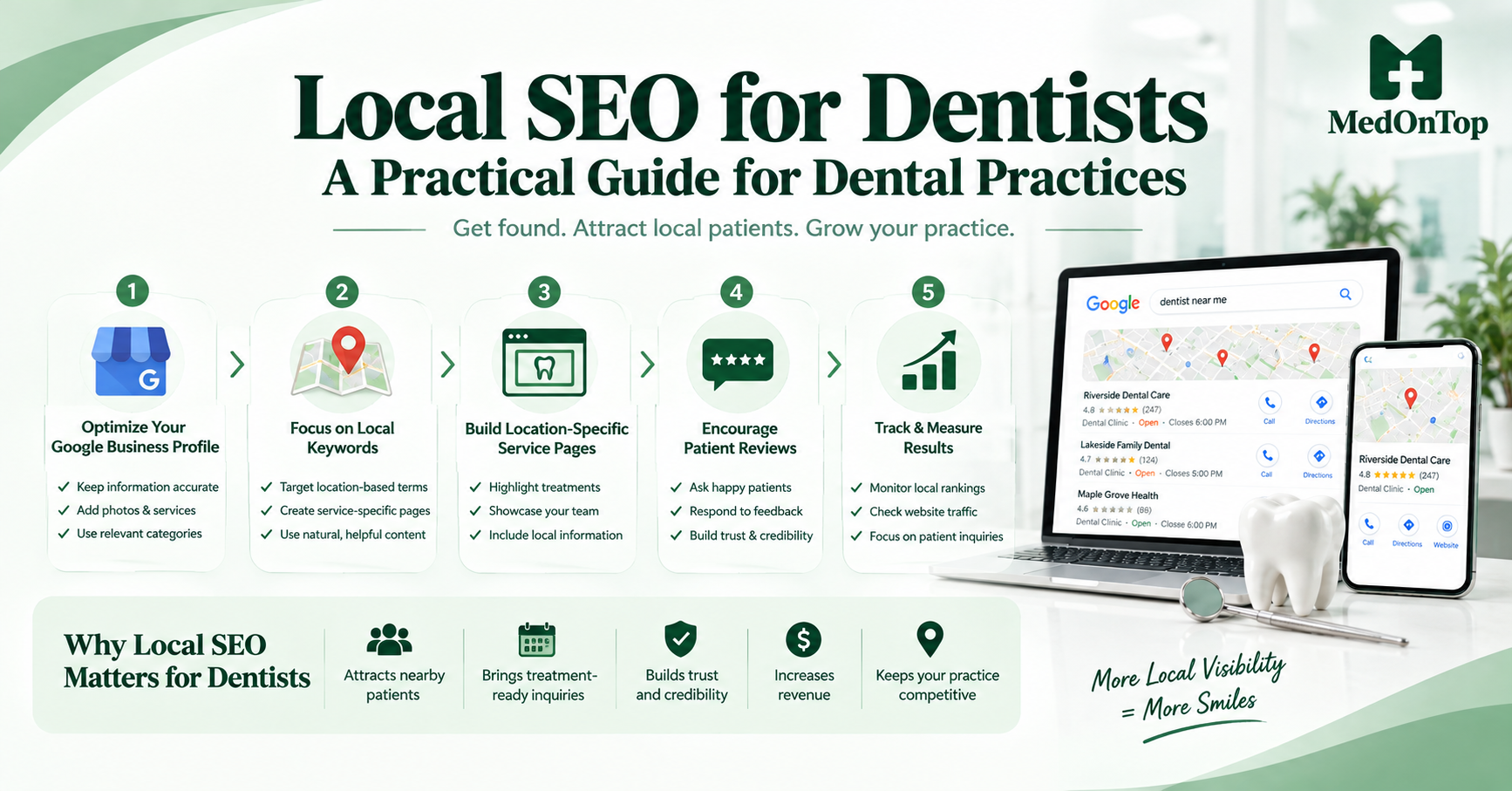
What Is Local SEO for Dentists?
Local SEO for dentists is the process of optimizing a dental practice’s online presence to improve visibility for searches connected to its physical location and available treatments. It helps patients find relevant dental providers through Google Maps, local business results, and organic search listings.
Dental local search optimization is particularly important because most patients need a provider within a practical travel distance. Searches such as “dentist near me,” “emergency dentist in Dallas,” and “dental implants in Houston” demonstrate different levels of treatment-specific intent.
Local SEO vs. Traditional Dental SEO
Traditional SEO focuses on improving website visibility through content relevance, technical accessibility, and site authority. Local SEO includes those foundations but places additional emphasis on geographic relevance, Google Business Profile accuracy, local reputation, and location-specific service information.
A dental website may rank for educational articles without appearing prominently in nearby Google Maps searches. Conversely, a practice may have a visible Business Profile but lack informative treatment pages that support appointment decisions.
Both search channels should reinforce one another.
Google Maps vs. Organic Dental Search Results
Google Maps listings typically highlight business names, addresses, reviews, hours, and contact options. Organic search results direct users toward website pages explaining treatments, qualifications, locations, and appointment procedures.
A patient might discover a practice through Google Maps, visit its website to review treatment information, and then call for an appointment. This makes consistent information across both surfaces essential.
How Does Local Dental SEO Work?
Google’s local ranking systems primarily consider relevance, distance, and prominence when selecting businesses for nearby searches. These factors help determine which dental practices may best match a patient’s location and treatment needs.
Relevance: Matching Dental Services With Search Intent
Relevance describes how closely a practice matches a search. A pediatric dentist should communicate that specialty through accurate business categories, website content, and provider information.
An emergency dentistry page should explain the urgent problems the practice can assess and how patients can request care. Selecting unrelated Google Business Profile categories or repeating keywords cannot replace accurate clinical information.
Distance: How Physical Location Affects Rankings
Distance reflects how far a business is from the location associated with a search. Two patients searching for “dentist near me” from different neighborhoods may see different results. Dental practices cannot guarantee rankings across an entire city simply by adding neighborhood names to their websites. Each legitimate office should have accurate location information that helps patients identify where services are available.
Prominence: Building a Credible Local Presence
Prominence relates to how established and recognized a business is.
Google considers information such as website links and reviews when evaluating local prominence. A dental practice with credible provider information, relevant local mentions, and authentic patient feedback may strengthen its online presence. However, Google’s ranking formulas are not fully disclosed, and no individual signal guarantees visibility.
Why Is Local SEO Important for Dental Practices?
Dental practices depend heavily on local patient demand. Search visibility matters most when it helps patients find suitable providers and make informed appointment decisions.
Attract Patients Searching for Specific Treatments
A general dentistry clinic and an orthodontic specialty practice serve different patient needs. If an orthodontic practice only targets broad searches such as “dentist near me,” it may overlook patients specifically researching braces or aligners.
Treatment-specific pages help communicate available services.
For example, an Austin dental practice offering implants should provide a dedicated implants page that explains consultations, provider qualifications, and relevant treatment considerations. The objective is qualified inquiries rather than traffic from unrelated searches.
Reduce Dependence on Paid Search
Paid advertisements can generate visibility while advertising campaigns remain active. Organic local search provides another discovery channel without paying for each organic click. However, local SEO still requires ongoing investment in content, website maintenance, listing management, and measurement. Practices should evaluate both paid and organic acquisition according to lead quality and operational requirements.
Help Patients Evaluate Your Practice
Patients often compare providers before making contact. Accurate office information, professional credentials, treatment descriptions, genuine reviews, and accessible appointment options help them evaluate whether a practice meets their needs. A confusing website or inconsistent business listing can interrupt that process. Local SEO should therefore improve both search relevance and the patient experience.
How to Implement Local SEO for Dentists
Implementation should begin with the practice’s existing business information, followed by keyword mapping, website structure, and technical validation.
Step 1. Optimize Google Business Profile for Dentists
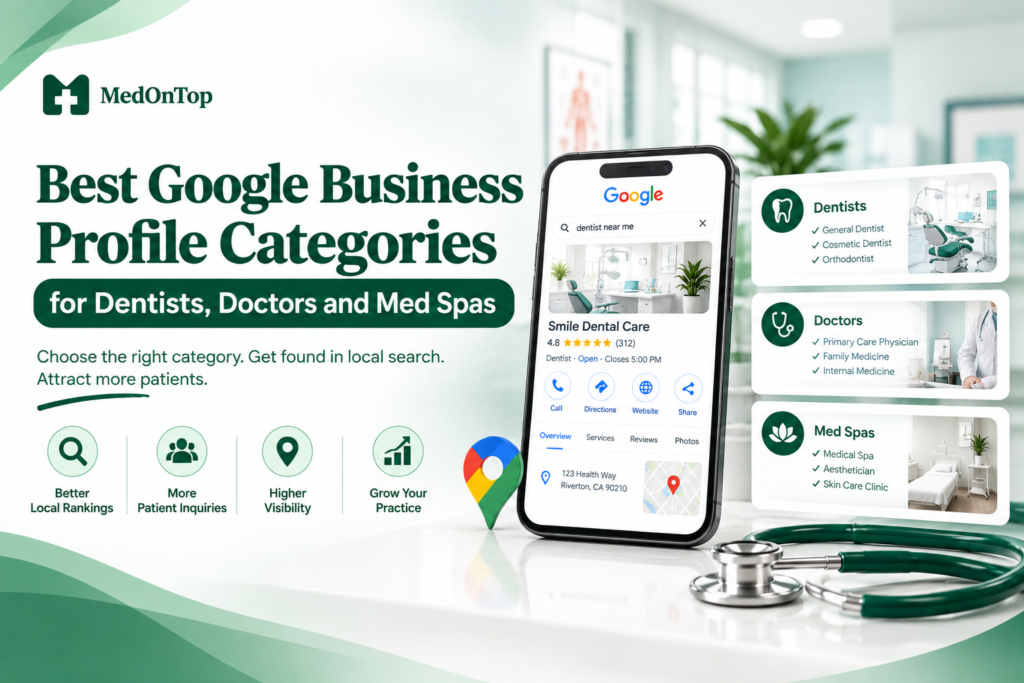
Google Business Profile allows eligible dental practices to manage information displayed across Google Search and Maps. Claim or create the appropriate profile, complete verification, and confirm the practice’s official details.
Review the following information:
- Primary and additional business categories
- Official business name, address, and phone number
- Operating hours and appointment availability
- Accurate services and practice photographs
- Website and appointment destinations
The category should describe what the business is rather than every procedure it provides.
For example, a general dental practitioner may use Dentist, while an eligible orthodontic specialty practice may use Orthodontist. Google’s rules also distinguish clinic organizations from individual practitioners. Avoid creating duplicate profiles merely to target additional services.
Effective GMB local SEO for dentists, using the former Google My Business terminology, now centers on maintaining an accurate Google Business Profile. A structured Google Business Profile optimization process also includes ongoing verification of location details, categories, and profile status.
Step 2. Map Dental Keywords to Search Intent
Keyword research should identify which dental treatments patients search for and where those services are actually available.
Organize keywords by treatment and search intent rather than assigning every variation to the homepage.
| Search intent | Example search | Appropriate page |
| General dental care | Dentist in Austin | Homepage or location page |
| Emergency treatment | Emergency dentist Austin | Emergency service page |
| Specialized care | Dental implants Austin | Implant service page |
| Family dental care | Family dentist near me | Family dentistry page |
| Practice evaluation | Dentist reviews Austin | Practice information |
For Google SEO for dental offices, this mapping connects relevant searches with pages that can satisfy the user’s immediate information needs. Avoid creating multiple pages with nearly identical content simply to target slight keyword variations.
Step 3. Build Accurate Service and Location Pages
Each major service should have a clear destination when it supports a distinct patient search intent. An emergency dentistry page should explain what urgent problems the practice handles, relevant availability, and how to request an appointment. A dental implants page should describe consultations, treatment considerations, and the providers involved.
Location pages should represent genuine offices.
For multi-location practices, include accurate address information, office hours, relevant services, and location-specific contact options. Do not publish nearly identical city pages for areas where the practice has no meaningful location-specific information.
Step 4. Improve Technical SEO and Website Accessibility
Google must be able to access and understand important dental pages. Check indexability, canonical URLs, redirects, XML sitemaps, mobile usability, and internal navigation. Important pages should load reliably and provide accessible content on mobile devices.
LocalBusiness structured data can communicate factual business details such as the practice’s address, telephone number, and opening hours. Use the most appropriate supported schema type, keep markup consistent with visible page content, and validate its implementation. Structured data improves machine-readable clarity but does not guarantee Google Maps rankings or rich search results.
Advanced Local SEO Strategies for Dental Practices
After completing the technical and listing foundations, dental practices can strengthen their content organization, local authority, and patient experience.
Build Dental Treatment Topical Clusters
Topical clusters organize related pages around one principal subject.
For example, a dental practice offering implants in Austin could develop the following content structure.
Primary service page: Dental Implants in Austin
Supporting articles could cover:
- What Happens During a Dental Implant Consultation?
- Dental Implant Recovery and Aftercare
- Dental Implant Costs and Payment Considerations
- Dental Implants vs. Bridges
Each supporting article should answer a distinct patient question and link naturally to the primary implants page. The primary page should address appointment-related intent, while supporting content explains specific treatment considerations. This helps prevent several pages from competing for the same search purpose.
Clear relationships between services, providers, and locations also make the content easier for search engines and AI-assisted systems to interpret. However, topical clusters alone do not guarantee inclusion in AI Overviews or other generated answers.
Strengthen Local Citations and Business Consistency
Local citations are mentions of a practice’s business information across relevant directories and websites. Review established healthcare directories, professional listings, and credible local business sources. Ensure the official business name, address, and phone number are accurate.
When an office relocates, important listings should be updated rather than leaving outdated addresses active. Prioritize relevant, legitimate directories instead of submitting the practice to hundreds of low-quality websites.
Earn Genuine Reviews and Protect Patient Privacy
Dental practices can encourage patients to share honest experiences through appropriate review requests. Do not purchase reviews, publish fabricated testimonials, or offer incentives conditioned on positive feedback.
Public review responses require particular care.
A dental practice should not confirm someone’s patient status, treatment history, or other protected health information in a response without an appropriate legal basis. Use neutral, professional language and direct sensitive concerns to private communication channels.
Improve Mobile Navigation and Appointment Conversion
A patient searching for emergency dental care may need contact information immediately. The relevant landing page should make calling the practice and finding appointment instructions straightforward.
Use clear navigation between service pages, office locations, and provider information. Ensure buttons are accessible, phone numbers are usable, and forms work correctly on mobile devices. The best local SEO options for dental practices include improvements to these conversion pathways, not just keyword optimization.
Common Dental Local SEO Problems and Solutions
Dental practices may struggle with visibility even after publishing service pages and creating a Google Business Profile. The correct response begins with identifying the specific problem.
Why Is My Dental Practice Not Showing on Google Maps?
A practice may not appear because of incomplete verification, incorrect information, eligibility problems, limited relevance, or competition.
First, determine whether the profile exists and is publicly visible. Check its verification status, primary category, business address, and listing restrictions. If the profile is active but ranks poorly, examine relevant local searches from different geographic locations. Distance can explain ranking differences even when the business information is correct.
Should Every Dental Treatment Have a Separate Page?
No. A separate page is useful when the treatment has distinct search intent and enough meaningful information to support independent content.
Dental implants and emergency dentistry typically represent different patient needs. Minor procedure variations may be better addressed within a broader service page. Avoid publishing multiple thin pages that repeat the same explanations with different keywords.
Why Does My Dental Website Get Traffic but Few Appointments?
Traffic can fail to generate appointments when visitors reach irrelevant or incomplete pages. A patient seeking urgent treatment needs to know whether the practice provides appropriate emergency services and how to contact the office. Review search intent, mobile usability, appointment instructions, and qualified inquiry data. More traffic is not automatically the solution if existing visitors cannot find what they need.
Does Dental Schema Markup Improve Maps Rankings?
Structured data helps search engines interpret factual business information, but Google does not identify schema markup as a guaranteed direct ranking improvement for Maps. Use accurate LocalBusiness markup to describe eligible business details. Technical teams should validate structured data and ensure it matches visible content. A correctly implemented schema configuration does not replace accurate Google Business Profile information.
How to Measure Local SEO Performance
The effectiveness of dentist local SEO should be evaluated through relevant visibility, meaningful interactions, and qualified patient inquiries.
Track Local Visibility and Organic Search
Google Search Console provides information about website impressions, clicks, search queries, and indexing. Google Business Profile performance reporting provides available metrics associated with business listing interactions. These systems measure different aspects of search discovery. Analyze relevant treatment and location queries rather than focusing only on total website traffic.
Connect Search Interactions With Qualified Inquiries
Measure whether visitors contact the practice for services it actually provides. Useful indicators include calls, appointment form submissions, consultation requests, and completed bookings. A rise in inquiries for treatments unavailable at the practice could indicate poor keyword targeting or inaccurate business information. Qualified patient demand is a more useful business measure than traffic volume alone.
Protect Patient Information in Analytics
Healthcare marketing measurement requires careful data handling. Review whether analytics scripts, call tracking, form integrations, and advertising tools may collect protected health information. HIPAA obligations depend on the organization, the information involved, and the circumstances of collection and disclosure.
Where applicable, assess vendor relationships, required agreements, permissions, and technical safeguards before deploying tracking systems. Avoid sending medical details or patient identifiers into ordinary marketing analytics without an appropriate compliance basis.
Measure Changes Against a Consistent Baseline
Record existing performance before implementing major SEO changes. Compare future results while considering seasonality, marketing campaigns, competitive activity, and local ranking differences. Maintain a change log for category updates, service-page revisions, and technical deployments.
No single metric proves that SEO produced additional appointments. Combining search data, qualified inquiries, and operational outcomes provides a more useful view of performance.
How MedOnTop Supports Dental Local SEO
Dental practices often face overlapping challenges involving Google Maps visibility, website content, local business information, and technical performance.
MedOnTop provides healthcare-focused SEO services that address these connected areas. Its dentist SEO services focus on improving search visibility and connecting relevant patient demand with dental practices.
A practical local SEO strategy can include reviewing Google Business Profiles, organizing treatment pages, evaluating technical website issues, and strengthening local search relevance. For multi-location practices, consistent business information and location-specific content support more manageable optimization. The purpose is to make dental services easier for appropriate patients to discover and evaluate while measuring meaningful business outcomes rather than rankings alone.
Local SEO for Dentists FAQs
What is local SEO for dentists?
Local SEO for dentists improves a dental practice’s visibility in geographically relevant Google Search and Maps results. It combines business listing optimization, local website content, technical SEO, and reputation management.
How long does local SEO take for dentists?
There is no guaranteed timeline. Some Business Profile corrections may become visible after approval, while competitive organic improvements can take several months. Results depend on the practice’s location, competition, website condition, and implementation quality.
How can dentists rank higher on Google Maps?
Dentists should maintain an eligible, verified Google Business Profile with accurate business information, relevant categories, genuine reviews, and complete contact details. Google considers relevance, distance, and prominence, so higher rankings cannot be guaranteed.
What are the best local SEO strategies for dental clinics?
Important strategies include Google Business Profile optimization, treatment-specific pages, accurate business citations, technical SEO, genuine patient reviews, and clear appointment pathways. Priorities should reflect each practice’s existing weaknesses.
Does a multi-location dental practice need separate Google Business Profiles?
Eligible physical office locations can generally have their own profiles. Each listing must represent a legitimate location and follow Google’s guidelines. Locations providing the same core services should maintain consistent business categories.
Can local SEO work without paid Google Ads?
Yes. Organic local rankings are not purchased through Google Ads. However, improving and maintaining local visibility requires time and investment in content, technical optimization, business listings, and reputation management.
How do dental practices measure SEO without exposing patient data?
Use aggregated search performance, appropriately configured conversion reporting, and carefully controlled inquiry metrics. Review analytics vendors and data flows for applicable healthcare privacy requirements before collecting or transmitting sensitive information.
Conclusion
Local SEO for dentists is most effective when Google Business Profile information, dental service pages, technical website quality, and patient experience work together. Dental practices should begin with accurate business listings, clear treatment information, and an accessible website. From there, topical content clusters, trustworthy reviews, local citations, and measurable appointment pathways can support continued improvement.
The goal is not simply to rank for more dental keywords. It is to help relevant patients discover suitable care and make informed decisions about contacting a practice. For dental practices evaluating their current search visibility, MedOnTop offers a free healthcare SEO audit as a starting point for identifying technical, local, and content optimization opportunities.