

A medical practice marketing plan turns marketing activity into a measurable path toward appropriate new-patient appointments. Over 90 days, a practice can audit how patients find it, choose a few realistic channels, improve inquiry handling, and measure which efforts contribute to bookings. This guide provides a practical schedule, budget calculations, a fictional clinic example, and a reusable worksheet.
Results depend on specialty, local competition, staffing, and appointment capacity; a 90-day plan is a management framework, not a patient-volume guarantee.Where specialist support is needed, healthcare SEO consulting can complement the practice’s own operational audit.
What Is a Medical Practice Marketing Plan?
A medical practice marketing plan is a written set of decisions about whom a practice can serve, which services to promote, how patients can find and contact the office, what staff and budget are available, and how success will be evaluated. Unlike a generic healthcare marketing plan, it must account for appointment slots, intake workflows, clinical accuracy, accessibility, and patient privacy. Its primary output should be appropriate, attended new-patient visits, not just more impressions or clicks.
A 90-day cycle is useful for building foundations, testing changes, and deciding what to continue. Search visibility may take longer to shift, so judge short-term execution separately from longer-term organic outcomes.
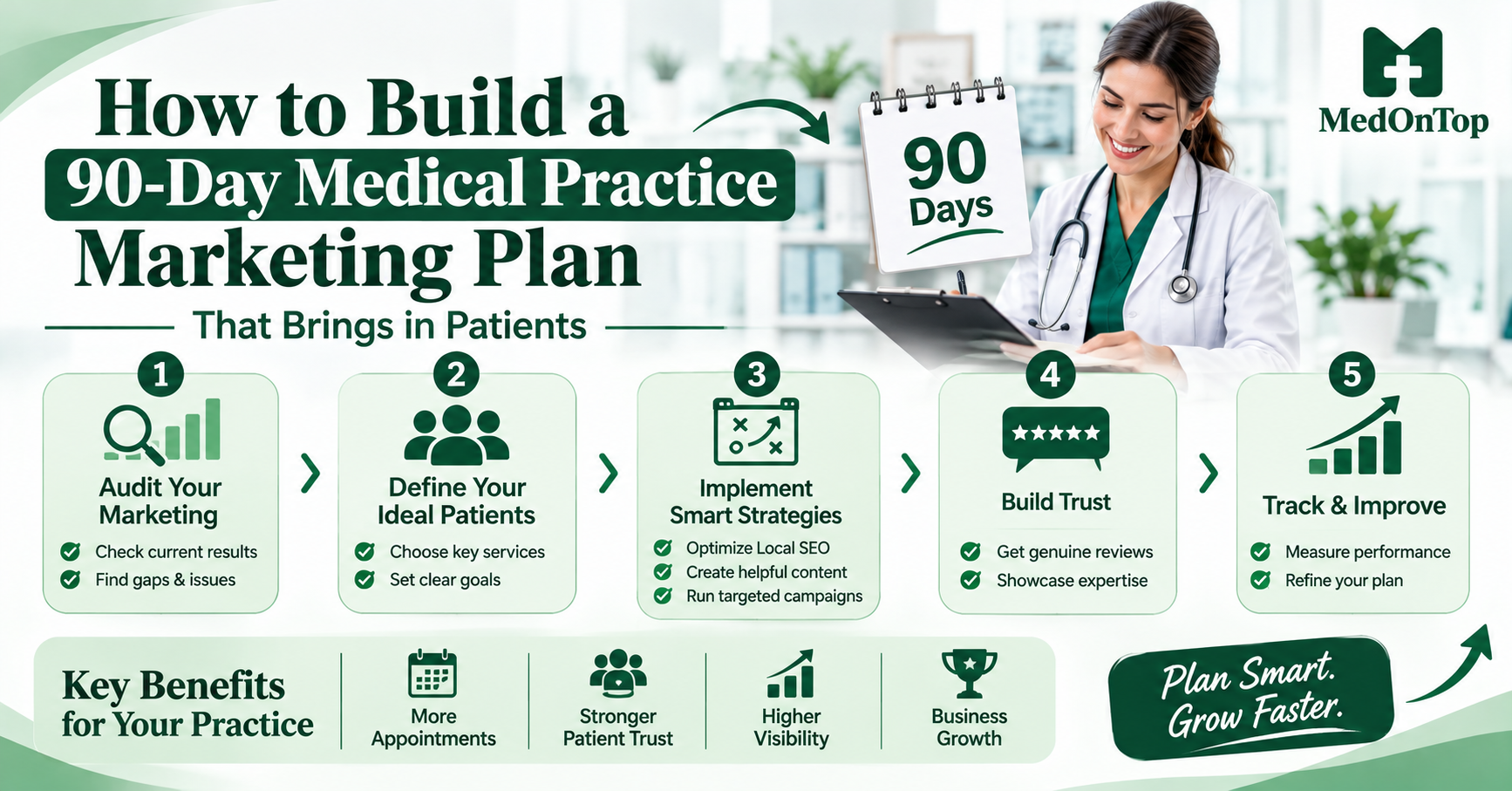
1. Audit Your Marketing and Appointment Capacity
Start with a comparable 30- to 90-day baseline when records exist: qualified inquiries, calls answered and missed, appointment requests, booked and attended new-patient visits, referral sources, major service-page visits, and available appointment slots. Record missing data rather than inventing it. Ask the front desk which questions repeatedly delay bookings.
Test the real patient journey on a phone: search for a relevant service, inspect the listing, open the service page, call or complete the form, and check the confirmation process. Look for inaccurate hours, unclear locations, insurance confusion, broken forms, accessibility barriers, and slow replies. A practice with no intake capacity should resolve that bottleneck before buying more traffic.
2. Define Priority Patients and Appointment Goals
Select one or two clinically appropriate services based on demand, access, capacity, and financial sustainability. Describe patient needs rather than building sensitive targeting profiles. For instance, a primary care clinic may focus on local adults looking for an available new-patient visit. Make all service claims accurate and have clinicians review medical descriptions.
Set a concrete objective such as “20 additional booked new-patient appointments over the next 90 days, compared with a relevant baseline.” Pair it with a patient-experience guardrail: respond promptly during staffed hours and monitor actual attendance. Assign one practice owner accountable for the goal and a distinct operational owner for the booking funnel.
3. Select Healthcare Marketing Strategies That Fit the Practice
If you are deciding how to promote your medical practice, start with the weakest part of the patient journey, not the channel with the loudest promise. Different healthcare marketing strategies solve different problems. A clinic with enough website traffic but few appointments should address conversion before expanding advertising.
| Channel | Prioritize when… | First practical action |
| Local SEO / Google Business Profile | Local search visibility or listing accuracy is weak | Verify categories, hours, services and location details |
| Website conversion | People visit but rarely inquire or book | Repair booking path and high-intent service pages |
| Paid search | The practice has capacity and can fund a controlled test | Test one service, geography and landing page |
| Content / reviews | Patients lack clear answers or trust signals | Publish clinically reviewed FAQs; request genuine reviews |
| Physician referrals | Care pathways depend on professional referrals | Share eligibility and secure scheduling instructions |
Local SEO, Helpful Pages, and Google Business Profile
Maintain consistent practice and provider details, correct hours, authentic service pages, and a complete Google Business Profile. Google states that local search ranking considers relevance, distance, and prominence; nobody can buy a better organic local position [1]. Build a focused local SEO for healthcare approach around real services and locations rather than exaggerated local rankings.
Website Conversion and Patient-Friendly Content
A useful service page makes it easy to understand who the service is for, clinician credentials, locations, insurance or payment information where appropriate, and how to book. Test mobile forms, calls, and accessibility. Publish clinically reviewed answers to actual patient questions. If qualified traffic already exists, conversion rate optimization may produce a stronger near-term operational improvement than more traffic.
Paid Search, Reviews, and Physician Referral Marketing
Paid search can test service demand quickly, but keep the pilot limited, control spend, review ad policies, and verify the landing page and privacy setup first. Invite genuine patient feedback without selectively requesting only positive ratings or fabricating testimonials [2]. Keep public replies free of patient-specific disclosures. Physician referral marketing should provide referring offices with accurate care criteria, contact information, and secure processes; review any financial referral arrangements with qualified counsel.
4. Build a Realistic Medical Practice Marketing Budget
Work backward from booked appointments. Required qualified inquiries = booking target ÷ qualified-inquiry booking rate. Estimated paid media spend = paid qualified inquiries × cost per qualified paid inquiry. These are planning formulas, not market benchmarks. Your actual costs should reflect local competition, service mix, agency expenses, and staff capacity.
| Metric | Fictional assumption | Calculation / interpretation |
| Additional bookings goal | 20 | Confirm 20 usable appointment slots |
| Inquiry-to-booking rate | 40% | 20 ÷ 0.40 = 50 qualified inquiries |
| Cost per paid qualified inquiry | $50 | 50 × $50 = $2,500 ad spend if all inquiries are paid |
| Cost per booked appointment | $125 | $2,500 ÷ 20 bookings; excludes other costs |
| Attended new patients | 16 assumed | 20 × 80% attendance; entirely hypothetical |
| Media-only cost per attended patient | $156.25 | $2,500 ÷ 16; not fully loaded acquisition cost |
Patient acquisition cost (PAC) should use a consistent definition: total attributable acquisition spending divided by new patients actually acquired within a comparable period. Include relevant production, management, and media costs when assessing fully loaded acquisition cost. A booked appointment is not automatically an attended new patient, and attribution often remains partial.
An illustrative $3,000 budget could allocate $2,000 to a narrowly scoped paid test, $600 to page and booking-flow improvements, and $400 to content and measurement support. This is a fictional allocation, not a recommended US practice benchmark. When capacity or tracking is weak, move resources from traffic generation to intake improvements.
5. Execute the 90-Day Marketing Plan
Assign owners, deadlines, and completion evidence. Review progress weekly, with formal channel decisions at days 30, 60, and 90. The action calendar below is adjustable; avoid launching more channels than staff can manage.
| Week | Action | Owner / proof of completion |
| 1 | Audit calls, inquiries, bookings, attendance and slots | Manager / baseline |
| 2 | Test site, GBP, service pages and listings | Marketer / issue log |
| 3 | Choose service goal, patient questions and privacy approach | Owner / approved brief |
| 4 | Fix forms, call routing, appointment paths and scripts | Operations / booking test |
| 5 | Improve priority service landing page | Web team / published page |
| 6 | Correct GBP and location details | Marketer / verified listing |
| 7 | Publish one clinically reviewed patient guide | Reviewer / approved copy |
| 8 | Start controlled paid test only if ready | Marketer / capped campaign |
| 9 | Review inquiry quality and response delays | Front desk / weekly scorecard |
| 10 | Refine underperforming page or advertisement | Marketer / change log |
| 11 | Update referral office resources | Practice liaison / outreach log |
| 12 | Compare bookings, attendance, spend and limitations | Manager / KPI analysis |
| 13 | Document continue, change or stop decisions | Owner / next-quarter plan |
Days 1–30: Foundation
Establish the baseline, fix appointment-blocking problems, define qualified inquiries, and review analytics with appropriate privacy and legal stakeholders. Confirm who answers calls and who contacts unbooked inquiries during staffed hours.
Days 31–60: Focused Launch
Improve the most important landing page and local listing, publish one useful answer to a patient question, and launch narrowly scoped paid search only when budget, capacity, and data protections permit. Inspect booking friction each week.
Days 61–90: Evaluate and Refine
Compare inquiry quality, booked and attended visits, response delays, and costs against baseline. Account for seasonality and unclear sources. Decide which improvements deserve another quarter and which experiments should stop.
A Complete Medical Practice Marketing Plan Example
Consider a fictional two-provider primary care clinic with capacity for additional visits. Its goal is 20 incremental booked new-patient appointments in 90 days. The practice manager owns intake, a marketing contractor improves the local listing and service page, and a clinician reviews medical content. The practice estimates 50 qualified inquiries at a 40% booking rate, but makes no assumption that all inquiries must be paid.
To understand the full funnel, suppose those 50 qualified inquiries came from 80 total inquiries, which followed 1,000 relevant page visits. If 40% book and 80% of those attend, the clinic would record 20 bookings and 16 attended appointments. Every figure here is hypothetical, not a promised outcome or an actual MedOnTop case study.
| Funnel stage | Fictional volume | What the clinic checks |
| Relevant website visits | 1,000 | Which service and location brought interest? |
| All inquiries | 80 | Were calls and forms accessible? |
| Qualified inquiries | 50 | Did requests match available services? |
| Booked appointments | 20 | Were responses timely and slots available? |
| Attended new patients | 16 | What caused cancellations or no-shows? |
Front-desk execution can determine whether marketing works. Assign call coverage, log missed calls safely, define follow-up responsibility, confirm how quickly the clinic responds during open hours, and review appointment reminders through approved systems. Do not place patient details or recordings into unsuitable marketing tools. If inquiries rise but bookings stay flat, inspect contact handling before increasing ad spend.
Measure Marketing Metrics While Protecting Patient Privacy
Use a simple weekly scorecard: qualified inquiries by source, booking rate, attended new-patient visits, missed-call rate, response time, media spend, cost per qualified inquiry, and cost per acquired patient when attribution supports it. These marketing metrics connect discovery activity with real patient access rather than treating traffic or ranking movement as proof of growth.
| Observed pattern | Likely diagnostic question | Next action |
| Traffic rises; inquiries flat | Is the booking path unclear? | Test service page, CTA and forms |
| Inquiries rise; bookings flat | Are calls missed or appointments unavailable? | Audit front-desk follow-up and capacity |
| Bookings rise; attendance flat | Is confirmation or scheduling difficult? | Improve approved reminder workflow |
| Paid inquiry cost rises | Are targeting and inquiry quality changing? | Narrow campaign, reassess value and budget |
Attribution is imperfect: a patient may discover a provider through search, discuss it with family, and call directly later. Prefer aggregated reports and distinguish known sources from unknown. Before using analytics pixels, call recording, audience lists, or third-party booking tools, review information flows, legal obligations, contracts and vendor permissions. HHS online-tracking guidance includes significant qualifications following the June 20, 2024 court ruling; not all page visits automatically constitute PHI [3].
Common Mistakes and a Ready-to-Use Worksheet
Avoid spreading a small budget across too many channels, neglecting missed calls, treating every lead as qualified, publishing unsupported medical claims, using fabricated testimonials, or promising that SEO will deliver a specific number of patients in 90 days. Choose a focused test and document what you can genuinely measure.
Copy the following planning worksheet into your internal operating document. Assign an owner and review it at least monthly.
| Planning field | Fill in for your practice |
| Priority clinical service and location | ____________________________ |
| Current capacity and 30–90-day baseline | ____________________________ |
| 90-day incremental booking goal | ____________________________ |
| Qualified inquiry / booking-rate assumptions | ____________________________ |
| Chosen channels and why | ____________________________ |
| Media, staffing and production budget | ____________________________ |
| Front-desk response owner and process | ____________________________ |
| Clinical and privacy review owner | ____________________________ |
| Weekly dashboard and review dates | ____________________________ |
| Day-90 continue / change / stop decision | ____________________________ |
Frequently Asked Questions
How do you promote a medical practice on a small budget?
Fix inaccurate listings and booking obstacles first, improve one priority service page, and strengthen appropriate referral relationships. Run paid campaigns only when staff can measure and handle qualified inquiries.
How do you market a medical practice to new local patients?
Start with accurate location information, useful specialty pages, accessible appointment contact options, and a consistent intake workflow. Choose channels based on local needs, not a one-size-fits-all formula.
What is a realistic goal for the first 90 days?
Set a measurable booking or process goal using historical performance and available appointment capacity. Treat the first month as a baseline-building period if reliable data are missing.
How do you calculate patient acquisition cost?
Divide comparable attributable acquisition costs by newly acquired patients under a clear definition. Cost per lead, cost per booking, and cost per attended new patient answer different questions.
Does physician referral marketing still matter?
Yes, especially for services that depend on professional referrals. Accurate service criteria, responsive scheduling, and secure communication improve the referral process. Legal rules may apply to financial arrangements.
How often should marketing performance be reviewed?
Review inquiry handling and leading indicators weekly, channel economics monthly, and the overall plan on day 90. Allow longer for organic-search effects where necessary.
Is website analytics tracking automatically HIPAA-compliant?
No. Requirements depend on the entity, information collected, vendor arrangements, and actual disclosures. Obtain qualified privacy and legal review rather than relying on a broad compliance claim.
Turn the Plan Into an Appointment-Focused Process
A useful medical marketing plan is one the practice can actually execute. Begin with a clear patient need and reliable booking capacity, fix the biggest intake bottleneck, test a small number of channels, and judge progress by appropriate inquiries and attended appointments. At day 90, record what worked, what remains uncertain, and what deserves further investment.
To identify search and website priorities for your practice, request a free healthcare SEO audit from MedOnTop.