
E-E-A-T OPTIMIZATION FOR HEALTHCARE
E-E-A-T Optimization That Earns Google's Trust for Your Practice
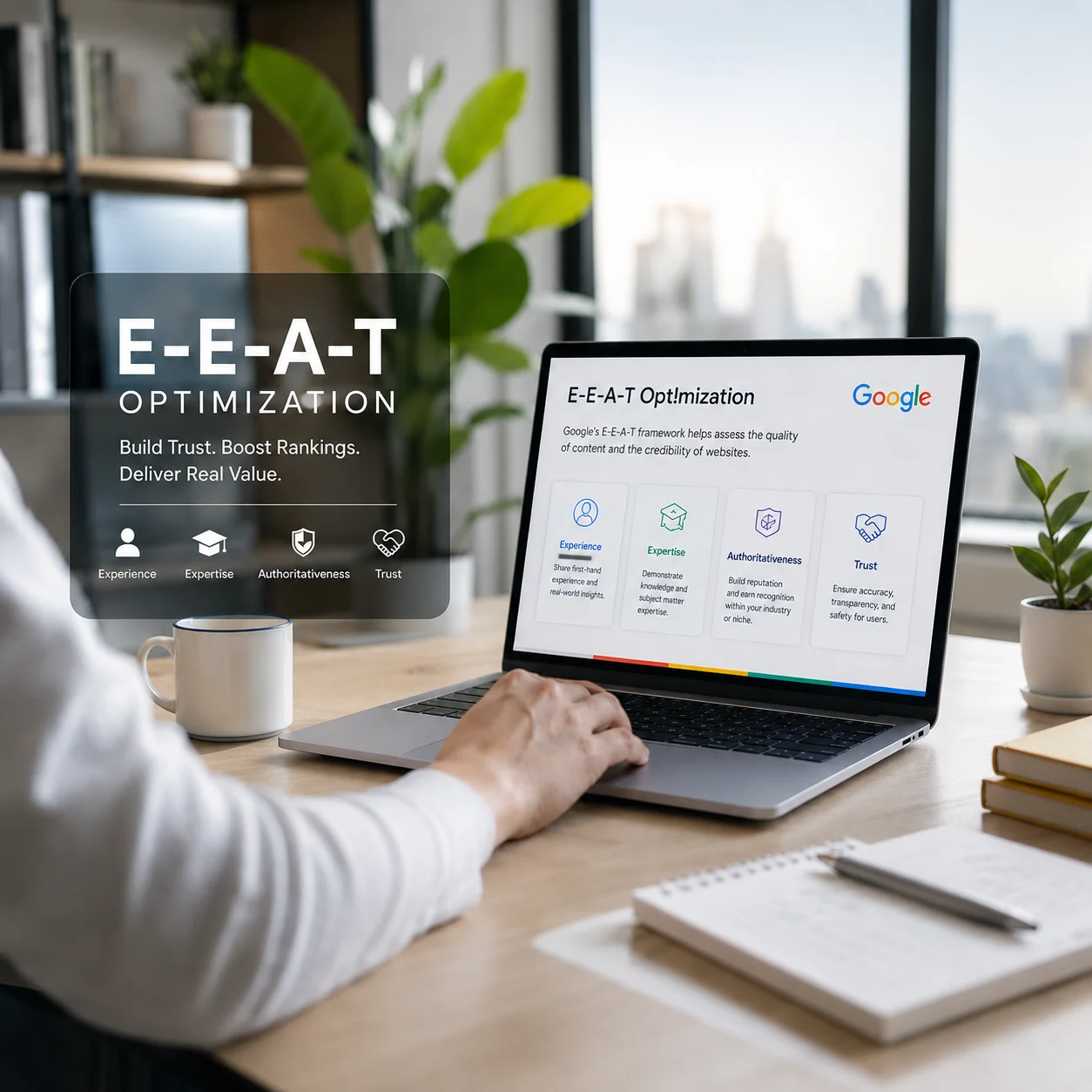
Healthcare websites live in Google’s most scrutinized category: Your Money or Your Life (YMYL). Every piece of content your practice publishes is evaluated against Google’s E-E-A-T framework, which stands for Experience, Expertise, Authoritativeness, and Trustworthiness. Sites that fail these signals are penalized in rankings regardless of their technical SEO performance.
Our E-E-A-T optimization program builds the credibility architecture that Google’s quality raters and ranking algorithms look for in healthcare content. We help your practice demonstrate real clinical experience, verified provider credentials, authoritative backlinks, and the trust signals that convert skeptical patients into booked appointments.
- Provider Credentialing
- Author Bio Optimization
- Medical Content Review
- Trust Signal Architecture
E-E-A-T OPTIMIZATION SERVICES FOR HEALTHCARE
E-E-A-T Services Built for Healthcare Websites
Every component of our E-E-A-T program targets the specific signals Google’s quality raters are instructed to evaluate when assessing healthcare content quality and provider credibility.
Provider Bio and Credential Optimization
Medical-grade provider profile pages that display board certifications, medical school credentials, residency training, publications, awards, and clinical experience in the structured format Google’s quality raters assess for Expertise signals
Healthcare Content Author Attribution
Authorship framework that assigns every piece of medical content to credentialed providers or certified medical writers, with clear bylines, credential disclosures, and author profile links that satisfy Google’s YMYL content authorship requirements
Medical Content Review and Accuracy Auditing
Systematic review of all existing website content against current clinical guidelines and peer-reviewed sources, with citations added, outdated information updated, and a documented review process that demonstrates ongoing content accuracy commitment
Trust Signal Architecture
Implementation of the trust elements patients and Google’s quality raters look for including practice awards, certifications, hospital affiliations, professional association memberships, insurance accepted pages, and clear contact and location information
Authority Backlink Acquisition for Healthcare
Targeted outreach for backlinks from medical journals, healthcare associations, state licensing boards, hospital networks, and regionally trusted healthcare publications that build Authoritativeness in Google’s eyes
About Us and Practice History Pages
Compelling, detail-rich About pages that tell your practice’s full story including founding date, provider career history, community involvement, patient care philosophy, and facility information that builds the Trustworthiness dimension of E-E-A-T
Patient Review and Testimonial Integration
Structured integration of verified patient testimonials, review widgets, and aggregate rating schema that demonstrates real patient Experience with your practice across Google, Healthgrades, and other trusted review platforms
E-E-A-T Content Gap Analysis
ull audit of your website’s current E-E-A-T signals compared to top-ranking competitors in your specialty, identifying every credibility gap and producing a prioritized action plan for closing them
WHY E-E-A-T MATTERS FOR HEALTHCARE RANKINGS
Google Holds Healthcare Content to the Highest E-E-A-T Standard
Google’s Search Quality Rater Guidelines dedicate extensive attention to YMYL content, which includes all medical, dental, and health-related websites. Quality raters are trained to evaluate whether content demonstrates real-world clinical experience, verifiable professional credentials, recognized authority within the medical community, and trustworthy business practices.
A healthcare practice website with weak E-E-A-T signals can have perfect technical SEO and still rank poorly because Google’s algorithm is designed to suppress medical content that cannot be verified as credible. Investing in E-E-A-T optimization is not optional for healthcare practices competing in organic search. It is the prerequisite for all other SEO gains to be realized.

Free Local SEO Visibility Score
See how you rank across your full service area, not just one ZIP code.
Free E-E-A-T Audit for Your Healthcare Website
We assess your practice website against all four dimensions of Google's E-E-A-T framework, scoring your current provider credentialing, content authorship, authority signals, and trust architecture. You receive a detailed gap analysis and a prioritized action plan with specific recommendations for each section of your site.
Experience: Show Real Clinical Outcomes
Google's 2022 addition of the first 'E' for Experience reflected a shift toward rewarding content created by people with direct, first-hand experience in the subject. For healthcare practices, this means showcasing real provider clinical experience, case outcomes, patient success stories, and treatment approaches grounded in hands-on practice, not just textbook descriptions. Provider bios that detail years in practice, patient volume, procedure counts, and specialty training demonstrate Experience in the way Google's quality raters are trained to recognize. Generic bios listing only degree credentials no longer satisfy this signal in competitive healthcare markets.
Expertise and Authoritativeness Together
Expertise is demonstrated at the content level through clinically accurate information, medical citations, current treatment guidelines, and clear differentiation of what is evidence-based versus anecdotal. Every service page and blog post should be traceable back to a qualified provider or certified medical writer whose credentials are visible on the page. Authoritativeness is built at the domain level through inbound links from medically recognized sources. A hospital link, a medical journal citation, a state health department resource page mention, or an appearance in a respected healthcare publication each add to your domain's authority score in Google's perception of your practice as a recognized medical resource.
Trustworthiness: The Foundation of YMYL Rankings
Trustworthiness encompasses everything that makes a patient feel safe engaging with your practice online. This includes secure HTTPS implementation, visible and accurate contact information, transparent pricing and insurance pages, clear practitioner licensing information, and consistent NAP data across all directories. For AI-driven search features like AI Overviews and ChatGPT recommendations, Trustworthiness signals have become even more critical. AI systems cite and recommend healthcare practices whose websites present verifiable, structured, and consistently accurate information that matches what external sources say about them.
OUR E-E-A-T OPTIMIZATION PROCESS
How We Build E-E-A-T Authority for Healthcare Practices
OUR E-E-A-T OPTIMIZATION PROCESS
OUR E-E-A-T OPTIMIZATION PROCESS
E-E-A-T Audit and Gap Scoring
We evaluate your website’s E-E-A-T signals, assess credibility and trust, and compare competitors to identify improvements that strengthen authority and search rankings.
Provider Credentialing and Author Framework
We create provider bios highlighting credentials, experience, and affiliations while establishing expert authorship to strengthen E-E-A-T, credibility, and search visibility.
Content Review, Citation, and Trust Signal Implementation
We improve content accuracy, add trusted medical references, update outdated information, and strengthen trust with reviews, credentials, association badges, and schema markup.
Authority Link Building and Ongoing Monitoring
We build healthcare authority links, monitor E-E-A-T signals, track rankings, acquire trusted backlinks, and address credibility gaps to strengthen your online authority continuously.
WHAT IS INCLUDED
Everything in Our E-E-A-T Optimization Program
Our program covers every layer of E-E-A-T signal development, from individual provider bio pages to domain-level authority link acquisition and structured trust architecture across your entire site.
Provider Bio and Credentials Pages
Complete rewrite or creation of provider profile pages displaying board certifications, training history, publications, clinical experience, and hospital affiliations in the depth Google's quality raters assess for Expertise signals.
Content Authorship Structure
Authorship attribution framework for all website content with bylines, credential disclosures, author profile links, and a documented content review process that satisfies YMYL authorship requirements.
Medical Content Review and Citation
Full content audit for clinical accuracy, outdated treatment claims, and unsupported medical statements. Peer-reviewed citations and source references added throughout service pages and blog content.
Trust Signal Implementation
Structured integration of practice awards, certifications, accreditations, association memberships, insurance pages, and clear contact information across all pages that influence Trustworthiness scoring.
Healthcare Authority Link Acquisition
Outreach to medical associations, hospital networks, health publications, licensing boards, and academic institutions for authority backlinks that build domain-level Authoritativeness in Google's YMYL evaluation.
Monthly E-E-A-T Performance Reports
Monthly reporting on E-E-A-T signal improvements, new authority links acquired, content credibility updates completed, ranking movements tied to E-E-A-T changes, and the next month's priority actions.
HEALTHCARE E-E-A-T CONSIDERATIONS
E-E-A-T for Healthcare Is Different from Other Industries
Google applies its strictest YMYL content standards to medical and dental websites. These requirements go well beyond what general business websites need to address for credibility.
- Every medical claim on your website should be attributable to a named, credentialed provider or peer-reviewed source, not written generically without authorship attribution
- Provider bios must go beyond listing a degree and city to demonstrate the depth of clinical experience, specialized training, and community standing that quality raters are trained to evaluate
- Outdated medical information is an active E-E-A-T liability. Content describing procedures or treatments no longer consistent with current clinical guidelines can suppress rankings across your entire domain
- AI search systems including AI Overviews, ChatGPT, and Perplexity use E-E-A-T signals to decide which healthcare providers to recommend. Strong E-E-A-T is now also a prerequisite for AI search visibility
- HIPAA compliance in patient testimonials and case study content is part of the trust architecture. Patient experience content that exposes protected health information creates both legal and E-E-A-T risk
- Schema markup for MedicalOrganization, Physician, and MedicalProcedure entities provides machine-readable E-E-A-T signals that help Google's systems categorize your practice and providers accurately
RELATED SERVICES
Amplify E-E-A-T with These Services
FREQUENTLY ASKED QUESTIONS
E-E-A-T Optimization for Healthcare: FAQs
What is E-E-A-T and why does it matter for healthcare SEO?
E-E-A-T stands for Experience, Expertise, Authoritativeness, and Trustworthiness. It is the framework Google’s quality raters use to evaluate content quality, with healthcare websites receiving the strictest scrutiny under the YMYL (Your Money or Your Life) category designation.
Healthcare websites that score poorly on E-E-A-T signals face persistent ranking suppression that cannot be overcome through technical SEO alone. Investing in E-E-A-T optimization is the foundational requirement for any healthcare practice that wants to compete in organic search and AI-generated results.
How does E-E-A-T affect AI search visibility for medical practices?
AI systems like Google’s AI Overviews, ChatGPT, and Perplexity actively assess the credibility signals of sources they recommend. Healthcare practices with strong E-E-A-T, including verified provider credentials, peer-reviewed content citations, and authoritative external links, are significantly more likely to be cited and recommended by AI-generated responses.
Practices that have invested in E-E-A-T before AI search became mainstream are already benefiting from this advantage. Practices that have not built these signals are invisible to AI recommender systems regardless of how often patients ask AI assistants for healthcare provider recommendations in their area.
How long does E-E-A-T optimization take to impact rankings?
Initial E-E-A-T improvements such as provider bio updates, content authorship attribution, and trust signal implementation typically show ranking impact within 60 to 90 days as Google recrawls and reevaluates your content. Authority link acquisition and domain-level Authoritativeness growth take 3 to 6 months of consistent work to produce measurable organic ranking lift.
E-E-A-T is a cumulative advantage. Each addition to your credibility architecture compounds with previous improvements, meaning practices that start building E-E-A-T signals now will hold a widening advantage over competitors who delay investing in this foundational ranking requirement.