
SEO vs PPC is not simply a choice between free clicks and paid clicks. For healthcare practices, search engine optimization (SEO) builds visibility in unpaid Google results over time, while pay-per-click advertising (PPC) places ads in eligible searches in exchange for advertising spend. PPC can generate inquiries sooner; SEO can create a steadier source of discovery as visibility develops. Neither guarantees booked patients.
The choice depends on appointment urgency, services, competition, and how well inquiries become bookings. A strong local SEO for healthcare foundation may be especially valuable when nearby patients search Google Maps for a provider.
This comparison covers costs, lead quality, measurement, and when to combine both channels.
What Is SEO vs PPC in Healthcare?
SEO improves how a practice appears in unpaid search results; PPC purchases eligible ad placements for relevant searches. Both help patients find services, but they differ in speed, cost structure, placement, and how visibility is maintained. SEO is not free: websites, content, local optimization, and ongoing work require investment. PPC charges for ad activity, and campaign management also costs money.
Someone searching for a physical therapist may see ads, Google Maps listings, and organic pages. Each can lead to the same front desk, but a click is not yet a new patient.
A Practical Patient Search Example
Imagine a dermatology clinic offering consultations in one city. It could develop a helpful local service page explaining appointments, provider credentials, and location details. At the same time, it could run a Google Search campaign for appropriate service queries, subject to advertising rules. The clinic should compare qualified consultations booked from each source rather than declaring the channel with the most visits the winner.
How Do SEO and PPC Work?
SEO Builds Visibility Across Search and Maps
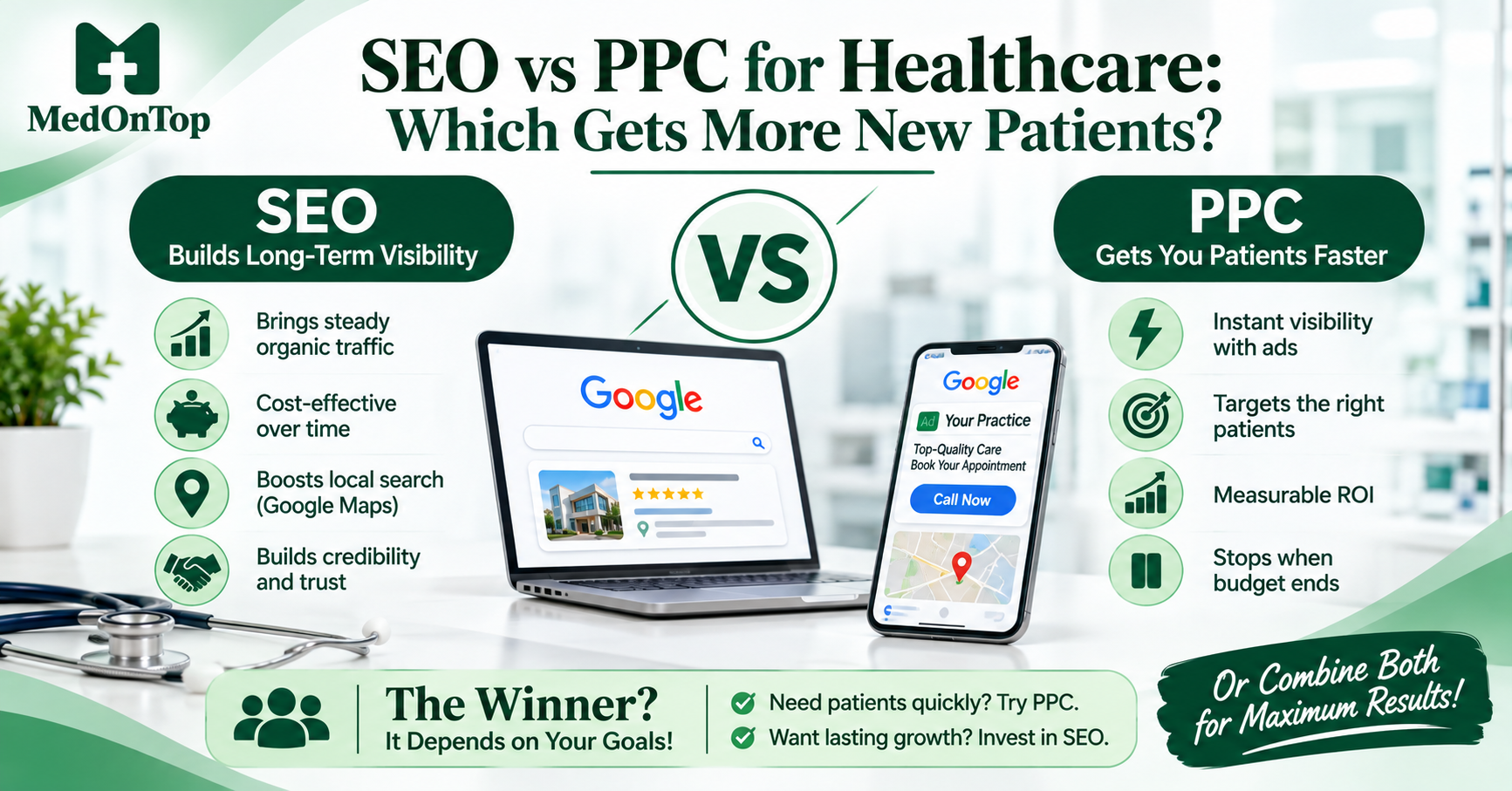
For organic search vs paid search, SEO earns visibility while ads depend on budget and eligibility. Healthcare SEO starts with useful pages that reflect what a practice actually provides. Clear service descriptions, accurate contact information, relevant locations, and credible clinician profiles help prospective patients assess whether a practice meets their needs. Google Business Profile optimization can support local discoverability, while technical health makes pages easier to access and understand.
PPC Buys Visibility for Selected Searches
Healthcare PPC commonly uses Google Ads to show eligible ads when people search for chosen services or locations. Advertisers choose campaign settings and budgets, write ads, and connect them to landing pages. They generally pay when users click search ads, although other campaign types can use different billing models.
An approved campaign can reach eligible searches quickly, but visibility can stop when funding stops.
Healthcare advertising requires extra care. Google restricts some healthcare promotions and sensitive-interest targeting; certain services or advertisers may need certification. A practice should check current policies for its specialty, location, ads, and landing pages rather than assuming every healthcare keyword is permitted.
SEO vs Google Ads: What Changes in Practice?
| Decision factor | Healthcare SEO | Healthcare PPC / Google Ads |
| Speed | Usually gradual | Can reach eligible searches sooner |
| Ongoing spending | Optimization and maintenance | Ad spend plus management |
| Visibility | Earned, not guaranteed | Dependent on eligibility, bids, and budget |
| Control | Less direct control over rankings | More control over campaign settings |
| Best measurement | Qualified organic inquiries and bookings | Qualified paid inquiries and bookings |
Which Gets More New Patients?
PPC may bring inquiries faster, while SEO may provide more durable discovery over time. The channel that gets more new patients is the one that produces more qualified, completed bookings at an acceptable acquisition cost. Your specialty, market, website, and intake process determine the outcome.
If You Need Appointments Soon
A new urgent care location or a practice with unfilled appointments may use paid search to reach people already looking for eligible services. PPC is most useful when the clinic can respond quickly, has appointment capacity, and offers a clear booking path. If calls go unanswered or landing pages omit insurance and scheduling details, additional ad spend may simply purchase missed opportunities.
If You Want Long-Term Local Demand
An established practice with useful service pages and accurate listings may prioritize SEO for ongoing discovery. A clinic can build these assets incrementally, but should not expect immediate leads. Rankings fluctuate, and competitive markets require sustained work.
If Your Specialty Has a Complex Patient Journey
Consider physical therapy compared with urgent care. Someone evaluating ongoing rehabilitation may compare credentials, locations, insurance details, and treatment approaches before contacting a clinic. Someone seeking urgent care may prioritize current availability and travel distance. Search behavior varies even within the same specialty, so broad claims about which channel wins are unreliable.
Good medical practice marketing accounts for those differences. A new clinic with immediate openings might prioritize PPC; an established clinic seeking sustained local visibility might prioritize SEO; a competitive specialty with sufficient budget may test both. In every case, exclude employment calls, existing-patient requests, and administrative inquiries from new-patient reporting.
How to Choose and Implement Your Strategy
Step 1: Audit the Starting Point
Review the last few months of organic traffic, paid campaigns, calls, forms, and actual appointments where records allow. Check whether the practice appears for relevant local searches, whether service pages explain offerings clearly, and whether staff can respond to incoming inquiries. Separate new patients from existing patients whenever reliable reporting permits.
Step 2: Map Search Intent to Services
Identify the searches likely to lead to appropriate appointments. Include service type, city or neighborhood, scheduling needs, and the information patients need before contacting you. Different pages should address distinct needs rather than repeating generic content with city names swapped in.
For PPC, avoid overly broad terms that attract researchers outside your service area. For SEO, prioritize real services and helpful questions rather than producing dozens of thin pages. Make sure medical explanations accurately reflect the clinicians and procedures your practice actually offers.
Step 3: Build the Right Pages and Campaigns
A useful service page tells visitors what is offered, where care is available, what happens next, and how to request an appointment. Provider bios, accessibility information, and clear contact methods can help people assess the clinic. A paid landing page should make the advertised service easy to find rather than redirecting every visitor to a crowded homepage.
Read MedOnTop’s medical SEO for doctors and healthcare practices for a fuller organic-search overview. Your site must also work technically. Page indexing, mobile navigation, speed, and clear structure affect the visitor experience and organic discovery. MedOnTop’s technical SEO for healthcare page explains this supporting work.
Step 4: Test, Measure, and Reallocate
Begin with a manageable set of services and a defined reporting period. Track which search terms, pages, and campaigns lead to qualified conversations and booked visits. Review outcomes with the scheduling team, not just the marketing dashboard. Pause irrelevant paid queries, improve weak pages, and adjust spending based on actual capacity and results.
Best Practices for Healthcare Search Marketing
Match the Patient’s Need, Not Just the Keyword
Medical practice advertising works better when the ad, page, and service match. Someone searching for an appointment should quickly see where the practice is located and how to contact it. Someone researching a treatment needs accurate information and a clear explanation of who provides it. Avoid making clinical promises or implying a procedure suits everyone.
Protect Trust and Patient Privacy
Show real practitioner credentials, accurate locations, and up-to-date information. Health-related pages may need appropriate clinical review, especially when discussing procedures or treatment choices. Reviews and testimonials should be handled with consent and applicable rules in mind.
Advertising platforms and analytics tools can create privacy risks if forms, tracking pixels, or URLs expose sensitive patient information. HIPAA compliance cannot be established by installing a standard analytics script or choosing a vendor that calls itself compliant. Have qualified staff review tracking tools, data flows, contracts, and permitted use of patient information.
Treat SEO and PPC as Complementary
For practices investing in both, a coordinated plan prevents conflicting claims, duplicated work, and disconnected reporting. An SEO vs Google Ads comparison should consider patient bookings, not just channel reports. A healthcare PPC strategy should be tailored to specialty-specific advertising restrictions and realistic appointment capacity.
How to Measure Patients and ROI
Start with the business outcome: new patients who actually book and, where measurable, attend appointments. Then work backward to the marketing activity that contributed to those visits. This is more useful than comparing clicks or rankings in isolation.
| Metric | What it tells you |
| Qualified inquiries | Calls or forms from people seeking an eligible service |
| Booking rate | Share of qualified inquiries becoming appointments |
| New-patient acquisition cost | Relevant marketing cost divided by acquired new patients |
| Appointment attendance | Whether booked visits turn into actual visits |
| Source trends | How organic and paid channels contribute over time |
Consider two hypothetical monthly reports: SEO costs 1,800andproduces12newbookedpatients(150 per booking); PPC costs 2,400includingmanagementandproduces16(150 per booking). Neither wins on booking cost. Compare attendance, qualified demand, capacity, and future maintenance before shifting funds. These are examples, not benchmarks. Cost per lead, cost per booking, and cost per attended patient are different measures. Financial ROI also requires attributable revenue and appropriate costs, not appointment counts alone.
Attribution has limits. A person may find a clinic through an ad, return through organic search, and call later. Call tracking and scheduling data can help, but privacy restrictions and incomplete source data mean no dashboard provides a perfect account of every patient journey.
How MedOnTop Can Help
MedOnTop supports US medical and dental practices through local SEO, technical SEO, content optimization, and healthcare PPC. Practices assessing SEO services for healthcare can examine how these activities support qualified inquiries, bookings, and longer-term search visibility rather than focusing only on traffic.
For a clinic considering paid acquisition, MedOnTop’s healthcare PPC agency services provide a relevant starting point for discussing campaign needs alongside organic search. A medical SEO consultant can also help evaluate which existing pages or location listings deserve attention before additional advertising spend.
When comparing healthcare SEO companies, ask how they distinguish qualified leads from booked new patients, how they address medical accuracy and privacy, and what reporting they will actually provide. No responsible partner should promise a specific ranking or patient count without evidence.
SEO vs PPC FAQs
Is SEO or PPC better for a new medical practice?
PPC can generate visibility sooner for eligible searches, which may help a new practice with available appointments. SEO should still begin early because location information, service pages, and website quality take time to develop. A limited paid campaign alongside foundational SEO is often a practical starting approach.
How long does healthcare SEO take to bring patients?
There is no universal timetable. Existing visibility, competition, site condition, local demand, and the work completed all influence results. Track qualified inquiries and bookings over successive months rather than expecting a guaranteed ranking or patient total by a particular date.
Is PPC more expensive than SEO?
It depends on the specialty, competition, management needs, and timeframe. PPC involves direct advertising spend and often management fees. SEO requires investment in content, technical work, local optimization, and maintenance. Compare cost per acquired patient over a defined period, not the price of a click against an organic visit.
Can SEO and PPC run at the same time?
Yes. PPC can cover appropriate searches while organic pages develop, and both can contribute to patient discovery. Keep
campaign reporting separate enough to understand performance, then evaluate the combined effect on qualified bookings and the practice’s available appointment capacity.
Are Google Ads allowed for every medical service?
No. Google limits certain healthcare and medicine promotions, and some advertisers or services require additional approval. Restrictions also apply to sensitive health-related personalized targeting. Review current policies and relevant legal obligations before launching or changing campaigns.
Should dentists and specialty clinics use the same strategy?
Not necessarily. A general dental office, a dermatology clinic, and a mental health practice can have different appointment needs, search patterns, competition, and advertising restrictions. Build the strategy around real services and patient decisions rather than relying on one generic budget formula.
Choosing the Right Next Step
SEO vs PPC is most useful as a planning question, not a contest with one permanent winner. If you need visibility quickly and have space for appointments, carefully managed paid search may help. If you want a stronger foundation for local discovery, credible service pages and ongoing SEO deserve investment. Many practices need both, with the balance changing as results become clearer.
Before increasing spend, review website visibility, missed calls, booking capacity, and the cost of acquiring an attended new patient. MedOnTop offers a free healthcare SEO audit as a starting point for evaluating organic gaps and deciding where paid search may complement improvements. The right plan should reflect patient needs and measurable appointments, not clicks alone.