
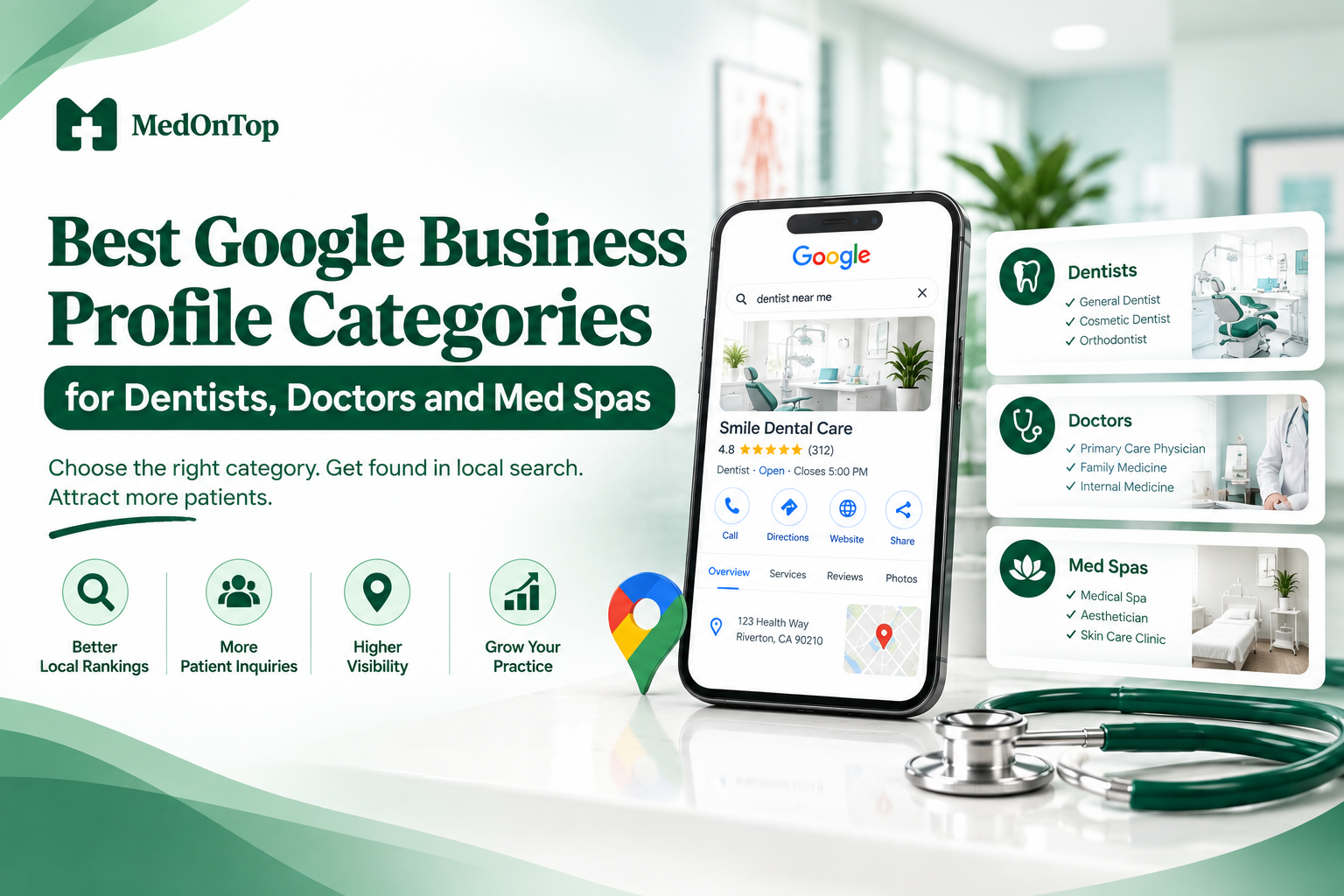
The best Google Business Profile categories for healthcare practices depend on their primary specialty, business structure, and services. A
general dentist should typically consider Dentist, a family physician may qualify for Family practice physician, and a medical aesthetics facility may be best represented by Medical spa.
Choosing the right Google Business Profile for doctors helps Google understand what a healthcare practice does and which local searches are relevant to its services. Accurate category selection is a fundamental part of Google Business Profile optimization.
However, categories alone do not guarantee higher rankings or more appointments. This guide explains the most relevant business categories for dentists, doctors, and med spas, how to select primary and additional categories, and how to maintain accurate listings across multiple locations.
What Are Google Business Profile Categories?
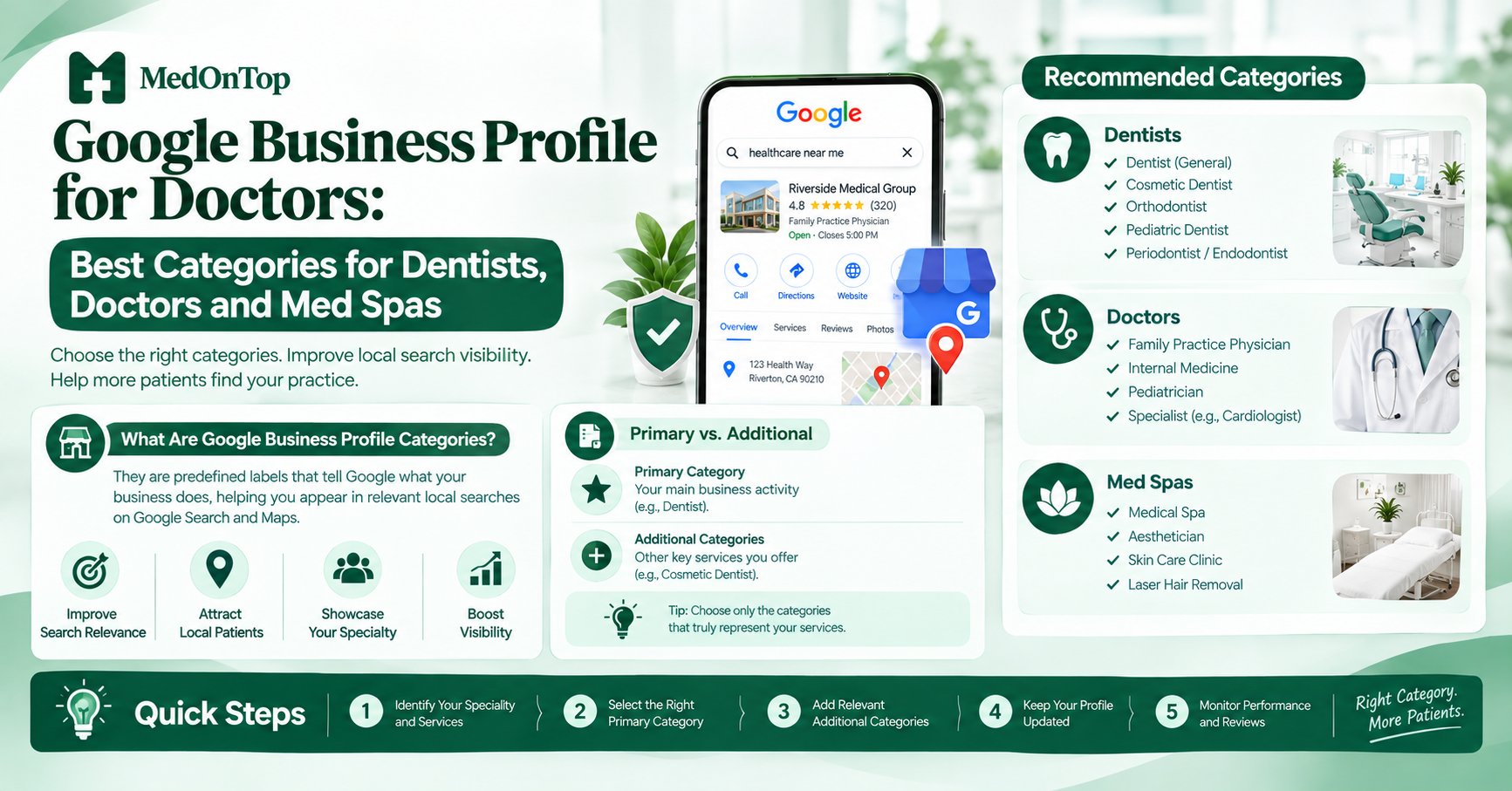
Google Business Profile categories are predefined classifications that describe what a business primarily does. They help Google connect businesses with relevant searches across Google Search and Maps. A medical practice selects categories based on its actual business activities, not every treatment or procedure it offers.
Google allows one primary category and up to nine additional categories. However, businesses should select only those that accurately represent their operations.
Primary vs. Additional Business Categories
The primary category identifies the main business activity.
For example, an orthodontic specialty practice would generally consider Orthodontist instead of a broader dental category.
Additional categories describe other substantial business activities performed by the same organization.
A dental practice offering comprehensive general and cosmetic dentistry might qualify for both Dentist and Cosmetic dentist, depending on its business model.
A service such as teeth whitening does not automatically justify adding a separate business category.
Google Business Profile vs. Google My Business
Google My Business is the previous name for Google Business Profile.
Both names refer to the platform healthcare organizations use to manage business information appearing on Google Search and Maps. Practice owners researching Google My Business for dentists are usually looking for category settings, profile verification, business hours, reviews, and local search optimization.
How Do Business Categories Affect Local Rankings?
Google’s local search systems primarily consider relevance, distance, and prominence when determining which businesses appear for location-based searches. Business categories contribute to relevance by identifying the type of healthcare organization or practitioner represented by a listing.
How Categories Influence Search Relevance
Consider two searches: “pediatric dentist near me” and “emergency dental clinic.” Although both involve dentistry, they reflect different patient needs. A practice categorized as Pediatric dentist provides Google with a clearer specialty signal than a general category alone.
However, Google also considers other business information when interpreting searches. The category must accurately reflect the practice rather than being selected solely for a desirable keyword.
How Categories Connect With Local SEO
A relevant category works best when supported by consistent website information, clinical service descriptions, and accurate location details. An orthodontic practice should have website content explaining its actual orthodontic services and provider qualifications.
This relationship helps support local SEO for healthcare practices. Categories help establish business identity, while supporting content gives patients additional information about the services available. Neither guarantees a particular local ranking.
Best Google Business Profile Categories for Dentists
The best primary category for a dental practice depends on whether the listing represents a general dentist, specialist, or dental clinic organization. Specialty categories should reflect the business’s genuine clinical focus.
Recommended Google Business Categories for Dentists
| Dental practice | Category to consider | Appropriate use |
| General dentist | Dentist | General dental services |
| Dental clinic | Dental clinic | Organization-level dental practice |
| Cosmetic dental practice | Cosmetic dentist | Substantial cosmetic dentistry activity |
| Orthodontic practice | Orthodontist | Orthodontic specialty care |
| Pediatric dental practice | Pediatric dentist | Specialized children’s dentistry |
| Periodontal practice | Periodontist | Periodontal specialty care |
| Endodontic practice | Endodontist | Root canal specialty practice |
| Oral surgery practice | Oral surgeon | Specialized oral surgery |
| Prosthodontic practice | Prosthodontist | Prosthodontic specialty services |
These classifications are starting points. Exact labels should be checked against the category options available in Google’s US Business Profile interface.
General Dentist vs. Cosmetic Dentist
A general dental practice providing preventive care, fillings, crowns, and occasional cosmetic treatments would ordinarily consider Dentist as its primary category. If cosmetic dentistry represents a substantial part of the business’s actual identity, Cosmetic dentist may also be relevant.
For example, providing teeth whitening does not automatically mean a clinic should replace Dentist with Cosmetic dentist. The decision should reflect the practice’s core services, qualifications, and public-facing business identity.
Orthodontists and Dental Specialists
An orthodontic specialty practice primarily offering braces and aligners should generally consider Orthodontist. A general dentist providing some aligner treatments should not automatically adopt that specialty category.
The same principle applies to pediatric dentists, endodontists, and periodontists. Specialty categories should accurately represent the provider or organization rather than individual procedures. This distinction matters for both patient expectations and professional credibility.
Choosing Additional Categories for Dentists
Google Business Profile SEO for dentists should focus on accuracy rather than category quantity. Additional categories may be appropriate when the practice operates substantial, legitimate services represented by those classifications.
The website should also support these categories with relevant treatment information, provider credentials, and location details. A coherent dentist SEO strategy connects the practice’s classification with patient search intent and clinically accurate service content.
Best Google Business Profile Categories for Doctors
Doctors and medical clinics should select categories according to their clinical specialization and the type of entity represented by the listing. A physician’s individual profile may require a different category from the medical organization where that physician works.
Best Categories for Family Doctors and Medical Clinics
Common categories to consider include Doctor, Family practice physician, Internist, and Medical clinic. A family medicine physician would generally consider Family practice physician. A medical organization providing multiple outpatient services might consider Medical clinic. The most specific accurate classification should take priority over a broad label.
Best Categories for Medical Specialists
Different specialties may qualify for categories such as Dermatologist, Cardiologist, Pediatrician, Neurologist, or Obstetrician-gynecologist. The selected category should reflect the practitioner’s or organization’s actual clinical identity.
For example, a general physician treating patients with cardiovascular risk factors should not select Cardiologist unless that specialty accurately represents the practice.
A healthcare organization should not use additional categories to imply it provides specialties that are unavailable at its location.
Individual Practitioner vs. Organization Profiles
Google has separate eligibility guidance for healthcare organizations and individual public-facing practitioners. An eligible medical clinic may have an organization profile, while qualifying physicians may maintain individual practitioner profiles.
However, separate profiles are not automatically permitted for every provider or department.
The correct structure depends on the entity’s public-facing identity, direct patient contact, operating arrangements, and Google’s eligibility requirements. Creating duplicate profiles to target additional keywords can result in listing management problems.
Categories for Multi-Location Medical Groups
Medical groups should maintain consistent primary categories across locations providing the same core service. Google’s category consistency rules also apply to business chains and comparable locations. Distinct business types or independently operating departments may justify separate classifications under applicable requirements.
A centralized category inventory helps administrators track changes, verification status, and service differences without introducing unnecessary inconsistencies.
Best Google Business Profile Categories for Med Spas
Medical spas should choose categories based on their actual business model, services, and professional identity. Medical spa is generally the most relevant starting point for a facility primarily operating as a medical aesthetics business. However, a skincare studio, dermatology clinic, and medical spa should not automatically share the same primary category.
Medical Spa vs. Skin Care Clinic
A medical aesthetics practice providing qualifying aesthetic services may consider Medical spa.
A business primarily focused on skincare may consider Skin care clinic.
A traditional spa offering relaxation services may be more appropriately represented by Day spa.
These distinctions help set accurate expectations about the type of facility patients or customers are contacting.
Dermatology Clinic vs. Medical Spa
A physician-led dermatology practice should not automatically change its primary category to Medical spa simply because it provides cosmetic procedures. If the main business is clinical dermatology, Dermatologist may be more appropriate. Similarly, an independent medical spa should not select Dermatologist unless that classification genuinely describes its operation. Accurate category selection must reflect available services and appropriate professional qualifications.
Additional Categories for Med Spas
Additional categories may describe substantial business activities beyond the primary classification.
For example, a medical spa specializing in laser hair removal may consider a relevant additional category if it accurately describes the business and appears in Google’s available options.
Do not select categories merely because the associated treatments are popular or commercially valuable. A consistent med spa SEO strategy should connect business classifications with treatment pages, provider information, and local patient search needs.
How to Choose and Update Google Business Profile Categories
The most reliable selection process starts with the practice’s actual operations rather than competitor keyword rankings.
Step 1. Review Your Existing Profile
Find the managed Business Profile through Google Search or Maps.
Check the primary category, additional categories, practice name, address, phone number, and listed services.
Confirm that the correct entity owns or manages the listing.
For multi-location organizations, record these details for every location before making changes.
Step 2. Match Categories With Business Identity
Identify the principal activity of each eligible business or practitioner. Compare available category options with actual services, professional specialties, and the organization’s public identity. For example, a pediatric dental specialty practice should evaluate Pediatric dentist rather than defaulting to Dentist. If an exact category is unavailable, choose the closest appropriate general classification. Google does not allow businesses to create custom categories.
Step 3. Update the Category Settings
Open the managed profile and select Edit profile.
Locate the business category field and choose the most accurate primary category from Google’s suggestions. Add additional categories only when they represent genuine business activities. Save the changes and review their approval status. Google may require additional verification after certain business information updates.
Step 4. Validate and Document the Changes
Check the public listing after Google processes the edit.
Confirm that the category and other business information display correctly. For larger organizations, maintain a change log recording the previous category, new category, location, edit date, and verification status. Evaluate the results over time rather than repeatedly changing categories in response to daily ranking movements.
Common Category Mistakes and Best Practices
Avoid Selecting Too Many Categories
Google allows up to nine additional categories, but this is a maximum rather than a recommended number. Selecting unrelated medical specialties does not create legitimate authority in those fields. Choose only classifications that accurately describe the business. Individual treatments and procedures should generally be represented through appropriate service information.
Avoid Duplicate Practitioner and Clinic Listings
Separate profiles must satisfy Google’s business eligibility requirements. A physician’s individual profile, medical clinic profile, and independently operating department are not automatically interchangeable. Do not create multiple listings for the same organization solely to improve visibility for different search terms. Review practitioner eligibility and business structure before introducing another profile.
Keep Categories and Website Content Consistent
A profile categorized as Orthodontist should connect to website information that clearly explains the practice’s orthodontic services. Similarly, a medical spa listing should direct visitors toward accurate aesthetic treatment and provider information. A well-organized topical content structure can support this relationship.
For example, a dental practice may use a principal dentistry service page supported by detailed treatment pages and relevant patient questions. This helps search engines and AI-assisted systems interpret relationships between the business, its services, and its location without making unsupported specialty claims.
Why Is My Clinic Not Showing on Google Maps?
An inaccurate category is one possible reason a clinic may not appear for relevant searches, but it is not the only explanation. Other factors include incomplete verification, incorrect business information, eligibility problems, proximity, competition, and listing restrictions.
Check whether the profile is verified and publicly visible before changing categories. If the listing exists but ranks poorly, review local relevance, distance, prominence, and competing businesses. Repeated category edits are not a substitute for diagnosing the actual visibility problem.
How to Measure Google Business Profile Category Performance
Category optimization should be evaluated through relevant search visibility and qualified patient interactions rather than ranking movements alone.
Track Relevant Local Search Performance
Monitor how the practice appears for specialty and location-based searches. For example, an orthodontic clinic should prioritize relevant orthodontic searches rather than broad medical keywords.
Google Business Profile performance reporting can provide information about available interactions such as calls, website clicks, and direction requests. Website analytics may provide additional context when implemented appropriately.
Measure Qualified Patient Inquiries
More profile interactions do not necessarily mean better business results. A medical clinic receiving calls for services it does not provide may have a relevance problem. Evaluate whether inquiries match the practice’s actual specialties, location, and appointment availability.
Where appropriate, compare qualified calls, consultation requests, and appointment outcomes using privacy-conscious measurement methods. Do not transmit protected patient information through ordinary marketing analytics.
Compare Results Before and After Category Changes
Establish a performance baseline before modifying categories. Record the implementation date and compare relevant trends over a reasonable period. Consider seasonality, competitive activity, website changes, and local search location differences.
A category change may contribute to performance movement, but an increase in calls or rankings does not independently prove causation. For multi-location organizations, consistent reporting can help identify differences between locations while preserving category governance.
How MedOnTop Supports Healthcare Local SEO
Google Business Profile category selection is one component of a broader healthcare local search strategy. MedOnTop provides healthcare-focused SEO and Google Business Profile optimization services that address local visibility, business information, and website relevance. For dental practices, medical clinics, and med spas, effective optimization involves understanding the organization’s actual specialties and how potential patients search for those services.
Accurate profile information should connect with trustworthy website content, relevant location pages, and clearly defined patient inquiry pathways. Multi-location organizations also benefit from consistent listing management and documented category decisions. The objective is to help relevant patients discover suitable healthcare services while supporting accurate and sustainable local visibility.
Google Business Profile Categories FAQs
What is the best Google Business Profile category for doctors?
The best category is the most specific available classification accurately describing the physician or medical organization. Examples may include Doctor, Family practice physician, Dermatologist, Pediatrician, or Medical clinic, depending on the listing.
What is the best Google My Business category for dentists?
Dentist is commonly appropriate for a general dental practitioner, while Dental clinic may suit a clinic organization. Orthodontist, Pediatric dentist, and other specialty categories should be selected only when they accurately represent the practice.
How many categories can a Google Business Profile have?
A Google Business Profile can have one primary category and up to nine additional categories. Google recommends selecting only categories that accurately describe the business rather than using every available slot.
Can changing my Google Business Profile category improve rankings?
Yes. Categories influence local search relevance and can affect rankings. However, Google also considers distance, prominence, and other information. Changing a category does not guarantee better visibility or more patient appointments.
How do I show my clinic on Google Search and Maps?
Create or claim an eligible Google Business Profile, complete the required verification, select an accurate business category, and maintain correct location, contact, and operating information. A relevant website can further explain the practice’s services.
Should a medical spa choose Medical spa or Skin care clinic?
Medical spa is generally appropriate for a business primarily operating as a medical aesthetics facility. Skin care clinic may be more suitable for a skincare-focused business. The selection should reflect actual operations and the available Google categories.
Can multiple doctors working at one clinic have separate Google Business Profiles?
Eligible public-facing physicians may maintain individual practitioner profiles under Google’s requirements. A clinic may also qualify for an organization profile. Separate listings should represent eligible entities rather than duplicate the same business for additional keyword coverage.
Conclusion
The best Google Business Profile categories for dentists, doctors, and med spas are those that accurately represent their primary business activities and professional specialties. A general dentist, orthodontist, family physician, dermatologist, and medical spa may require different classifications because they serve distinct patient needs.
Start with an accurate primary category, use additional categories selectively, and ensure that website information supports the same business identity. Healthcare organizations should also review verification status, practitioner eligibility, location consistency, and qualified patient inquiries when evaluating their local search presence.
If your practice needs help identifying potential visibility issues, MedOnTop offers a free healthcare SEO audit to support a more informed local SEO strategy.