
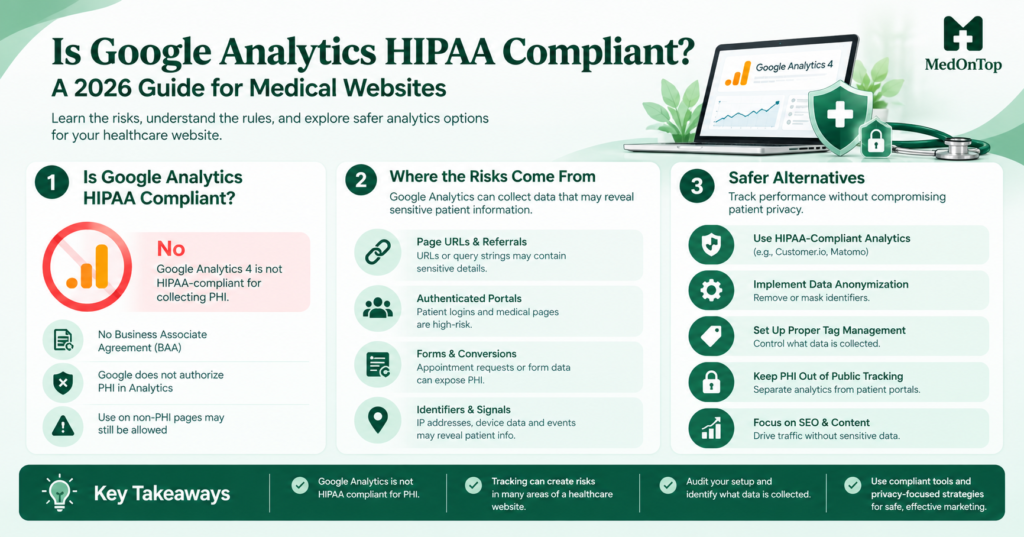
Google Analytics is not HIPAA-compliant for collecting protected health information (PHI). Google does not offer a Business Associate Agreement (BAA) for Google Analytics 4, which means healthcare organizations cannot use it to transmit PHI to Google. Limited use on pages that do not involve PHI may still be permissible.
For hospitals, clinics, and medical practices, the challenge is determining which website interactions expose patient information. A HIPAA-compliant SEO strategy should account for those risks before analytics tags are deployed.
A routine GA4 implementation can collect page locations, referral information, interaction events, and identifiers. Depending on context, these signals may reveal sensitive information about patients or their healthcare activities. This guide explains Google Analytics HIPAA restrictions in 2026, where tracking creates exposure, how to audit existing implementations, and how healthcare organizations can measure website performance without unnecessarily disclosing patient information.
1. Is Google Analytics HIPAA Compliant?
Google Analytics 4 is a website and application measurement platform, but it is not authorized to receive PHI under a Google Analytics BAA.
Google explicitly states that HIPAA-regulated customers must not expose PHI to its Analytics service. It also makes no representation that Google Analytics satisfies HIPAA requirements. This distinction matters because HIPAA compliance depends on the organization, the data being processed, the vendor’s contractual obligations, and the actual implementation.
Why Google Analytics Does Not Offer a HIPAA BAA
A Business Associate Agreement establishes specific obligations when a vendor handles PHI on behalf of a HIPAA-regulated organization. Google provides BAAs for certain covered Google Cloud and Workspace services. Google Analytics is not one of those services.
Consequently, a Google Cloud BAA does not automatically authorize sending PHI into GA4. Nor does purchasing an enterprise analytics product change Google’s published Google Analytics HIPAA restrictions. Healthcare organizations need to evaluate the individual service receiving information, not simply the vendor’s overall compliance portfolio.
What Counts as PHI in Website Analytics?
PHI is individually identifiable health information held or transmitted by a HIPAA-regulated entity or its business associate. For websites, potentially sensitive data includes appointment information, patient identifiers, medical conditions, treatment requests, and combinations of technical identifiers with healthcare context.
Consider a cardiology website where a logged-in patient reviews an upcoming appointment. If an analytics event transmits the patient’s identity, appointment details, or associated medical information, that disclosure raises HIPAA concerns. The important question is not whether an event is called page_view or appointment_click. It is what information actually reaches the analytics provider.
2. How Google Analytics Creates HIPAA Risks
GA4 operates through browser tags, application SDKs, event collection, and integrations. Each component introduces potential disclosure paths that must be examined separately.
Browser Tracking and Page URLs
A typical GA4 installation loads JavaScript that sends measurement events to Google’s collection infrastructure.
Events may include page URLs, referral information, event parameters, and browser-related signals. URL paths and query strings deserve particular attention because application developers sometimes place sensitive information inside them.
For example, an appointment confirmation URL containing a patient identifier or visit-specific token could expose information through an analytics request. Removing sensitive URL parameters before collection helps reduce exposure, but it does not establish that every remaining event is safe.
Authenticated Patient Portals
Patient portals commonly process medical records, prescriptions, billing information, appointment details, and other PHI. The U.S. Department of Health and Human Services identifies authenticated healthcare pages as particularly sensitive tracking environments.
Google’s guidance advises HIPAA-regulated customers not to install Google Analytics tags on authenticated pages likely to be HIPAA-covered. A reliable architecture keeps general website measurement separate from authenticated clinical workflows rather than attempting to sanitize every portal interaction after collection.
Appointment Forms and Conversion Events
Form analytics can expose information even when developers do not intentionally send form-field values. Automatic event collection, custom JavaScript, tag-manager variables, and third-party plugins may capture submission context or sensitive parameters.
For instance, an event describing an identifiable patient’s appointment request for a particular service can create a disclosure risk. The safer pattern is to process appointments within an appropriately protected environment and keep PHI out of general-purpose analytics.
Public Healthcare Pages and the 2024 Court Decision
Not every public healthcare webpage automatically involves PHI. In June 2024, a federal district court vacated part of HHS tracking guidance that treated the combination of an IP address and a visit to certain unauthenticated public healthcare pages as sufficient, by itself, to trigger HIPAA obligations.
The decision did not eliminate HIPAA restrictions on tracking technologies. Public-page interactions can still involve PHI depending on what information is collected and the circumstances. Healthcare organizations therefore need page-specific and data-specific assessments rather than blanket assumptions that all public pages are prohibited or all anonymous visitors are safe to track.
3. Why HIPAA-Safe Analytics Matters for Healthcare Websites
HIPAA-safe analytics enables healthcare organizations to evaluate digital performance while limiting unnecessary patient-data exposure. For technical teams, the objective is to maintain a clear boundary between marketing measurement and systems handling sensitive healthcare information.
Reduce Privacy and Compliance Exposure
Tracking scripts often operate outside the application codebase. Marketing teams can add tags through Google Tag Manager without requiring a production deployment.
This flexibility creates governance problems when new scripts collect data from previously protected workflows. Controlling tag permissions, reviewing outgoing requests, and maintaining an approved tracking inventory help reduce unexpected disclosures.
Protect Patient Trust
Patients expect healthcare websites to handle sensitive interactions discreetly.
A visitor researching treatment options may not understand how analytics vendors process website information. Unexpected disclosures can undermine confidence, particularly when appointments, conditions, or clinical services are involved. Privacy-conscious measurement reduces dependence on unnecessary individual-level tracking.
Preserve Meaningful Marketing Measurement
Removing unsafe tracking does not mean abandoning performance analysis. Hospitals can still assess search visibility, technical performance, content effectiveness, and operational conversion outcomes using appropriately designed measurement systems.
The business objective remains straightforward. Understand which website improvements produce useful outcomes without sending PHI to unauthorized vendors.
4. How to Implement Safer Analytics on Healthcare Websites
Replacing or restricting Google Analytics requires more than changing a configuration setting. Implementation should begin with a documented assessment of data flows.
Step 1. Audit Existing Analytics and Tracking Scripts
Inventory every browser script, tag-manager container, embedded widget, analytics SDK, and server-side event integration. Use browser developer tools to inspect network requests during realistic user journeys. Review submitted payloads rather than relying exclusively on tag configuration screens.
A healthcare website SEO audit can help identify existing measurement dependencies and technical issues that deserve further privacy review. Include appointment forms, patient authentication, third-party scheduling systems, and dynamically generated URLs.
Step 2. Classify Pages and Events by Data Sensitivity
Create a data classification matrix that identifies which pages and interactions can involve PHI.
| Website area | Potential exposure | Recommended approach |
| General careers page | Usually limited healthcare context | Assess before enabling GA4 |
| Public treatment page | Context-dependent health information | Legal and technical review |
| Appointment request | Identifiable healthcare information | Exclude PHI from GA4 |
| Authenticated patient portal | High probability of PHI | Do not deploy GA4 |
| Clinical intake form | Direct patient information | Use appropriately protected systems |
Classification should consider both the website’s content and the information transmitted during interactions.
Step 3. Design a Privacy-Controlled Analytics Architecture
Separate public marketing measurement from protected patient workflows.
For analytics that must handle PHI, evaluate providers willing to enter appropriate BAAs and support the required safeguards. A privacy-focused architecture may use first-party event processing, server-side aggregation, tightly controlled access, and limited retention.
Server-side tracking alone is not sufficient. Forwarding PHI through a proxy to GA4 remains problematic because the destination still receives the information. Teams implementing technical SEO for healthcare websites should coordinate analytics deployment with URL architecture, authentication boundaries, and application security.
Step 4. Test, Document, and Monitor Data Collection
Validate the implementation in staging and production. Inspect actual network payloads, test authenticated sessions, review tag firing conditions, and confirm that sensitive form information never enters prohibited analytics destinations.
Document approved events, responsible owners, retention settings, vendor agreements, and escalation procedures. Regression testing matters because a harmless-looking frontend update can accidentally expose new query parameters or form metadata.
5. HIPAA Analytics Best Practices
A sustainable HIPAA analytics program combines engineering controls, vendor governance, and operational review.
Minimize Information at the Collection Layer
Collect only what the organization needs to answer defined measurement questions. Avoid patient identifiers, medical record numbers, health-related free-text input, appointment details, and sensitive URL parameters in general-purpose analytics.
GA4 privacy controls, including data redaction and retention settings, can reduce certain risks. They do not create a BAA or authorize collecting PHI. Similarly, consent banners are not substitutes for HIPAA-compliant authorization where such authorization is legally required.
Restrict Tag Management and Third-Party Access
Treat tag-manager publishing permissions as a security-sensitive capability.
Use approval workflows, role-based access, version control where practical, and periodic script reviews.
Third-party plugins deserve particular scrutiny because some automatically attach metadata to events or introduce additional tracking requests without obvious changes to the visible interface.
Evaluate HIPAA Analytics Alternatives
The appropriate platform depends on whether measurement requires PHI, which party processes the data, and what safeguards are contractually supported.
| Analytics approach | Engineering consideration |
| GA4 on approved non-PHI pages | Strict page and event restrictions |
| BAA-backed healthcare analytics | Verify contractual scope and safeguards |
| Self-hosted analytics | Organization manages security and infrastructure |
| Aggregated operational reporting | Design outputs to avoid patient identification |
Self-hosting does not automatically establish compliance. Infrastructure controls, access management, auditability, data retention, and vendor relationships still require evaluation.
A BAA is necessary in applicable business associate relationships, but signing one is not a complete compliance strategy.
6. How to Measure Healthcare Website Performance Safely
Healthcare marketing measurement should focus on decisions that improve website effectiveness rather than maximizing the amount of identifiable information collected.
Measure Search and Technical Performance
Useful indicators include organic search visibility, indexed pages, crawl errors, Core Web Vitals, landing-page performance, and non-sensitive content engagement.
These measurements can identify whether patients can discover and navigate relevant information without requiring access to clinical records. Google Search Console and technical monitoring tools may support parts of this workflow, although each integration still needs an appropriate data review.
Track Conversions Without Exposing PHI
A healthcare organization can evaluate aggregate appointment outcomes through appropriately secured internal reporting.
For example, an appointment system might produce de-identified departmental totals for authorized business reporting, subject to proper de-identification and disclosure controls. Avoid transmitting patient-level booking details, contact information, or health-related event identifiers into GA4. For healthcare conversion rate optimization, measurement should prioritize meaningful outcomes alongside privacy, accessibility, and usability.
Establish Operational Success Metrics
Evaluate whether the analytics architecture supports reliable reporting, limits unnecessary data collection, and survives routine website updates.
Track approved event coverage, unauthorized tag findings, remediation time, and reporting quality. Effective measurement is not simply a larger dashboard. It is a dependable system that gives decision-makers useful information without creating avoidable compliance risk.
7. How Med On Top Supports HIPAA-Conscious Healthcare Analytics
Med On Top provides healthcare-focused SEO services that include analytics configuration reviews, tracking assessments, technical SEO, and conversion optimization. Its HIPAA-compliant SEO service addresses potential PHI exposure involving Google Analytics, Google Tag Manager, advertising pixels, and website forms.
The practical value begins with identifying which systems collect information, which events are necessary, and where existing configurations may create privacy concerns. For healthcare organizations reconsidering their tracking strategy, Med On Top’s free SEO audit offers a starting
point for reviewing website performance and discussing potential measurement issues.
Technical remediation should be coordinated with the organization’s privacy officer, security team, and legal counsel. Agency configuration work cannot independently establish an organization’s HIPAA compliance.
8. Google Analytics HIPAA FAQs
Is Google Analytics HIPAA compliant in 2026?
No, Google Analytics 4 is not authorized to receive PHI under a Google Analytics BAA. Google does not provide a BAA for this service. HIPAA-regulated organizations may use GA4 only in implementations that do not expose PHI and otherwise comply with applicable requirements.
Can hospitals use Google Analytics?
Yes, in limited circumstances. Google Analytics for hospitals may be appropriate on pages determined not to involve HIPAA-covered information. Patient portals, clinical workflows, and other interactions involving PHI should not send that information to GA4.
Does Google Analytics 4 sign a Business Associate Agreement?
No. Google does not offer a Business Associate Agreement for Google Analytics 4. BAAs covering eligible Google Cloud or Workspace products do not extend automatically to Google Analytics.
Does removing IP addresses make GA4 HIPAA compliant?
No. Removing or limiting IP-related information does not address every potential PHI disclosure. Event parameters, URLs, identifiers, and interaction context can still expose sensitive data. Compliance requires evaluating the complete data flow, not one field.
Is Google Tag Manager HIPAA compliant?
Google Tag Manager is a tag deployment system, not a blanket HIPAA compliance solution. Its risks depend on the tags deployed, information processed, and relevant service arrangements. It must not be used to route PHI into Google Analytics or other unauthorized destinations.
What are the best alternatives for healthcare analytics?
Healthcare organizations can evaluate BAA-backed analytics providers, appropriately secured first-party systems, or aggregated reporting architectures. Selection should consider PHI processing, contractual obligations, access controls, retention, and operational requirements rather than marketing claims of compliance.
Can healthcare websites track appointment conversions without GA4?
Yes. Properly designed internal reporting can measure aggregate appointment activity without transmitting identifiable patient details to GA4. The architecture should separate clinical transactions from marketing analytics and apply suitable de-identification, security, and access controls.
Conclusion
The question of whether Google Analytics is HIPAA-compliant has a clear answer for PHI collection. Google does not offer a BAA for GA4, and healthcare organizations must not disclose PHI through the service. The harder decision concerns implementation boundaries. Public content, appointment workflows, authenticated portals, and third-party scripts present different risks that require individual assessment.
Hospitals and medical practices can maintain useful website measurement through controlled data collection, appropriate analytics providers, and regular technical reviews.For organizations refining their healthcare SEO and analytics setup, Med On Top can support the website auditing and technical optimization process while compliance decisions remain subject to qualified legal and privacy oversight