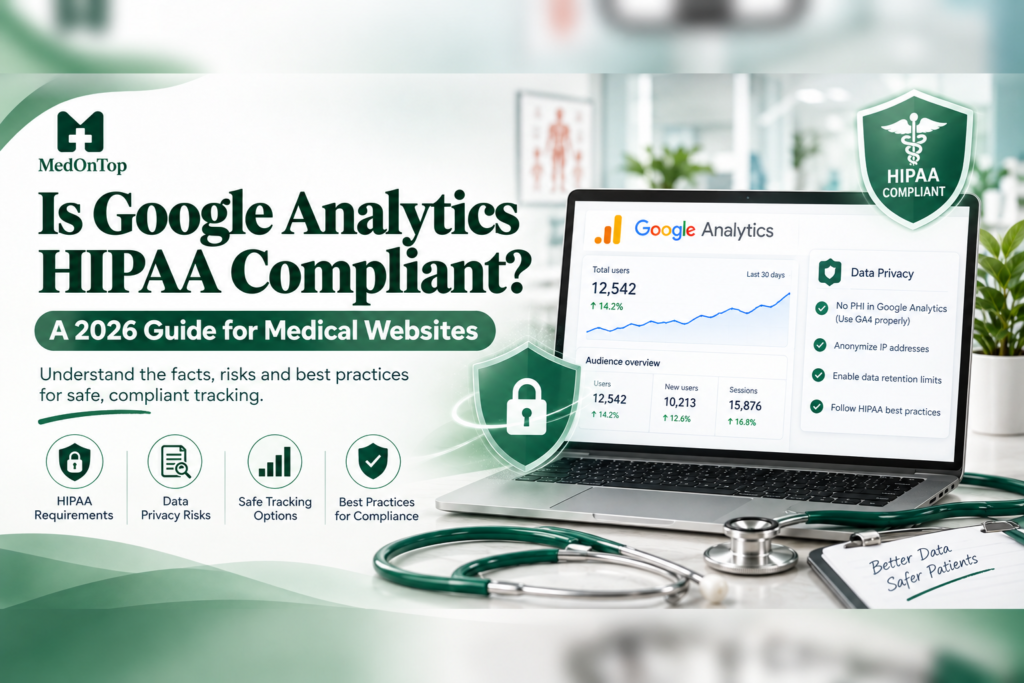

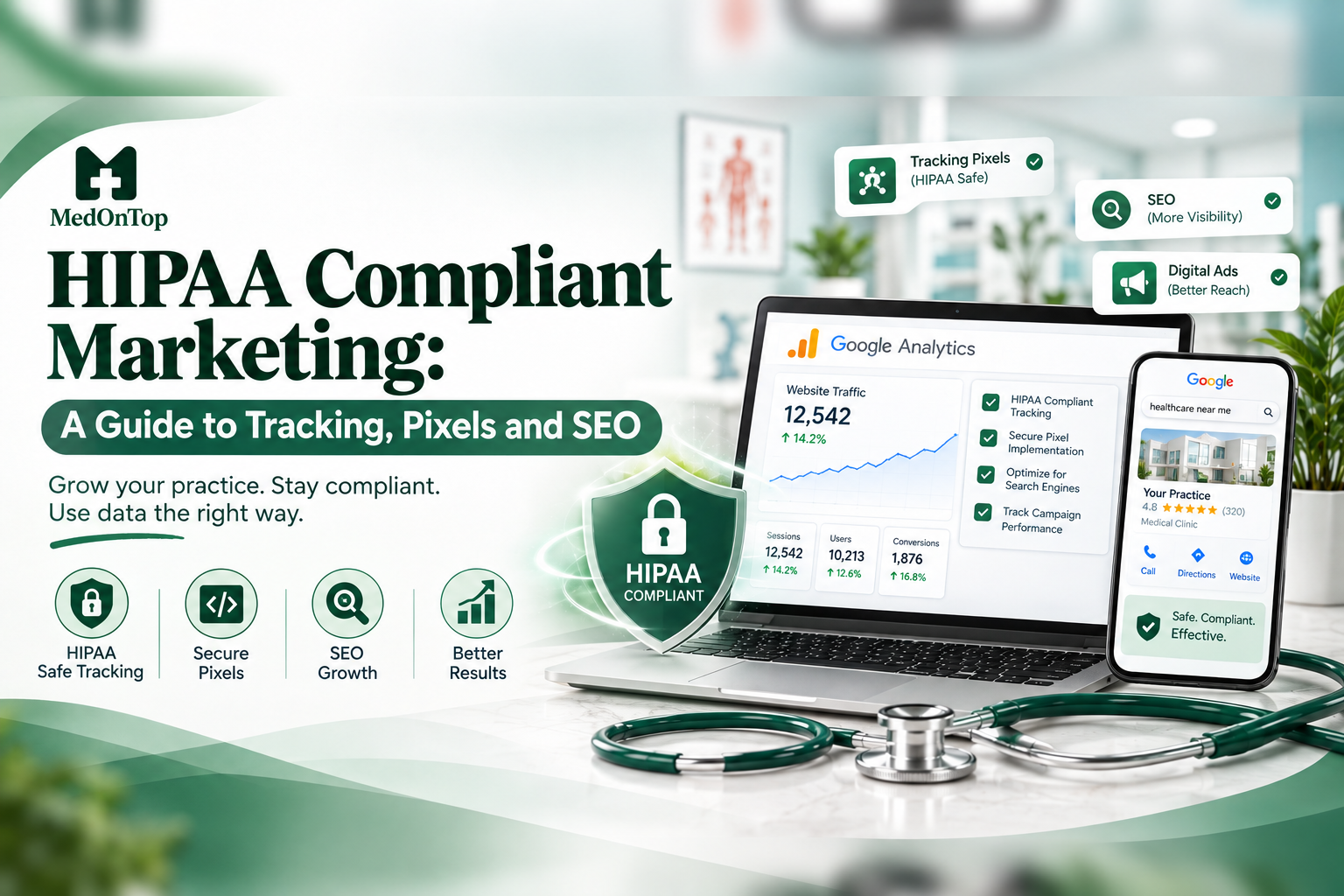
HIPAA-compliant marketing means promoting healthcare services without using or disclosing protected health information unlawfully. For regulated organizations, that requires examining not just campaign copy but the network requests, forms, identifiers, analytics tools, and vendors behind a website. A privacy notice cannot repair an impermissible data transfer.
A sound HIPAA-compliant SEO strategy can improve discovery through public, informative pages while limiting dependence on patient-level advertising attribution. The harder engineering challenge is determining where public browsing becomes an identifiable healthcare interaction.
1. What Is HIPAA-Compliant Marketing?
HIPAA-compliant marketing is marketing that observes applicable HIPAA restrictions on using, disclosing, and safeguarding protected health information, or PHI. HIPAA primarily regulates covered entities and their business associates. Not every wellness website is covered, although FTC rules and state privacy laws may still apply.
The Privacy Rule generally requires a valid individual authorization before PHI is used or disclosed for a communication qualifying as marketing. It also recognizes exclusions for certain treatment and healthcare operations communications and limited exceptions, including some face-to-face communications and gifts of nominal value.
Where Marketing Rules Apply
A physician explaining a clinically relevant treatment to a patient differs from a provider sending an identifiable patient list to an outside advertiser promoting unrelated services. The latter can trigger authorization requirements. Financial remuneration from third parties may introduce additional conditions.
A Realistic Acquisition Journey
Imagine an orthopedic practice advertising a knee pain consultation. A visitor first reads a public service page, then opens a scheduling workflow and enters their name, contact details, and reason for visiting. The practice can review aggregate search and campaign performance without transmitting the appointment content to an advertising network.
Search result → Public service page → Protected scheduling process → Approved aggregate report
2. How Tracking Pixels and Healthcare Analytics Work
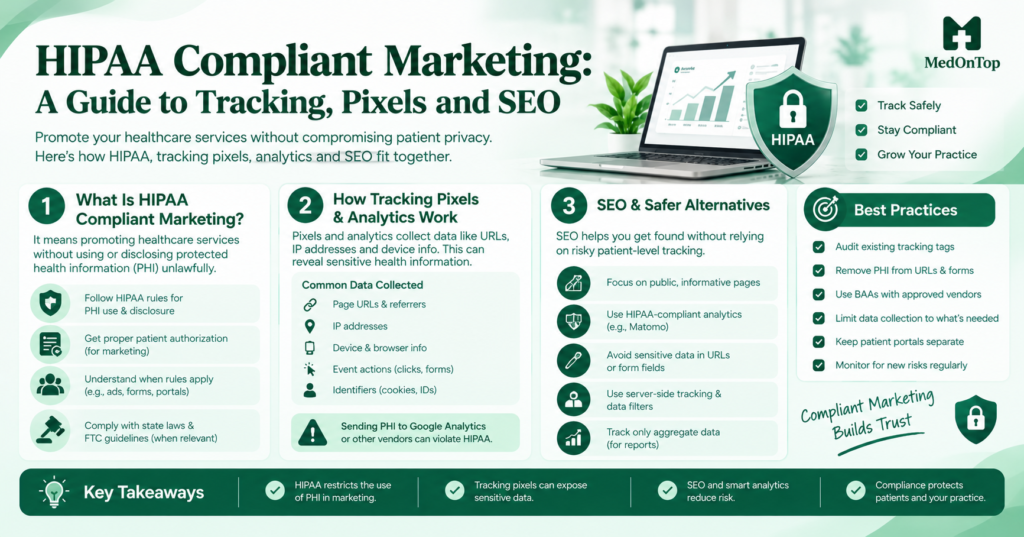
A tracking pixel is typically JavaScript or a small image request that reports browser activity to an analytics or advertising destination. It may transmit the current URL, referrer, IP address, cookie identifiers, click IDs, event names, and custom fields. These values can be combined with account data outside the healthcare website.
The Data Hidden in an Ordinary Event
Consider a scheduling event whose payload contains event=appointment_submitted, email=person@example.test, and service=oncology_consultation. Even if the marketing dashboard displays only a conversion count, the receiving vendor may have already received identifiable health-related information.
A safer event contract might contain an approved aggregate count for a reporting period, without email addresses, appointment reasons, persistent user identifiers, or raw page URLs. Removing a name while keeping a stable hashed email does not necessarily prevent identification. Filtering must happen before data reaches an unapproved recipient.
The phrase health pixel is a product category or marketing description, not a regulatory certification. A vendor may advertise de-identification, server-side routing, or sensitive-event controls. Engineers should verify what is transmitted, what is retained, whether data can be reidentified, and whether onward uses are permitted.
Public Pages, Portals, and HIPAA Guidance
HHS has explained that regulated entities must evaluate tracking technologies when the information disclosed includes PHI. In June 2024, a federal court vacated a particular interpretation treating an IP address plus a visit to an unauthenticated public page about a health condition or provider as sufficient, by itself, for the challenged tracking guidance. That decision did not exempt all public-page tracking from scrutiny.
Authenticated patient portals, intake forms, and appointment experiences warrant particularly close analysis. Context matters: an innocuous-looking URL parameter may encode a patient identifier, while a form event can reveal a requested medical service.
Does Server-Side Tracking Solve It?
Server-side collection can provide a controlled point for validating event schemas, dropping disallowed fields, and routing permitted outputs. A gateway should reject unknown keys by default rather than strip a few familiar sensitive fields and forward everything else.
But forwarding PHI through an intermediary to an advertiser remains a disclosure. Hosting a proxy, encrypting traffic, or obtaining a business associate agreement does not independently make every use lawful. Destination permissions and processing purposes must still be established.
3. Why Healthcare Marketing Compliance Matters
The business case is operational, not merely reputational. Marketing systems change frequently, while patient information often travels through many interconnected products. One campaign launch can introduce a new script into a sensitive page without the security team noticing.
Preventing Silent Data Leakage
Tag managers, chat widgets, embedded booking platforms, error reporters, and analytics SDKs may make requests outside the primary application.
Clear ownership of those destinations helps teams detect unauthorized disclosure paths before an incident. Reducing unnecessary data also reduces the number of systems that need access controls, retention rules, incident response planning, and vendor oversight.
Protecting Attribution From Fragile Implementations
A marketing team that relies on unrestricted pixel events may lose meaningful reporting when a compliance review requires those events to be disabled. Rebuilding attribution under deadline is more costly than selecting privacy-conscious metrics from the beginning.
4. How to Implement a Controlled Tracking System
A good design starts with data flow discovery, not with selecting a supposedly compliant pixel. Make the allowed behavior explicit and test the implementation at the network boundary.
Step 1. Inventory Current Scripts and Vendors
Map every script, iframe, SDK, webhook, form processor, and server endpoint. Include plugins installed by other teams, third-party scheduling pages, session replay tools, and analytics features embedded in CMS themes.
Inspect browser requests on public service pages, appointment pages, and authenticated screens. Capture request destinations and payload shapes using synthetic test data, never actual patient records.
A website SEO audit can reveal crawl, rendering, and technical website problems, but it is not a substitute for reviewing PHI disclosures and processor agreements.
Step 2. Classify Events and Establish Permissions
Write a data dictionary identifying each event’s business purpose, triggering page, permitted fields, recipient, retention period, and accountable owner. Record whether a field might identify someone in context, even if it looks harmless in isolation.
Separate public-content analytics from patient-specific workflow analytics. Decide whether the activity uses PHI, whether HIPAA applies to the organization, whether a Privacy Rule permission or valid authorization supports disclosure, and whether a vendor relationship requires a business associate agreement.
Step 3. Enforce Tracking Boundaries in Code
Use a documented event schema and destination allowlist. Configure the client to emit only approved public-site events. For sensitive screens, disable third-party tags unless their deployment has been separately approved for that data and purpose.
At the server gateway, reject unexpected fields, remove query parameters, apply retention limits, and segregate audit logs from campaign dashboards. A Content Security Policy can help constrain browser connections but cannot replace vendor approval or data classification.
Avoid logging complete request bodies by default. A system that filters analytics events but stores raw payloads in an error-monitoring platform simply moves the exposure elsewhere.
Step 4. Test Releases and Monitor Changes
Create automated checks for representative journeys: reading a public page, opening scheduling, submitting a test appointment, logging in, and receiving a confirmation. Verify that no patient identifier, medical intake detail, or sensitive URL reaches an unauthorized destination.
Test both production-like browser traffic and server-side forwarding. Record exceptions and reassess them when technologies or guidance change.
5. HIPAA Compliant Marketing Best Practices
Treat Vendor Claims as Inputs, Not Proof
Ask vendors what raw data arrives, whether subcontractors access it, how retention and deletion work, and whether the vendor uses data for its own advertising or model development. Where the vendor is a business associate handling PHI, confirm an appropriate agreement and a permitted purpose.
A signed agreement does not legalize an otherwise impermissible disclosure. Evaluate the system’s behavior at the moment data leaves the regulated environment.
Build SEO Without Exposing Patient Workflows
SEO generally centers on public information. Accurate service descriptions, provider credentials, relevant location pages, and clear navigation help patients understand available care without exposing individual medical histories.
Strong technical SEO for healthcare should also address indexable URLs, canonical tags, structured data grounded in real provider information, secure hosting, and crawl controls. Never put patient names, record numbers, or appointment tokens into crawlable URLs or sitemaps.
Search Console and aggregate search-performance data can support content decisions without creating patient-level advertising audiences.
Keep Advertising Audiences Separate From Care Data
Uploads of patient lists, health-condition segments, or treatment-specific conversion records create substantial disclosure risks. Paid channels also enforce their own policies around sensitive health attributes, which must be reviewed separately from HIPAA.
Organizations evaluating Meta advertising services should use approved targeting and measurement configurations rather than assuming a pixel or customer-match feature is suitable for healthcare data.
Make Privacy a Release Requirement
Create one approval path for engineering, security, legal, and marketing changes to tracking.
Enforce least-privilege access, proportionate retention, and periodic reviews. Small aggregated report cells may still allow identification, so suppress or combine results where needed. Governance only works when it survives routine campaign iterations.
6. How to Measure Performance Responsibly
It is reasonable to give up some person-level attribution in return for a simpler, lower-risk architecture.
| Business question | Privacy-conscious measurement |
| Which services attract search demand? | Aggregate Search Console queries and landing-page visibility |
| Which campaigns deserve budget? | Spend, approved campaign-level outcomes, and trend analysis |
| Is the website usable? | Core Web Vitals, errors, accessibility, and uptime |
| Are inquiries becoming appointments? | Internal, appropriately aggregated scheduling reports |
| Did a release break measurement? | Event-schema tests and destination monitoring |
Interpret Trends Without False Precision
Campaign reports should state what they actually measure. A submitted lead form, completed appointment, and new patient are different outcomes. Do not present one as a substitute for another.
Where permitted, aggregate appointment outcomes by period or location and apply minimum reporting thresholds to small groups.
Use visibility → qualified visit → inquiry → appointment as a decision framework, not as a mandate to link identifiable records across all systems. Privacy-preserving reporting can remain commercially useful even when individual-level conversion paths are unavailable.
7. How Med On Top Fits Into the Process
Med On Top’s healthcare-focused SEO and advertising offerings align with two separate needs: helping suitable public pages become discoverable and evaluating which acquisition channels justify investment.
Organizations considering paid acquisition can explore healthcare PPC services as part of a broader conversation about campaign structure and permissible measurement. Any implementation touching PHI should be reviewed with the organization’s engineering, security, and qualified legal advisers.
The practical starting point is a clear list of business questions. Once teams know what they need to measure, they can select systems that collect no more information than necessary.
8. HIPAA Compliant Marketing FAQs
Is Google Analytics HIPAA compliant?
Do not assume standard Google Analytics deployment is appropriate for receiving PHI. Evaluate each transmitted field, Google’s applicable terms, and whether the intended processing can meet HIPAA requirements. If a disclosure is impermissible, configuration changes or an alternative measurement approach are necessary.
Can a healthcare practice use Meta Pixel?
Possibly on appropriately assessed uses, but not simply because a page is public or a consent banner appears. Review the data disclosed, the recipient’s permitted uses, platform policies, and the applicable legal basis before installation.
What is HIPAA compliant tracking?
It is tracking configured so that uses and disclosures of PHI, where involved, satisfy applicable HIPAA permissions, safeguards, and vendor obligations. The term describes the complete processing arrangement, not a particular JavaScript library.
Is a health pixel automatically safe for patient data?
No. Inspect the payload leaving the browser or server, the receiving vendor’s processing, and whether information can be reidentified. Claims about encryption, hashing, or automated redaction are not independent proof of compliance.
Does HIPAA prohibit SEO?
No. Public service pages, accessible content, and ordinary search optimization are generally compatible with HIPAA. Problems can arise when publishing workflows, analytics, URLs, or third-party tools expose identifiable patient information.
Does a business associate agreement permit advertising disclosures?
Not by itself. A BAA specifies obligations when the vendor qualifies as a business associate, but the particular PHI use or disclosure must also have a permissible basis under the Privacy Rule.
What should a healthcare CTO review first?
Prioritize scheduling forms, authenticated portals, analytics tags, session replay, error logs, and outgoing network requests. Then review the event schema and vendor permissions before expanding campaign instrumentation.
Building a Defensible Healthcare Marketing System
HIPAA-compliant marketing is a continuing engineering and governance responsibility. The strongest approach identifies sensitive workflows early, prevents unnecessary data transfers, and measures campaigns through useful but carefully scoped signals.
SEO and aggregated performance reporting can support patient acquisition without turning identifiable healthcare activity into routine advertising telemetry. Teams planning a redesign or campaign rollout should review data flows with technical and legal owners before adding new tracking products