
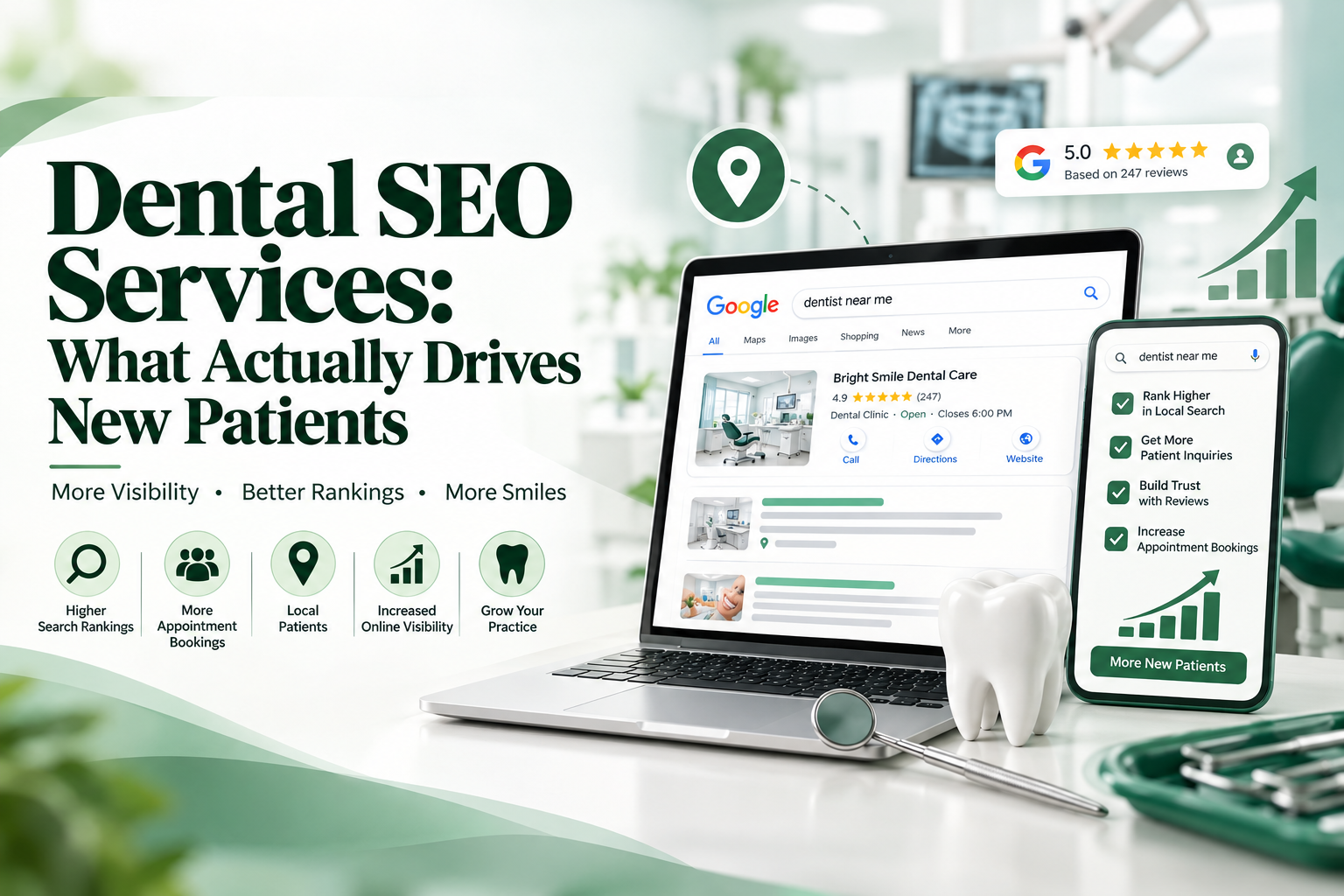
Dental SEO services help dental practices appear in relevant Google searches, attract patients in their service areas, and convert website visits into appointment requests. Effective dental SEO combines local search optimization, technical website improvements, treatment-specific content, and clear booking pathways.
A dental practice may rank for several keywords without receiving meaningful appointment inquiries. Visibility matters, but the real objective is connecting patients with appropriate care when they are actively searching. A strategy built around local SEO for healthcare addresses this connection through geographic relevance and accurate practice information.
Successful SEO also depends on how patients evaluate a dentist. Treatment details, professional credentials, reviews, website usability, and appointment accessibility influence whether someone contacts a practice. Understanding these factors helps dental practice owners distinguish useful SEO investments from activities that produce rankings without measurable patient growth.
What Are Dental SEO Services?
Dental SEO services involve improving a dental practice’s website, business listings, content, and technical infrastructure to increase visibility in relevant organic and local search results. Unlike paid advertising, organic SEO does not charge for individual clicks. However, achieving and maintaining visibility requires ongoing investment in website quality, content accuracy, technical maintenance, and local relevance.
Dental SEO and digital marketing frequently overlap, but they serve different functions. SEO concentrates on organic search discovery, while broader dental marketing may include paid advertising, email communication, social media, and patient retention campaigns. A complete dental SEO strategy connects three elements: what patients search for, which pages answer those searches, and how visitors contact the practice.
Dental SEO Example
Consider a dental clinic offering dental implants in a particular city. A prospective patient searches for “dental implants near me.” Google may display local business listings and organic results associated with that treatment.
A properly optimized implant page explains treatment suitability, the consultation process, possible considerations, and how to schedule an assessment. The journey follows a practical sequence.
Patient search → Relevant treatment page → Practice evaluation → Appointment request
If the page lacks treatment information or its booking form fails on mobile devices, higher rankings alone may accomplish little.
How Do Dental SEO Services Work?
Dental SEO operates across several connected systems. Search engines must discover and interpret website pages, associate the practice with relevant locations, and determine whether the content satisfies user intent.
Local SEO and Google Business Profile Optimization
Local visibility is particularly important because most routine dental appointments require patients to visit a physical practice. Google Business Profile provides information such as the clinic’s address, opening hours, phone number, services, and reviews. Accurate information supports discovery through Google Search and Maps.
Optimization requires selecting appropriate business categories, maintaining consistent contact details, updating business hours, and ensuring that listed services accurately reflect available care. Location relevance also matters. A practice should not create numerous near-identical city pages merely to capture neighboring searches.
Instead, its website should clearly explain where the clinic operates, which areas it serves, and how patients can access its facilities. Local rankings depend on factors including relevance, distance, and prominence. A well-optimized profile cannot eliminate the geographic limitations of a physical practice.
Treatment-Specific Content and Search Intent
Patients use different search language depending on their needs. Someone searching “emergency dentist” may need immediate assistance. A person researching dental implants may compare treatment approaches before scheduling a consultation.
These searches should not lead to an identical generic service page. Effective SEO marketing for dentists maps treatment-related keywords to pages that address distinct patient questions.
A root canal treatment page, for example, should describe the procedure, when professional evaluation may be appropriate, recovery considerations, and the consultation process. Keyword placement matters less than whether the page provides accurate, useful information that aligns with the search.
Technical SEO and Website Performance
Search engines need accessible pages, consistent URLs, appropriate canonical signals, and understandable site architecture.
Technical SEO also affects patients directly. Slow-loading pages, inaccessible navigation, broken appointment buttons, and poorly rendered mobile layouts can interrupt the booking journey.
A technical audit should evaluate indexability, sitemap coverage, redirects, structured data, mobile responsiveness, and Core Web Vitals.
Page speed optimization is especially relevant when dental websites rely on large treatment images, third-party scheduling tools, or unnecessary scripts. Performance improvements should preserve functionality while reducing avoidable loading delays.
Professional Credibility and Content Trust
Dental treatment information can influence healthcare decisions. Search engines and patients both benefit from clear evidence of professional responsibility. Author biographies, verified dental credentials, accurate treatment descriptions, and appropriate review processes help establish credibility.
A clinic should identify its practitioners and clearly distinguish general treatment education from individualized clinical advice.
E-E-A-T optimization provides a useful framework for examining experience, expertise, authoritativeness, and trustworthiness. These principles should guide actual editorial quality rather than become decorative claims placed throughout the website.
Why Do Dental Practices Need SEO?
The business value of SEO depends on attracting patients who are both geographically relevant and interested in services the practice offers.
Reach Patients With Immediate Treatment Intent
Patients searching for specific dental treatments often have clearer needs than people encountering general advertising. For example, a search for “same-day emergency dentist” indicates a different level of urgency than “what causes tooth sensitivity.”
SEO for dental clinics should distinguish between these intents and provide an appropriate next action for each. Emergency service pages may emphasize contact availability and operating hours. Educational pages can explain symptoms and encourage professional assessment when appropriate.
This alignment improves the usefulness of search traffic.
Build Visibility Beyond Paid Campaigns
Paid advertising can generate visits while campaigns remain active and funded. Organic search visibility can continue between advertising campaigns, although rankings require maintenance and are never guaranteed.This makes SEO a complementary acquisition channel rather than a direct replacement for paid marketing.
Practices can use advertising to reach patients for time-sensitive services while developing organic visibility for recurring treatment searches.The right allocation depends on appointment capacity, competition, treatment economics, and acquisition costs.
Improve Patient Confidence Before Contact
Patients frequently compare several clinics before making an appointment. A website with clear practitioner details, transparent service descriptions, accessible contact information, and straightforward navigation helps them evaluate their options.SEO improvements often expose weaknesses beyond rankings.
An incomplete service page may reveal missing patient education. Conflicting opening hours may create uncertainty. Poor mobile navigation can discourage appointment requests.Addressing these issues improves the experience for visitors regardless of how they reached the website.
How to Implement Dental SEO Services
An effective implementation process begins with diagnosis rather than immediately publishing additional content.
Step 1: Audit Search Visibility and Website Infrastructure
Review the existing website to understand what search engines can access and what patients experience.
Use Google Search Console to examine indexing, search queries, impressions, clicks, and page-level performance.A crawl can identify broken links, duplicate metadata, redirect chains, missing canonical tags, and important pages excluded from indexing.
Review mobile layouts and test appointment forms, phone links, and scheduling integrations.Evaluate Google Business Profile accuracy alongside existing organic visibility.The audit should establish a baseline before changes are introduced.
Step 2: Map Keywords to Patient Intent
Organize keywords by treatment, location, and stage of patient decision-making.
A practical keyword map might include:
| Search intent | Example keyword | Suitable destination |
| Local discovery | Dentist near me | Practice or location page |
| Treatment research | Dental implant procedure | Implant service page |
| Urgent care | Emergency dentist | Emergency treatment page |
| Provider evaluation | Family dentist in city | Relevant practice page |
Avoid creating separate pages for every slight keyword variation.
Terms such as “dentist website SEO” and “SEO for dental website” describe related optimization needs. They generally do not justify separate pages covering identical information. Prioritize keywords based on service relevance, local competition, and potential appointment value rather than search volume alone.
Step 3: Build a Logical Website Structure
A dental website should make its important services accessible through intuitive navigation. Core service pages should link naturally to relevant supporting content. An implant page might connect to information about consultations, treatment planning, and post-treatment care.
URLs should remain readable, while internal links should use meaningful anchor text. For multi-location practices, each legitimate location needs accurate contact information, relevant staff details, and location-specific information. Avoid duplicating the same content across dozens of geographic pages with only city names changed.
Step 4: Optimize, Test, and Refine
Implement content and technical improvements in controlled stages. Validate important redirects, indexing directives, metadata, and structured data after deployment. Check whether changes affect page performance or booking functionality. Track organic landing pages alongside contact actions and appointment requests. A page receiving additional visitors but fewer qualified inquiries may need better intent alignment or a clearer conversion pathway. SEO should function as a continuous improvement process based on observed results.
Dental SEO Best Practices That Influence Patient Acquisition
The strongest dental marketing SEO practices address discoverability and patient decision-making together.
Publish Clinically Accurate Service Content
Treatment pages should explain what the service involves, who may benefit from professional assessment, and what patients can expect during consultation.Avoid promising painless procedures, permanent results, or universally successful outcomes.
Where appropriate, involve qualified dental professionals in reviewing clinically sensitive material.Content should be updated when treatment information, practitioner details, or clinic policies change.
Maintain Reliable Local Business Information
Check business names, addresses, phone numbers, and opening hours across important listings. Respond professionally to reviews without revealing or confirming private patient information.
Do not purchase fabricated reviews or pressure patients to provide positive feedback. For practices operating multiple locations, maintain distinct, accurate profiles for eligible physical locations.
Improve Mobile Booking Usability
Mobile visitors should be able to locate essential information and request appointments without navigating multiple unnecessary screens. Prominent contact options are useful, but aggressive pop-ups can interfere with reading and accessibility. Test booking forms using real devices and realistic network conditions. Confirm that submitted requests reach the correct system and that errors are communicated clearly.
Use Structured Data Responsibly
Relevant structured data can help search engines interpret business information and page content. Dental websites may use suitable organization, local business, breadcrumb, and other supported schema types. Structured data must accurately represent visible content and should follow applicable search engine requirements. Adding schema does not guarantee enhanced search appearances or improved rankings.
Prepare Content for AI-Assisted Search
Search experiences increasingly include generated answers and summarized information. Dental content benefits from clear definitions, descriptive headings, accurate provider information, and direct answers to treatment-related questions.
A discussion of AI search optimization can help clarify how content structure and entity consistency support machine interpretation. No technique guarantees inclusion in AI-generated answers. The priority remains producing information that is reliable, understandable, and useful to patients.
How to Measure Dental SEO Performance
Ranking improvements are useful indicators, but they do not establish whether SEO is generating new patients. Measurement should connect organic discovery with qualified patient actions.
| Metric | What it reveals |
| Organic impressions | Visibility for relevant searches |
| Organic clicks | Visits generated from search |
| Local profile interactions | Actions taken through business listings |
| Qualified calls and forms | Potential patient inquiries |
| Appointment bookings | Inquiries that become scheduled visits |
| Technical health | Problems affecting access and usability |
Configure analytics events for meaningful actions such as completed contact forms, booking confirmations, and appropriate click-to-call interactions.
Telephone tracking requires care. If tracking numbers are used, preserve accurate primary business information and follow applicable privacy requirements.
Avoid collecting sensitive medical details through unnecessary analytics parameters.
Compare results by service page and location. A small increase in implant consultation inquiries may matter more commercially than a large increase in unrelated informational traffic.
For reliable attribution, distinguish appointment requests from confirmed bookings and new patients from returning patients.
How Med On Top Supports Dental SEO Strategy
Dental practices need coordinated improvements across technical SEO, local visibility, website content, and patient conversion pathways.
Med On Top provides a relevant starting point for exploring healthcare-focused digital optimization. A useful agency engagement should begin by identifying which barriers currently limit patient acquisition.
For one clinic, the main problem may be weak local visibility. Another may have sufficient traffic but poor appointment completion rates. A third may need substantial website restructuring before content expansion becomes worthwhile.
The proposed work should explain technical priorities, page-level changes, expected measurement methods, and dependencies on the clinic’s scheduling systems. Practices should also establish who approves clinical information, manages business listings, and reviews analytics access.
Dental SEO services are most valuable when technical delivery and business objectives remain connected through transparent reporting.
Dental SEO Services FAQs
How long does dental SEO take to generate results?
Dental SEO typically requires several months of consistent work before meaningful trends become clear. Timing depends on competition, website condition, existing authority, and implementation scope. Technical fixes may produce earlier changes, while competitive treatment keywords often require longer-term development.
What is the difference between local dental SEO and general SEO?
Local dental SEO focuses on geographically relevant searches, Google Business Profile visibility, and location accuracy. General SEO also covers content, technical infrastructure, and broader organic rankings. Dental practices usually need both because patients search for treatments and nearby providers.
Is SEO marketing for dentists better than paid advertising?
Neither channel is universally better. Paid advertising offers campaign-level control and can generate visibility quickly. SEO develops organic discoverability over time. A practice should compare acquisition costs, appointment quality, available capacity, and long-term performance before allocating its budget.
Can a dental clinic rank without regularly publishing blogs?
Yes. Well-structured service pages, accurate local information, technically sound websites, and credible provider details can support organic visibility. Blog content is useful when it answers genuine patient questions or strengthens treatment-related information. Publishing frequently without a clear purpose offers limited value.
What matters most for dentist website SEO?
The priorities are technically accessible pages, relevant service content, accurate local business information, professional credibility, and functional appointment pathways. Their relative importance depends on the practice’s current weaknesses. A technical audit and search-intent review should establish the order of implementation.
How should dental practices evaluate an SEO agency?
Ask how the agency audits websites, prioritizes work, handles clinical content review, and measures appointments rather than rankings alone. Request clear ownership arrangements for analytics accounts, website access, and business listings. Be cautious of guaranteed rankings, unexplained tactics, and reports focused exclusively on keyword positions.
Building a Dental SEO Strategy Around Real Patient Needs
Dental SEO works best when every improvement serves a practical purpose. Local optimization helps patients discover nearby practices. Accurate treatment pages support informed decisions. Technical improvements remove obstacles between finding a clinic and contacting it.
The strongest strategy does not depend on maximizing keyword counts or publishing content at scale. It identifies the services patients need, improves the pages serving those searches, and measures whether qualified inquiries become appointments.
For dental practices evaluating their next investment, a focused assessment of local visibility, website infrastructure, and booking performance provides a sensible starting point.