
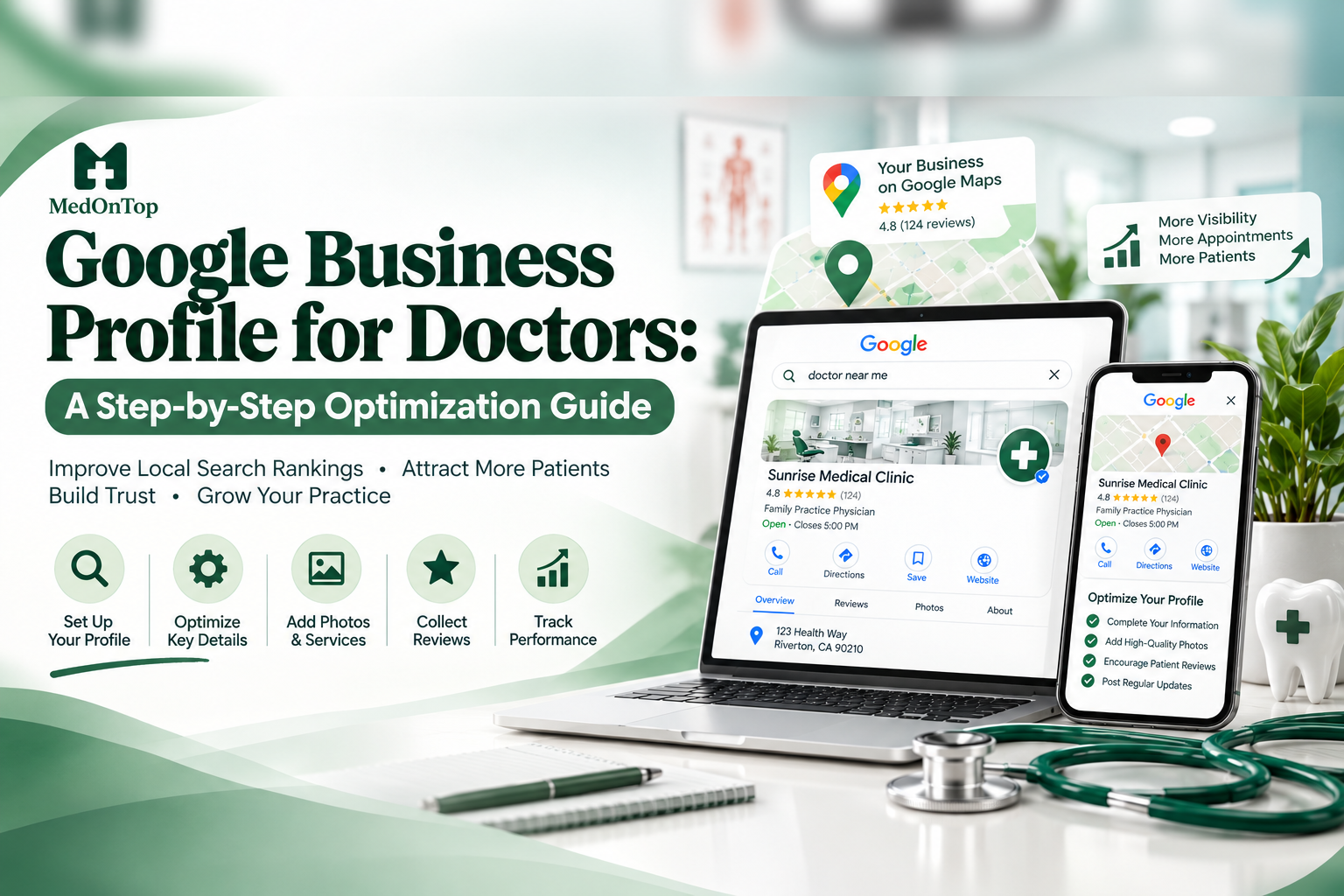
Google Business Profile for Doctors is a free Google listing that helps patients find medical practices through Google Search and Maps. It displays essential information, including a doctor’s specialty, clinic location, operating hours, patient reviews, and appointment options.
An optimized profile is an important component of local SEO for healthcare. It connects nearby patients with relevant providers while helping practices maintain accurate information across Google’s local search results.
However, verification alone does not establish strong visibility. Medical practices must manage categories, practitioner listings, website connections, patient feedback, and location information consistently. This guide explains how to configure, optimize, and measure a healthcare Google Business Profile while accounting for Google’s requirements and the operational realities of medical practices.
What Is Google Business Profile for Doctors?
Google Business Profile is a business listing management platform that allows eligible healthcare providers to control important practice information appearing on Google Search and Maps. Previously called Google My Business, the platform helps patients identify nearby medical facilities, evaluate doctors, obtain directions, and contact practices.
A healthcare Google Business Profile typically contains the practice name, primary medical category, address, telephone number, opening hours, website, and available services. Depending on eligibility and profile features, it may also display appointment links and accessibility information.
Unlike a medical practice website, which provides detailed clinical and organizational information, the profile serves as an immediate discovery and contact point.
Google Business Profile Example for a Medical Practice
Consider a patient searching for “dermatologist near me.”
Google may display a map alongside relevant dermatology practices. Each listing can provide location details, reviews, directions, and contact options. The patient’s journey might follow this sequence:
Local search → Medical practice listing → Provider evaluation → Appointment request
Accurate information reduces the number of steps between discovering a doctor and contacting the practice. For administrators, the important distinction is that Google Business Profile and the practice website are connected systems. Their information should agree, but they serve different purposes.
How Does Google Business Profile Work for Healthcare?
Google evaluates local listings using several signals to determine which businesses are relevant to a user’s search. Its local ranking framework primarily considers relevance, distance, and prominence. These factors operate together rather than as independent ranking scores.
Relevance to Medical Search Intent
Relevance measures how closely a listing matches the patient’s search. Someone searching for a pediatrician expects results associated with pediatric care, not a general medical facility that happens to mention children in its description.
Selecting an accurate primary category, adding appropriate secondary categories, and documenting actual services help Google interpret the practice. The website should reinforce the same information through specialty pages, physician biographies, and location-specific content.
Distance and Physical Practice Location
Distance reflects how far a medical facility is from the location Google associates with the search. A clinic cannot directly optimize its physical proximity to every potential patient. It can, however, provide an accurate address and map position.
Incorrect map pins, outdated addresses, or duplicate locations can create navigation problems and complicate local discovery. Practices operating from multiple legitimate locations should maintain location-specific records rather than treating every branch as one interchangeable listing.
Prominence and Provider Credibility
Prominence concerns how established or recognizable a business appears.
Google considers information from across the web, including reviews, links, and other references to the organization. For doctors, accurate professional credentials, consistent directory information, and credible website content also help patients evaluate the practice.
Medical websites benefit from clear authorship, professional qualifications, and appropriate content review processes. These principles are discussed further in E-E-A-T optimization for healthcare websites. A complete profile supports relevance, but it does not guarantee a particular ranking position.
Why Do Medical Practices Need an Optimized Google Business Profile?
The value of a Google Business Profile extends beyond visibility. It affects how patients discover, verify, and contact healthcare providers.
Reduce Friction in Patient Discovery
Patients frequently search for medical care using combinations of specialties, symptoms, services, and locations. An accurate profile lets them identify relevant practices without navigating several websites.
For example, a patient searching for an urgent care clinic may need operating hours and directions immediately. Incorrect information could result in an unnecessary journey or a missed appointment opportunity.
Establish Confidence Before Contact
Patients often compare several providers before scheduling care. Consistent practice information, legitimate patient feedback, and identifiable medical professionals help them evaluate available options. A listing containing outdated photographs, conflicting telephone numbers, or inaccurate clinic hours may introduce uncertainty, even when the underlying medical services are excellent.
Support Appointment Operations
A properly maintained listing can direct patients to the correct telephone number or booking page. This matters for organizations managing several specialties, administrative teams, or clinic branches. Routing a patient to the wrong location creates avoidable scheduling work. Accurate appointment destinations can reduce those errors.
Strengthen Medical Practice Local SEO
Google Business Profile supports medical practice local SEO by connecting physical location information with the organization’s broader online presence.
It complements service pages, local citations, and organic search optimization rather than replacing them. A well-maintained listing can also reduce dependence on paid visibility for some searches, although organic placement and patient acquisition are never guaranteed.
How to Set Up Google Business Profile for Doctors
The setup process should begin with an eligibility and information audit, not immediate profile creation. Duplicate practitioner listings and inconsistent ownership arrangements can create substantial management problems later.
Step 1: Audit Existing Listings and Verify Eligibility
Search Google Maps for the practice name, address, and individual doctors. Identify existing listings before creating new ones. Confirm whether each location qualifies under Google’s eligibility requirements. A practice generally needs legitimate in-person patient contact during its stated operating hours.
Review the ownership structure carefully. Google permits eligible public-facing practitioners to maintain individual profiles when they can be contacted directly at the verified location. Multi-practitioner organizations may also maintain a separate practice listing.
A solo practitioner representing a branded organization may be better served by a shared profile, following Google’s naming guidance. Avoid creating duplicate listings for every specialty associated with the same physician.
Step 2: Map Patient Intent and Select Medical Categories
Choose the primary category that most accurately represents the practice. For example, a dermatology clinic should select an appropriate dermatology category when available instead of using an unnecessarily broad healthcare classification. Add secondary categories only when they accurately describe services delivered at that location.
Map search intent against the practice’s actual offerings.
| Patient search intent | Profile information needed |
| Find a nearby specialist | Specialty category and location |
| Confirm appointment availability | Booking destination and contact details |
| Check clinic accessibility | Relevant accessibility attributes |
| Compare providers | Physician information and reviews |
| Obtain directions | Correct address and map pin |
This mapping prevents categories and service descriptions from becoming disconnected from actual clinical operations.
Step 3: Create, Claim, and Complete the Profile
Visit Google Business Profile, sign in with an authorized account, and claim an existing listing or create an eligible new one. Complete Google’s required verification procedure. Available verification methods vary, and Google determines which options a practice can use.
After verification, configure the essential information:
- Official practice name matching real-world signage
- Accurate physical address, map pin, and contact number
- Primary category and relevant secondary categories
- Regular operating hours and holiday exceptions
- Official website and appropriate appointment destination
- Genuine facility photographs and supported attributes
Use the real business name without promotional keywords or unnecessary location modifiers. For multi-location organizations, give the practice appropriate administrative ownership while providing staff and agencies with access through their own accounts.
Step 4: Validate and Establish Ongoing Maintenance
Test the published listing from a patient’s perspective. Open the map directions, call the displayed number, and follow the appointment link on a mobile device. Check whether the destination page corresponds to the correct practitioner, specialty, and location.
Assign responsibility for maintaining operating hours, provider changes, and service updates. A simple change-management process is useful. When clinic information changes, update the website, Google Business Profile, and relevant directories as part of the same operational task.
Google Business Profile Optimization Best Practices
Effective Google My Business healthcare optimization requires more than completing every available field. The strongest practices treat profile management as an extension of their website architecture, patient communications, and administrative workflows.
Keep Practice Information Consistent
The practice name, address, and phone number should remain consistent across authoritative listings. Audit relevant healthcare directories and appointment platforms for outdated details. Do not automatically replace every department’s telephone number with a central switchboard if doing so would interfere with patient routing.
Instead, define which contact details belong to each location and practitioner. Consistency should reflect real operations, not impose artificial uniformity across distinct departments.
Optimize Medical Services and Descriptions
Describe the services patients can actually obtain at the listed location. Use clear terms such as preventive care, dermatology consultation, or physical therapy evaluation where appropriate. Avoid filling the description with repeated city names, unsupported specialty claims, or promotional language.
Medical service descriptions should correspond to information available on the website. Where procedures require clinical evaluation, avoid suggesting universal suitability or guaranteed outcomes.
Maintain Professional Visual Information
Publish authentic photographs of the exterior, reception area, waiting room, and other appropriate spaces. Exterior images help patients recognize the facility when arriving. Interior photographs can communicate accessibility and the general environment without exposing private patient information.
Obtain appropriate permission before publishing photographs containing identifiable individuals. Avoid including clinical records, computer displays, or sensitive information in the background. Photographs should be updated when meaningful changes occur rather than uploaded simply to manufacture activity.
Manage Patient Reviews Responsibly
Reviews can influence patient decisions and contribute to local prominence. Ask patients for genuine feedback using neutral, voluntary requests. Do not offer incentives, selectively solicit positive reviews, or pressure patients to submit feedback.
Healthcare review responses require particular care. A doctor should not publicly confirm that a reviewer received treatment, disclose clinical circumstances, or discuss private medical records.
For critical feedback, acknowledge the concern without confirming a patient relationship and provide an appropriate private communication channel. Staff responsible for responses should receive clear privacy guidance and escalation procedures.
Connect the Profile to a Technically Sound Website
The website linked from Google Business Profile should offer a reliable continuation of the patient’s search. Mobile performance, clear navigation, accessible forms, and accurate service information matter.
For multi-location practices, consider dedicated location pages containing relevant services, physicians, contact details, and directions. Implement appropriate structured data, such as supported medical organization or physician schema, where it accurately represents visible page content.
Structured data helps describe entities to search systems but does not guarantee enhanced search features. Avoid placing sensitive patient data in tracking URLs, analytics events, or third-party marketing tools without appropriate privacy and compliance review.
Maintain Authority Across Search Experiences
Google Business Profile is one part of an increasingly interconnected healthcare discovery system.
Patients may encounter information through traditional search results, maps, and AI-generated search experiences. Consistent medical entity information, credible physician biographies, and well-structured specialty pages improve the clarity of a practice’s online presence.
For organizations assessing these developments, AI search optimization for healthcare provides a related framework for improving how medical information is organized and presented. No single profile adjustment guarantees inclusion in AI-generated responses.
How to Measure Google Business Profile Performance
Google Business Profile performance should be evaluated using patient actions and operational outcomes, not ranking screenshots alone. A useful measurement framework connects search visibility with meaningful engagement.
Visibility → Profile interaction → Contact or booking request → Confirmed appointment
Each stage requires separate interpretation.
Track Profile Interactions
Google Business Profile performance reporting may provide information about profile visibility and supported interactions, including calls, website clicks, and direction requests.
These metrics help identify changes in discovery and engagement. However, a phone interaction does not necessarily represent a new patient, and a website click does not establish that an appointment occurred.
Measure Website and Appointment Outcomes
Use properly configured campaign parameters on supported website links to distinguish profile traffic from other acquisition channels. Where booking systems permit reliable attribution, evaluate completed appointment requests and attended appointments.
Healthcare tracking configurations must avoid transmitting protected or sensitive patient information into unsuitable analytics platforms. Aggregate reporting is often more appropriate than user-level advertising attribution.
Compare Locations and Identify Problems
For multi-location practices, compare performance by branch while accounting for differences in geography, specialties, and operating capacity. A location receiving numerous calls but relatively few bookings may have scheduling availability or call-handling issues rather than an SEO problem.
Review trends across meaningful periods, particularly after verified changes to categories, website destinations, or location information. The objective is to identify correctable operational and discovery problems, not interpret every fluctuation as an algorithm change.
How Med On Top Supports Healthcare Local SEO
Google Business Profile optimization works best when listing information, website content, and local search infrastructure follow a consistent strategy.
Med On Top provides healthcare-focused SEO services covering local search optimization, Google Business Profile management, location page architecture, citation management, and medical content optimization.
For a medical practice, this type of work may involve auditing existing listings, correcting business information, aligning service pages with patient searches, and identifying technical issues affecting local discovery. Its healthcare local SEO offering also addresses reporting and the relationship between Map Pack visibility and website performance.
The appropriate scope depends on practice structure. A single-location physician office has different listing and content requirements from a multi-specialty organization operating across several cities. A practical starting point is an audit that identifies duplicate profiles, inaccurate categories, inconsistent directory records, and broken patient contact pathways before prioritizing additional optimization.
Google Business Profile for Doctors FAQs
Is Google Business Profile free for doctors?
Yes. Eligible medical practices can create and manage Google Business Profiles without paying Google for the listing. Practices may separately hire specialists for optimization, reporting, and ongoing management.
Can doctors and medical clinics have separate Google Business Profiles?
Yes, when they meet Google’s eligibility and practitioner guidelines. Multiple public-facing physicians at one location may qualify for individual listings alongside the organization’s profile. Unnecessary duplicate listings should be avoided.
How long does Google Business Profile optimization take?
Initial configuration may be completed relatively quickly, but verification times vary. Improvements in local visibility can take longer and depend on competition, location, relevance, and existing online prominence. No fixed ranking timeline is guaranteed.
What is the best Google Business Profile category for a doctor?
The best primary category is the most specific available category that accurately describes the doctor’s practice. Secondary categories should reflect legitimate additional services, not unrelated keywords selected solely for visibility.
Do patient reviews improve local SEO for medical practices?
Google identifies review quantity and positive ratings among signals relevant to local prominence. Reviews also help patients evaluate providers. They must represent genuine experiences, and healthcare organizations must protect patient confidentiality when responding.
Can a telehealth-only doctor create a Google Business Profile?
Generally, an online-only practice without qualifying in-person patient contact is not eligible. Providers offering legitimate in-person services may qualify if they satisfy Google’s applicable business and practitioner requirements.
How often should doctors update their Google Business Profile?
Update essential information whenever it changes. Review operating hours, appointment links, contact details, photographs, and practitioner information routinely. A monthly audit is a reasonable operational schedule, with immediate updates for changes affecting patient access.
Conclusion
An effective Google Business Profile for Doctors combines accurate clinical information, appropriate listing structure, legitimate patient feedback, and reliable appointment pathways. The most important work happens beyond initial verification. Categories must reflect actual specialties, addresses must remain accurate, and the connected website must support patients moving from search to care.
Medical practices should prioritize information quality, patient privacy, and measurable contact outcomes rather than pursuing rankings through unnecessary keywords or duplicate listings. For organizations managing multiple practitioners or locations, a structured profile audit can establish which problems require correction first. Med On Top can support that evaluation through its healthcare-focused local SEO services.