
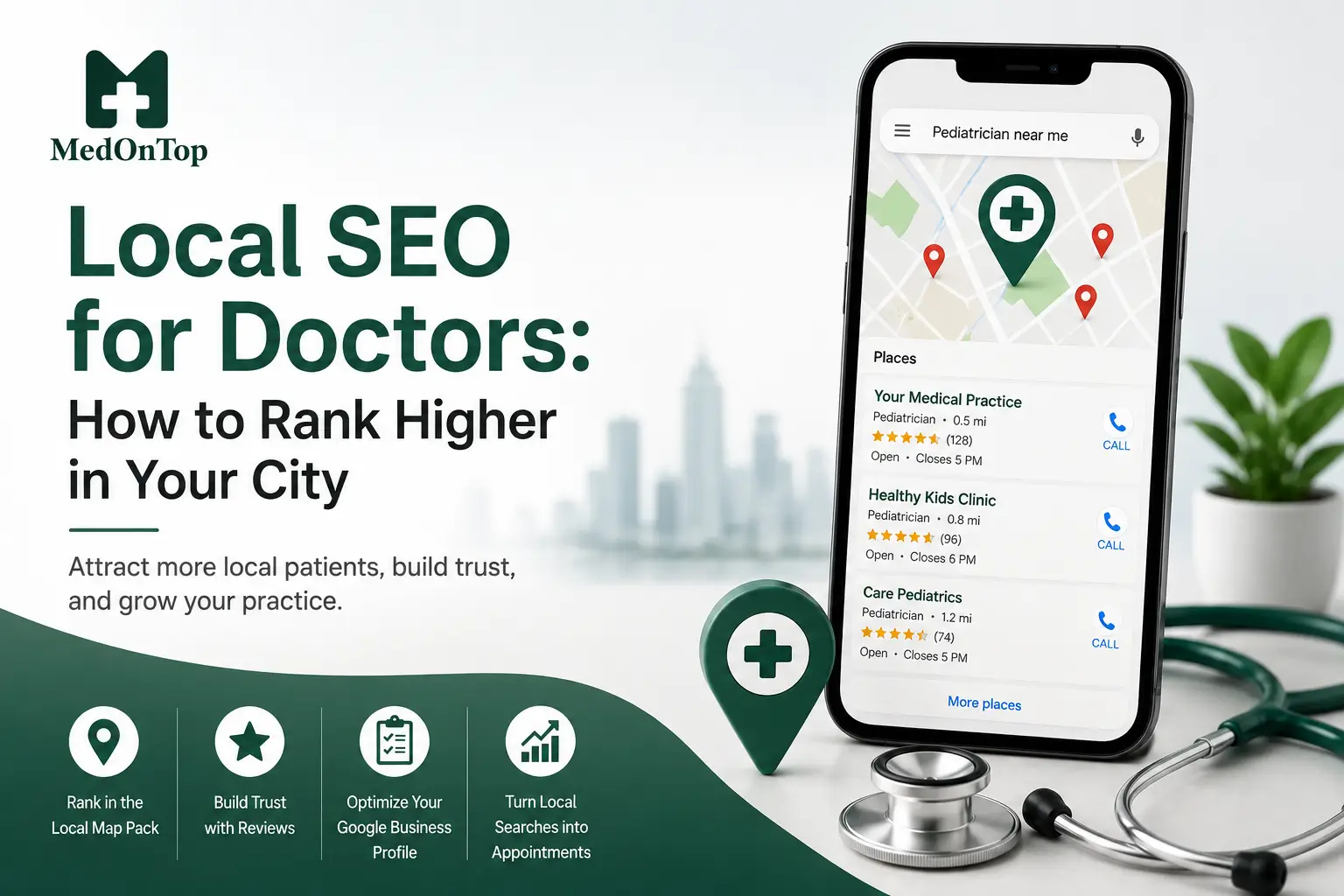
Local SEO for doctors is the process of optimizing a medical practice’s online presence, including Google Business Profile, website content, citations, and reviews, so it appears when patients search for care in their city. It helps practices rank in the Google Map Pack, build patient trust, and convert local searches into booked appointments.
What Is Local SEO for Doctors?
Local SEO for doctors is the practice of optimizing a medical practice’s online presence so it appears in local search results when patients search for care nearby. When someone searches “pediatrician near me” or “dermatologist in Austin,” Google decides which practices to show based on a specific set of local ranking signals: your Google Business Profile, the consistency of your business information across the web, your review profile, and how clearly your website communicates your location and specialty.
For most practices, this is where new patients start. Before someone calls your office or requests an appointment online, they’ve already searched, compared a handful of nearby providers, skimmed reviews, and formed an opinion. If your practice isn’t visible at that moment, it doesn’t matter how strong your offline reputation is.
Why Local SEO Matters More for Healthcare Than for Most Businesses
Two things make local SEO for doctors different from local SEO for, say, a coffee shop or a law firm.
First, patient search behavior is overwhelmingly local and urgent. People rarely search “best cardiologist” in the abstract; they search with a location, a symptom, or an insurance constraint already in mind, and they’re often trying to solve a problem soon.
Second, Google classifies medical content as YMYL (Your Money or Your Life). Pages that could affect a person’s health, financial stability, or safety are held to a higher quality standard under Google’s Search Quality Rater Guidelines, which means expertise, authoritativeness, and trustworthiness (E-E-A-T) carry more weight for a medical practice’s website than for a typical local business. Thin content, unverifiable claims, or an inconsistent online presence hurt a healthcare SEO strategy more than they would hurt an unrelated industry.
This is also why generic local SEO for healthcare advice only gets a medical practice partway. A strategy built specifically for medical practice SEO needs to account for physician credentials, clinical accuracy, and HIPAA-compliant SEO practices that don’t apply to most local businesses.
Local SEO for Doctors vs. General Local SEO
| Factor | General Local SEO | Local SEO for Doctors |
| Target audience | Broad local customer base | Patients actively seeking specific care |
| Content standard | Standard quality guidelines | YMYL, higher E-E-A-T bar |
| Trust signals | Reviews, business info | Reviews, credentials, licensing, provider bios |
| Compliance considerations | Minimal | HIPAA-aware review responses and content |
| Schema markup | LocalBusiness | LocalBusiness + Physician/MedicalOrganization |
| Content focus | Products/services, promotions | Conditions treated, procedures, provider expertise |
Key Ranking Factors for Doctor SEO
1. Google Business Profile (GBP)
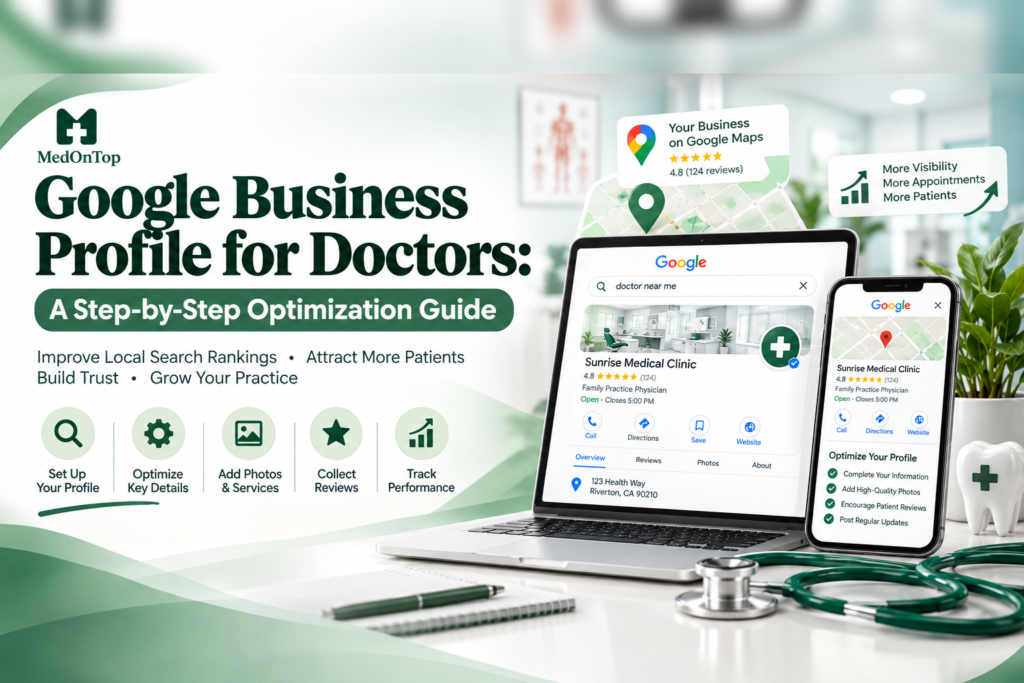
Your Google Business Profile optimization is the single most influential asset in local SEO for doctors, since it’s what determines whether you appear in the Map Pack. Google Business Profile completeness and category selection directly affect which searches trigger your listing.
To optimize it:
- Use accurate name, address, phone number, and hours exactly as they appear on your website.
- Choose the most specific primary category available (e.g., “Pediatrician” rather than “Medical Clinic”).
- Add high-quality photos of your facility, staff, and treatment areas.
- List every service and specialty you offer.
- Post regular updates: new services, seasonal hours, and health awareness content.
- Enable direct booking if your practice management system supports it.
2. NAP Consistency and Citations
NAP stands for Name, Address, and Phone number. Search engines cross-reference your NAP across directories, and inconsistencies, like a suite number missing here or an old phone number there, weaken the trust signal Google uses to confirm your practice is legitimate and active.
Priority directories for a US medical practice include Healthgrades, Vitals, Zocdoc, WebMD Physician Directory, and your relevant specialty association directory, in addition to Google Business Profile and Bing Places. This kind of local link building work claiming, verifying, and standardizing your NAP on each directory should be checked quarterly for drift.
3. Patient Reviews
Review volume, recency, and your response rate all factor into local ranking, and reputation management is often the deciding factor for patients choosing between two similarly ranked practices.
Practical steps:
- Ask for reviews systematically after appointments, with a direct link to your Google review page.
- Respond to every review, positive or negative, professionally and promptly.
- Never include patient-identifying information in a public review response. Even confirming that someone is a patient can create a HIPAA exposure.
- Never buy or incentivize reviews; both violate platform policies and erode trust when discovered.
4. Location-Specific Website Content
A single generic “Services” page performs worse than individual, localized pages. This is where content marketing and on-page SEO work together: build a dedicated page for each condition or service and mention your city or neighborhood naturally in the title, headers, and body; don’t stuff it in, just present it where a patient would naturally expect it.
If you operate more than one location, give each one its own page with unique address details, provider info, and localized content. Duplicating the same text across location pages undermines all of them.
5. Schema Markup
Structured data helps search engines, and increasingly AI systems, understand exactly what your practice offers. For a medical practice, that means going beyond basic LocalBusiness schema to include Physician or MedicalOrganization schema, covering specialty, accepted insurance, hours, and services. This is part of the broader technical SEO for healthcare work that improves how your practice is represented in AI overviews and answers from tools like ChatGPT or Perplexity, which rely on structured, verifiable data when citing sources.
6. Mobile Experience
Most local health searches happen on a phone, often when someone needs care soon. Mobile SEO and page speed determine whether that search turns into a call: a slow or clunky mobile site loses patients to a faster competitor before they ever see your services.
Step-by-Step: Implementing Local SEO for Your Practice
- Audit your current presence. Search your own practice name and specialty + city to see what currently shows up, and check for any duplicate or outdated listings.
- Claim and complete your Google Business Profile, following the checklist above.
- Standardize your NAP across your website and every directory where your practice appears.
- Build or update location-specific service pages, one per condition or service line.
- Add schema markup for your practice, providers, and services.
- Launch a systematic review request process tied to your appointment workflow.
- Track performance monthly using Google Business Profile Insights and Google Search Console, watching keyword rankings for terms like “[specialty] in [city].”
- Adjust based on data. Double down on what’s driving calls and bookings, and rebuild underperforming pages with more specific, useful content.
Expert Tips
- Treat your Google Business Profile as a living page, not a one-time setup. Update it monthly.
- Write provider bios that establish real credentials (education, board certification, years in practice) to strengthen E-E-A-T.
- Keep a consistent posting cadence of practical, locally relevant health content rather than promotional posts.
- Structure content so a direct question gets a direct, quotable answer near the top of the section, since this is what AI search optimization is built around and what AI overviews and AI assistants tend to surface.
Common Mistakes to Avoid
- Letting NAP data drift after an address, phone number, or hours change. Update every listing within days, not months.
- Using patient details in review responses, even with good intentions, which risks a HIPAA violation.
- Duplicating content across location pages instead of writing unique, localized copy for each one.
- Targeting generic keywords (“doctor near me”) instead of specific, high-intent terms (“pediatric dermatologist in Denver”).
- Ignoring negative reviews instead of responding professionally and constructively.
- Treating local SEO as a one-time project rather than an ongoing process that needs monthly attention.
How Long Does Local SEO Take to Work?
Most practices see early movement, including profile views, direction requests, and initial ranking shifts, within 4-8 weeks, largely from Google Business Profile optimization and early review activity. Meaningful, durable ranking improvements typically take 3–6 months, depending on how competitive your specialty and city are. If you want a clearer picture of where your practice stands today, MedOnTop’s free SEO audit is a good starting point, and our healthcare SEO consulting team can help you build out the full strategy from there.
Frequently Asked Questions
Q1. What is local SEO for doctors?
Local SEO for doctors is the process of optimizing a medical practice’s Google Business Profile, website, citations, and reviews so it appears in local search results and the Map Pack when patients search for care nearby.
Q2. How is healthcare SEO different from regular local SEO?
Healthcare content is treated as YMYL by Google, which means expertise, authoritativeness, and trustworthiness (E-E-A-T) are weighted more heavily than they are for most other local businesses, and practices also need to account for compliance considerations like HIPAA in reviews and content.
Q3. How long does it take to see results from local SEO?
Initial improvements are often visible within 4–8 weeks, with substantial ranking gains typically taking 3–6 months depending on competition in your specialty and city.
Q4. Why is Google Business Profile so important for doctors?
It’s the primary source Google uses to decide whether your practice appears in the Map Pack, and it’s usually the first thing a prospective patient sees before visiting your website.
Q5. How many reviews does a practice need to rank well?
Consistency and recency matter more than raw volume. A steady flow of a few new reviews each month tends to outperform a large but stagnant review count.
Q6. What keywords should doctors target?
Combine specialty and location naturally: “[specialty] in [city],” “[condition] treatment near [neighborhood],” or “[service] clinic in [area],” focused on the specific conditions and services your practice actually treats.
Q7. Do doctors need separate pages for each service or location?
Yes. Individual, localized pages for each service and each location consistently outperform a single generic page, since they let you speak specifically to what a patient is searching for.
Q8. Is schema markup necessary for medical practice SEO?
It’s not strictly required to rank, but Physician and MedicalOrganization schemas help search engines and AI systems understand and accurately represent your practice, which can improve both traditional visibility and AI Overview citations.
Q9. Can a practice handle local SEO in-house, or does it need an agency?
Basic steps, like claiming your profile, requesting reviews, and fixing NAP inconsistencies, are manageable in-house. Technical work like schema implementation and ongoing strategy in competitive markets is often where healthcare SEO services add the most value.
Q10. What’s the biggest local SEO mistake medical practices make?
Treating it as a one-time setup instead of an ongoing process. Profiles, listings, and content all need regular maintenance to hold rankings.