
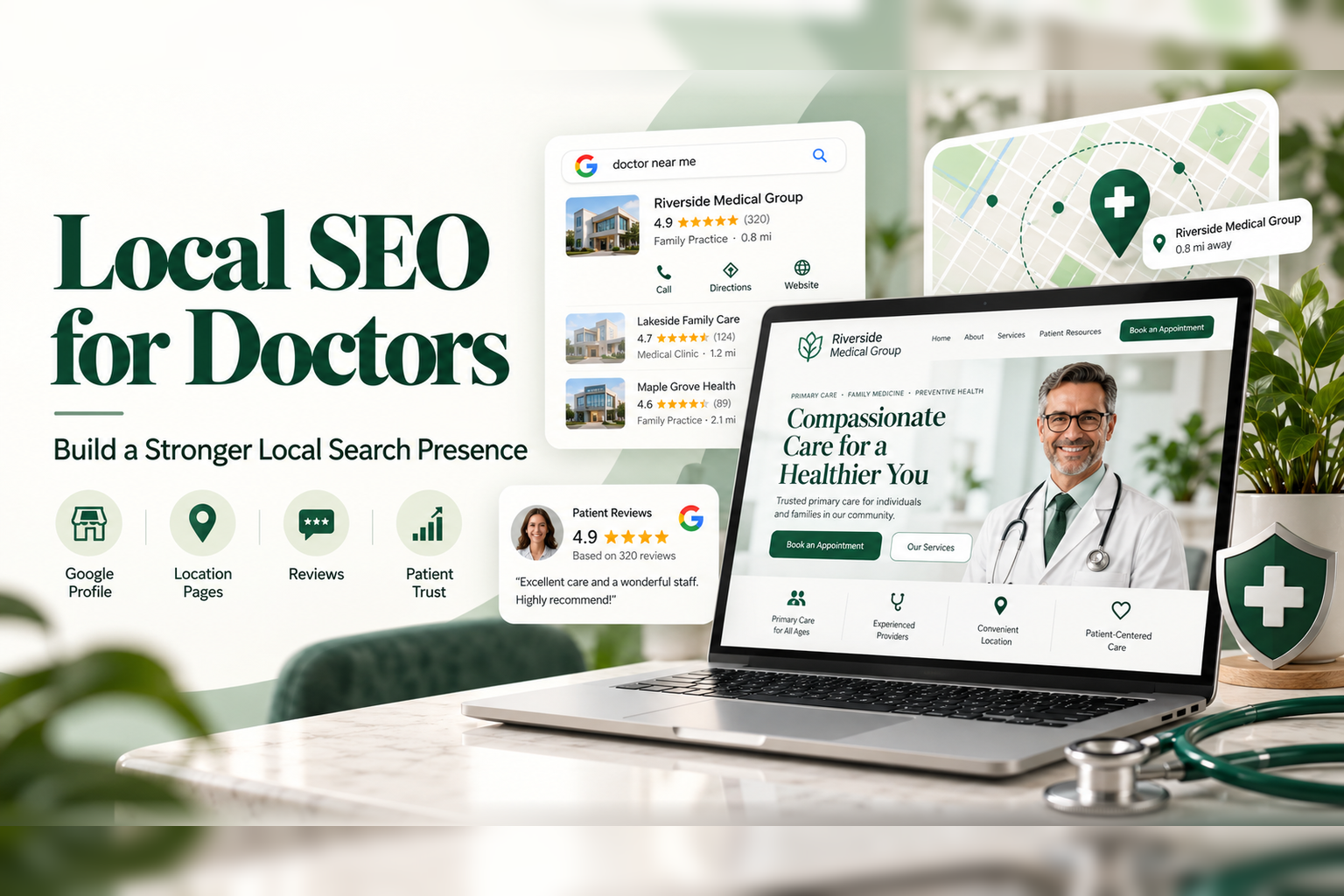
Local SEO for doctors is the process of improving a medical practice’s online presence so nearby patients can find the right provider, service, and location when they search. It combines website optimization, local visibility, reviews, accurate practice information, and trustworthy healthcare content. For practices that want a structured foundation, local SEO for healthcare connects these elements around local patient intent.
A strong local SEO plan for doctors does more than help a clinic appear in search results. It makes services, office locations, provider details, hours, contact options, and appointment pathways easier to discover. This guide explains how local SEO works for medical practices, how to build a practical strategy, and how to measure whether visibility is turning into meaningful patient actions.
What Is Local SEO for Doctors?
Local SEO for doctors is a search optimization strategy focused on helping medical practices appear for location-based and nearby healthcare searches. It supports visibility when someone looks for a physician, clinic, specialty, treatment, or healthcare service in a specific area.
Unlike broad doctors SEO, local SEO emphasizes geographic relevance, including where a practice is located, what it offers, and whether its information is consistent.
A complete local strategy often connects the practice website, location pages, provider information, Google Business Profile, reviews, citations, local content, technical SEO, and conversion paths. The goal is not simply more impressions. It is to help the right patients reach the right page or profile when they are actively looking for nearby care.
Local SEO for Doctors Example
A patient searching for “cardiologist near me” may want to confirm the physician’s specialty, office location, hours, credentials, insurance information, and appointment options.
Local search → Relevant practice or provider result → Trust and location information → Appointment or contact action
How Does Local SEO for Doctors Work?
Local SEO strategies for doctors work by giving search engines consistent signals about relevance, location, services, and trust while making the same information useful to patients.
Local Search Intent and Service Relevance
A patient searching for “family doctor in Dallas” has a different goal from someone searching “what causes seasonal allergies.” The first query signals local provider intent, while the second is mainly informational.
A useful SEO strategy for doctors maps high-intent local searches to service, provider, or location pages. Each page should explain the service, who provides it, where care is available, and what the patient can do next.
This structure is especially important for practices with multiple specialties or locations, where a generic homepage may not satisfy local intent.
Google Business Profile and Practice Information
Google Business Profile can be a major local discovery point for medical practices. The profile should accurately represent the practice name, address, phone number, hours, category, website, and other available details.
Information on the profile should align with the website. Conflicting phone numbers, outdated hours, or inconsistent location details can confuse patients. For multi-location practices, each legitimate location should be represented carefully.
Location and Provider Pages
Strong location pages provide more than an address. They can explain available services, providers, contact information, access instructions, and appointment pathways for that office.
Provider pages help patients understand who delivers care, including specialties, education, credentials, professional focus, and practice location where appropriate. Clear provider information also strengthens the human expertise behind a medical website.
Reviews, Reputation, and Trust
Reviews can influence how patients evaluate a practice and may contribute to the broader local search ecosystem. Practices should focus on ethical reputation management rather than trying to manipulate ratings.
Responses should protect patient privacy. A practice should not reveal or confirm sensitive medical information when replying publicly to reviews.
Doctors Website SEO and Technical Foundations
Doctors website SEO should include crawlable pages, mobile usability, logical navigation, descriptive titles, internal linking, useful headings, fast-loading templates, and properly managed indexation.
Technical problems can quietly weaken local SEO. A location page blocked from indexing, a broken appointment button, or a slow mobile experience can prevent otherwise strong content from doing its job.
Why Do Doctors Need Local SEO?
Patients often begin their search for care online, and many provider searches are tied to location. If a practice is difficult to find locally, nearby patients may never reach its website or learn about its services.
Local SEO aligns the practice’s online presence with the way patients search. A strong location page can answer where the practice is, what care is available, and how to contact the office. A maintained profile can provide hours, directions, and other decision-making information before the patient visits the site.
It also helps organize relationships between services, providers, locations, and educational resources. That structure supports patients while giving search engines clearer context, including for map-based and AI-assisted search experiences.
How to Build a Local SEO Plan for Doctors
A practical local SEO plan for doctors should begin with the practice’s real services, providers, and locations rather than a long list of keywords.
Step 1: Audit the Current Local Presence
Review the website, Google Business Profile, provider pages, location pages, contact information, mobile experience, and important directory listings.
Look for missing location pages, outdated hours, inconsistent contact information, duplicate profiles, weak provider biographies, broken appointment links, and technical problems such as poor internal linking or pages that cannot be indexed.
Step 2: Map Patient Searches to Services and Locations
Group search intent around specialties, services, providers, neighborhoods, cities, and common patient needs. The objective is not to create a page for every keyword variation. It is to identify distinct search needs that deserve a useful destination.
A multi-location dermatology practice, for example, may need separate location pages plus dedicated pages for major services, connected to relevant providers and nearby offices.
Step 3: Build the Correct Website Structure
Create a hierarchy that makes services, providers, and locations easy to find. Each important page should serve a clear purpose and avoid competing unnecessarily with another page for the same intent.
A practice can use its main website as the central authority layer, with service pages supporting treatment intent and location pages supporting geographic intent. Med On Top focuses on healthcare-specific search strategies where these relationships matter.
Internal links should guide users naturally between related services, locations, physicians, and appointment options.
Step 4: Optimize, Monitor, and Improve
Optimize titles, headings, page copy, local information, internal links, structured data where appropriate, and conversion paths.
Then monitor performance. Search behavior, competition, providers, locations, and services can change, so local SEO is not a one-time setup. Pages should be reviewed when important practice information changes.
Local SEO Tips and Best Practices for Doctors
The strongest local SEO tips for doctors focus on consistency, usefulness, and trust rather than shortcuts.
Keep Practice Information Consistent
Use accurate practice names, addresses, phone numbers, hours, and website information across important profiles and directories. Update major sources when location details or hours change.
Create Useful Location Pages
Avoid thin pages that repeat the same copy with a different city name. Each legitimate location page should help a patient understand that office.
Useful information can include:
- Address, phone number, and office hours
- Services or specialties available at the location
- Providers who practice there
- Directions or access information when relevant
- Clear appointment or contact options
Strengthen Medical Trust Signals
Show real provider information, qualifications, and organizational details where appropriate. Medical content should identify authors or reviewers when useful, especially for pages discussing conditions, procedures, or treatment considerations.
Content should remain educational and should not promise outcomes. Accuracy and transparency matter more in healthcare than promotional wording.
Build Content Around Local Patient Needs
Educational content can support local SEO when it answers real patient questions about services, preparation, care pathways, or when professional evaluation may be appropriate. It should connect naturally to relevant service and location pages rather than exist only to capture keywords.
Prepare for AI-Assisted Local Discovery
Patients increasingly encounter summarized answers and AI-assisted search experiences alongside traditional results. Clear entity information, well-structured pages, accurate provider details, and concise answers can make a medical website easier for search systems to understand.
Practices exploring this layer can connect local search work with AI search optimization so content remains structured around both human decisions and machine interpretation.
How to Measure Local SEO Performance
Local SEO performance should be evaluated through meaningful patient journeys, not rankings alone. A top position for a low-value query may matter less than consistent visibility for searches tied to actual services and locations.
Useful measurements include:
- Visibility for relevant local service, provider, and specialty searches
- Organic visits to location and service pages
- Calls, appointment requests, directions, and contact actions
- Google Business Profile engagement where available
- Indexation, page speed, mobile usability, and technical health
- Search-to-page and page-to-action conversion paths
A simple framework is:
Local visibility → Relevant visit → Trust and information → Patient action
Compare locations separately and check whether high-visibility pages attract the right visitors. Rankings fluctuate, so trends are more useful than isolated daily positions.
How Med On Top Supports Local SEO for Doctors
Med On Top provides healthcare-focused local SEO services that can support practices facing weak local visibility, inconsistent location information, underdeveloped service pages, or disconnected website structure.
The work can connect local search strategy with website optimization, provider and location architecture, technical SEO, and content planning so the website, profiles, and patient journey support one another.
Practices can book a call to discuss their current search presence and the areas that may need attention. The appropriate strategy depends on locations, services, competition, website condition, and goals.
For specific questions about an existing website or local search challenge, the Med On Top contact page provides another direct way to start the conversation.
Local SEO for Doctors FAQs
What is local SEO for doctors?
Local SEO for doctors is the process of optimizing a medical practice’s website, location information, business profiles, and local search signals so nearby patients can find relevant providers and services more easily.
Why is local SEO important for doctors?
Many healthcare searches include local intent. Local SEO helps a practice present accurate service, provider, and location information when patients search for nearby care, making the path from discovery to contact clearer.
How long does local SEO take for a medical practice?
There is no universal timeline. Progress depends on the website’s condition, competition, number of locations, existing authority, technical problems, and the amount of optimization required. Local SEO should be evaluated as an ongoing process rather than a guaranteed short-term result.
What should a local SEO strategy for doctors include?
A useful strategy can include Google Business Profile optimization, location pages, provider information, service pages, technical SEO, local citations, reviews, internal linking, content, and performance measurement. Priorities should reflect the practice’s real structure and patient journey.
Do reviews help local SEO for doctors?
Reviews are important to the way patients evaluate a practice and can support a strong local presence. Practices should seek reviews ethically, avoid manipulation, and protect patient privacy when responding publicly.
Does every doctor need a separate location page?
Not necessarily. A separate page makes sense when there is a real location that patients can visit and the page can provide useful information. Creating thin pages for areas where the practice has no legitimate presence can reduce quality rather than improve it.
Can local SEO help doctors appear in AI search results?
Clear, trustworthy, well-structured local information can make a practice easier for search systems to interpret, including AI-assisted experiences. However, no optimization method can guarantee inclusion. Accurate entity, provider, service, and location information remains the stronger foundation.
Build a Stronger Local Search Presence
Local SEO for doctors works best when visibility, accuracy, and patient experience are treated as one system. A practice needs more than a business profile or a few city keywords. It needs clear service pages, useful location information, credible provider details, sound technical foundations, and an easy route from search to contact.
The most effective local SEO strategies for doctors begin with what patients actually need to know: where the practice is, which services are offered, who provides care, whether the information can be trusted, and what the next step is.
Answering those questions clearly gives patients a better search experience and gives search engines stronger context about the practice. A practice that is difficult to find locally may need better structure, cleaner location signals, stronger provider pages, or a more focused local SEO plan. Identifying the gap is the first step toward improving its local search presence.