
When someone searches “dermatologist near me” or “pediatric dentist in [city],” Google typically shows a map with three practices before it shows any website links at all. If your practice isn’t one of those three, or doesn’t appear clearly in the results below them, you’re losing patients to competitors who simply show up first.
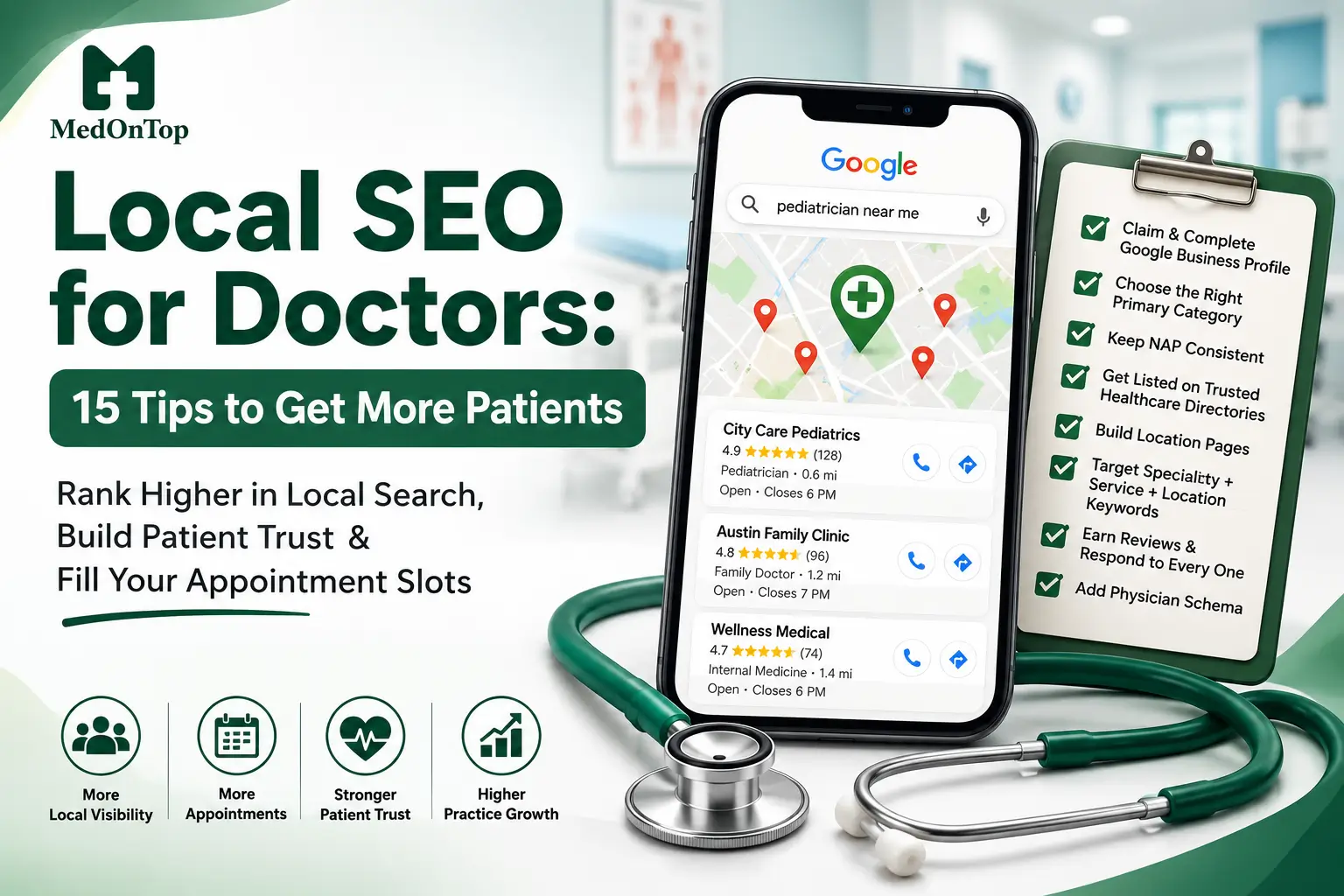
Local SEO for doctors is what determines whether your practice appears in that moment. It’s a distinct discipline from general SEO because it depends on location signals, directory consistency, and trust indicators that patients and Google both weigh heavily before someone books an appointment. Below are 15 tips that go beyond the basics most healthcare SEO guides cover.
1. Claim and Fully Complete Your Google Business Profile
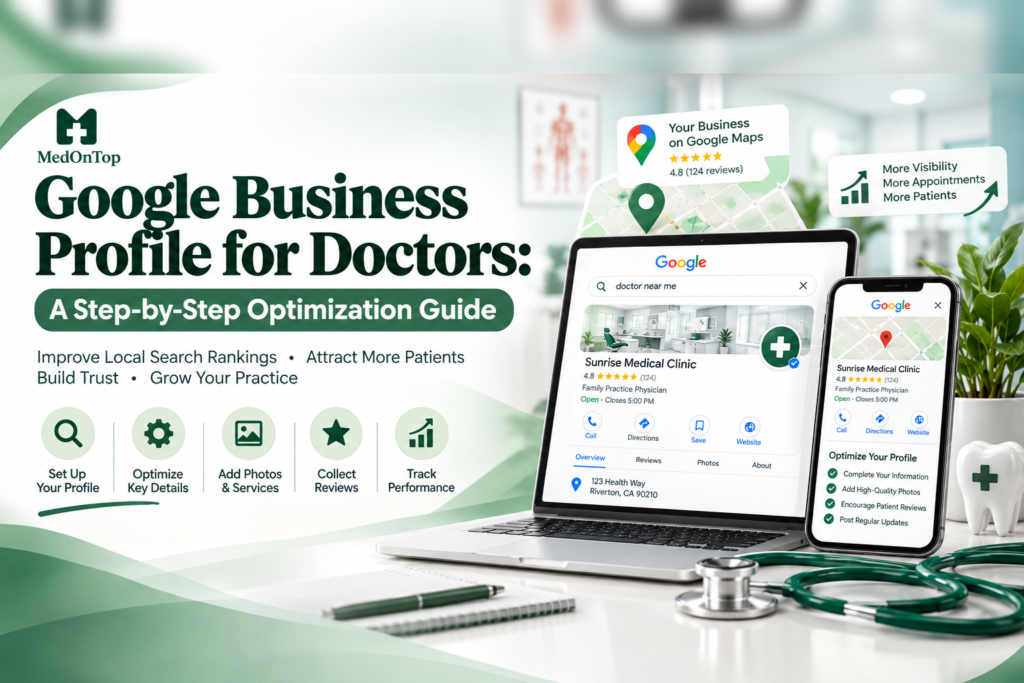
Your Google Business Profile (GBP) is the foundation of local SEO for medical professionals. An incomplete or unclaimed profile means Google has less information to match you to relevant searches, and patients have less reason to trust what they find.
Fill in every available field: services offered, accepted insurance (where the field applies), business hours including holiday exceptions, appointment links, and high-quality photos of your clinic, waiting room, and team. Profiles with complete information consistently outperform bare-bones listings in local visibility.
2. Choose the Correct Primary Category for Your Specialty
Many practices default to a generic category like “Doctor” or “Medical Clinic” when a more specific option exists. A dermatologist should select “Dermatologist,” not “Doctor.” A dental practice offering implants might choose “Dental Implants Periodontist” as a secondary category rather than leaving it unclaimed. The more precisely your category matches patient search behavior, the more relevant Google considers your listing for specialty searches.
3. Keep Your NAP Consistent Across Every Platform
NAP stands for Name, Address, and Phone number. Inconsistencies between your website, GBP, and directory listings, an old suite number, or a phone number that doesn’t match confuse Google’s local ranking algorithm and erode patient trust. Audit your listings on Healthgrades, Vitals, Zocdoc, WebMD, and your state medical board directory to confirm every detail matches exactly.
4. Get Listed on Trusted Healthcare Directories
Beyond Google, patients research providers on healthcare-specific directories before booking. Healthgrades, Vitals, Zocdoc, and WebMD carry significant authority in Google’s eyes and are often where patients cross-check credentials and reviews. An accurate, complete profile on these platforms functions as both a citation signal and a direct patient acquisition channel.
5. Build Genuinely Distinct Location Pages for Multiple Clinics
If your practice operates in more than one city or neighborhood, resist the temptation to duplicate a single page and swap the city name. Google recognizes near-identical content across pages and may not rank either version well. Each location page should include the specific address, the doctors who practice there, parking or transit details, and services actually offered at that location.
6. Target Specialty + Service + Location Keywords
Broad keywords like “doctor” are highly competitive and rarely convert. Instead, structure your keyword targeting around three components: your specialty, the specific service, and the location. Examples include “pediatric dentist root canal Austin” or “orthopedic knee specialist Denver.” This same logic applies across specialties. Practices offering seo tips for dental care should apply it to procedure-specific pages like “dental implants” or “same-day crowns” paired with a neighborhood or city name, rather than competing for the single word “dentist.”
7. Earn Reviews the Right Way, and Respond to Every One
Reviews remain one of the strongest local ranking and trust factors. Ask satisfied patients directly, ideally through a follow-up text or email after a visit, rather than incentivizing reviews, which violates most platform policies and can trigger removal.
Respond to every review, positive or negative, in a way that never discloses or implies a patient’s condition, diagnosis, or treatment details publicly. A HIPAA-safe response to a negative review might read: “We’re sorry to hear your visit didn’t meet expectations. Please contact our office directly so we can address this.” That protects patient privacy while still demonstrating responsiveness.
8. Add Physician and MedicalOrganization Schema Markup
Structured data helps Google, and increasingly AI tools like ChatGPT and Gemini, understand exactly who your doctors are, what they specialize in, and where your practice operates. Implementing Physician schema for individual providers and MedicalOrganization or LocalBusiness schema for the practice itself gives search engines a clear, machine-readable summary of your credentials and location. This is a frequently overlooked step; most healthcare websites mention schema in general terms without specifying which types actually apply.
9. Publish Content That Answers Real Patient Questions
Generic wellness content rarely ranks or converts. Instead, build content around the specific questions patients ask before booking: recovery timelines, what a procedure involves, insurance coverage, or how to prepare for a visit. This content should be written or reviewed by a licensed provider, with that reviewer clearly credited, which strengthens both patient trust and Google’s E-E-A-T evaluation of your site.
10. Optimize for “Near Me” and Voice Search Queries
A growing share of healthcare searches happen conversationally, especially on mobile and through voice assistants: “who’s the best pediatrician near me open now.” Structure content to answer natural-language questions directly, and make sure your hours and location data stay current, since voice results pull heavily from GBP data in real time.
11. Showcase Doctor Credentials and Author Bios
Every provider should have a dedicated bio page listing their education, board certifications, years in practice, and areas of focus, with a professional photo. This is one of the clearest E-E-A-T signals available to a medical website, and Google’s health-content quality standards place significant weight on demonstrated expertise behind clinical information.
12. Improve Mobile Speed and Core Web Vitals
Most local healthcare searches happen on a phone, often while someone is in discomfort or has limited patience for a slow site. Beyond a vague “load fast” goal, monitor your Core Web Vitals scores directly in Google Search Console and prioritize fixes to Largest Contentful Paint and Interaction to Next Paint, since both directly affect how Google ranks mobile local results.
13. Build Local Backlinks Through Healthcare Relationships
Link building for medical practices works differently than in other industries. Sponsor a local health fair, partner with a nearby hospital system, join your county or state medical society, or contribute a quote to a local news health segment. These relationships produce backlinks from genuinely relevant, high-trust local sources, which carry more local ranking weight than generic directory submissions.
14. Add FAQ Schema to Service Pages
Beyond Physician and LocalBusiness schema, mark up the frequently asked questions on your service pages with FAQPage schema. This increases the chance your content appears directly in Google’s expandable FAQ results and gives AI search tools clearly structured question-and-answer pairs to reference when citing your practice.
15. Track the Actions That Actually Lead to Patients
Rankings alone don’t fill your schedule. Monitor calls, direction requests, appointment-link clicks, and website form submissions through Google Business Profile Insights and Google Analytics. If a keyword ranks well but generates no patient actions, the page likely needs a clearer call to action or better alignment with what the patient actually wants to know.
Local SEO vs. General SEO for Healthcare Websites
| Factor | Local SEO for Doctors | General SEO |
| Primary goal | Visibility in Google Maps and “near me” searches | Broad organic ranking across search |
| Key asset | Google Business Profile | Website content and backlinks |
| Ranking signals | NAP consistency, reviews, proximity | Keyword relevance, domain authority |
| Content focus | Location + service pages | Topical, informational depth |
| Typical patient intent | Ready to book nearby | Researching broadly |
| Timeline to results | 1–3 months for less competitive terms | 3–6+ months |
Expert Tips
- Update your GBP with a new photo or post at least weekly. Active profiles receive more visibility than static ones.
- Never let a review sit unanswered for more than a few days. Response time is itself a trust signal patients notice.
- Revisit your primary GBP category quarterly. Google occasionally adds more specific medical categories worth switching to.
Common Mistakes to Avoid
- Targeting only broad terms like “doctor” instead of specialty-service-location combinations
- Leaving Google Business Profile fields incomplete or outdated
- Publishing near-duplicate location pages across multiple clinic branches
- Responding to negative reviews in a way that discloses patient information
- Treating schema markup as optional rather than implementing Physician, LocalBusiness, and FAQPage types
- Expecting local ranking improvements within days instead of the realistic 1–3 month window for lower-competition terms
Conclusion
Local SEO for doctors isn’t a single fix. It’s the combination of an accurate Google Business Profile, consistent directory listings, location-specific content, structured data, and genuine patient trust signals working together. Practices that treat these 15 tips as an ongoing process, not a one-time setup, are the ones patients actually find when searching for care nearby.
Call to Action
Ready to turn local searches into booked appointments? Start with a free SEO audit or explore MedOnTop’s healthcare SEO consulting to build a strategy tailored to your practice.
FAQ
How long does local SEO take to work for a medical practice?
Less competitive, long-tail keywords can show movement within 1–3 months. More competitive specialty terms in dense markets typically take 3–6 months of consistent optimization.
What’s the difference between local SEO and general SEO for doctors?
Local SEO focuses on Google Business Profile, NAP consistency, and proximity-based ranking factors that surface a practice in “near me” searches. General SEO focuses on broader website authority and content depth across all search intents.
Which primary category should I choose on Google Business Profile?
Choose the most specific category available for your specialty, such as “Dermatologist” or “Pediatric Dentist,” rather than a broad category like “Doctor” or “Medical Clinic.”
Can I offer incentives for patient reviews?
No. Incentivized reviews violate most platform policies, including Google’s, and can result in review removal or profile penalties. Ask genuinely, and make leaving a review as easy as possible instead.
How do I handle a negative review without violating HIPAA?
Respond professionally without confirming or referencing any specific patient, condition, or treatment. Invite the reviewer to contact your office directly to resolve the issue privately.
Do I need separate SEO pages for each clinic location?
Yes. Each location should have its own page with a unique address, provider list, and locally relevant details. Duplicating one page across locations weakens rankings for all of them.
What schema markup should a medical website use?
Physician schema for individual providers, MedicalOrganization or LocalBusiness schema for the practice, and FAQPage schema on service pages with frequently asked questions.
Which healthcare directories matter most for local SEO?
Healthgrades, Vitals, Zocdoc, and WebMD carry the most authority for physician listings in the US, alongside your state medical board directory.
Does local SEO apply to dental practices the same way?
Yes. The same principles- GBP optimization, review management, and specialty-service-location keyword targeting- apply directly. Dental-specific SEO should also target procedure pages like implants or orthodontics paired with location terms.
How much does local SEO cost for a medical practice?
Costs vary widely based on practice size, competition, and whether work is handled in-house or through an agency, ranging from a few hundred to several thousand dollars monthly for ongoing management.