
A good healthcare SEO agency specializes exclusively (or near-exclusively) in medical practices, proves results through booked appointments rather than just keyword rankings, follows Google’s E-E-A-T standards with physician-reviewed content, handles patient data through HIPAA-conscious, BAA-backed processes, and offers transparent reporting with clear contract terms.
Key Takeaways
- Specialization matters more than size. A healthcare-only agency understands YMYL, E-E-A-T, and HIPAA in ways a generalist marketing shop typically doesn’t.
- Ask for appointment data, not just rankings. Keyword position reports don’t pay your overhead; new patient volume does.
- A signed Business Associate Agreement (BAA) is a hard requirement if the agency’s tools ever touch patient-submitted information.
- Clarify content and data ownership up front. You should keep everything the agency builds if you end the relationship.
- Compare pricing models before you compare prices. Retainer, project-based, and performance pricing all carry different trade-offs.
Why Choosing the Wrong Healthcare SEO Agency Is a Bigger Risk Than It Looks
Hiring the wrong SEO vendor for a medical practice isn’t just a wasted marketing budget. It can create real compliance exposure and cost you visibility for months. Google classifies medical content as YMYL (Your Money or Your Life), which means it applies a stricter quality bar than it does to most other industries, evaluated through the lens of E-E-A-T (Experience, Expertise, Authoritativeness, Trustworthiness).
A generalist agency that writes unreviewed blog posts, skips physician bylines, or plugs in a booking widget without HIPAA-conscious form handling isn’t just producing weaker content. It can actively suppress your rankings and expose your practice to compliance risk. That’s the core reason healthcare SEO is treated as its own specialty rather than a subset of general local SEO.
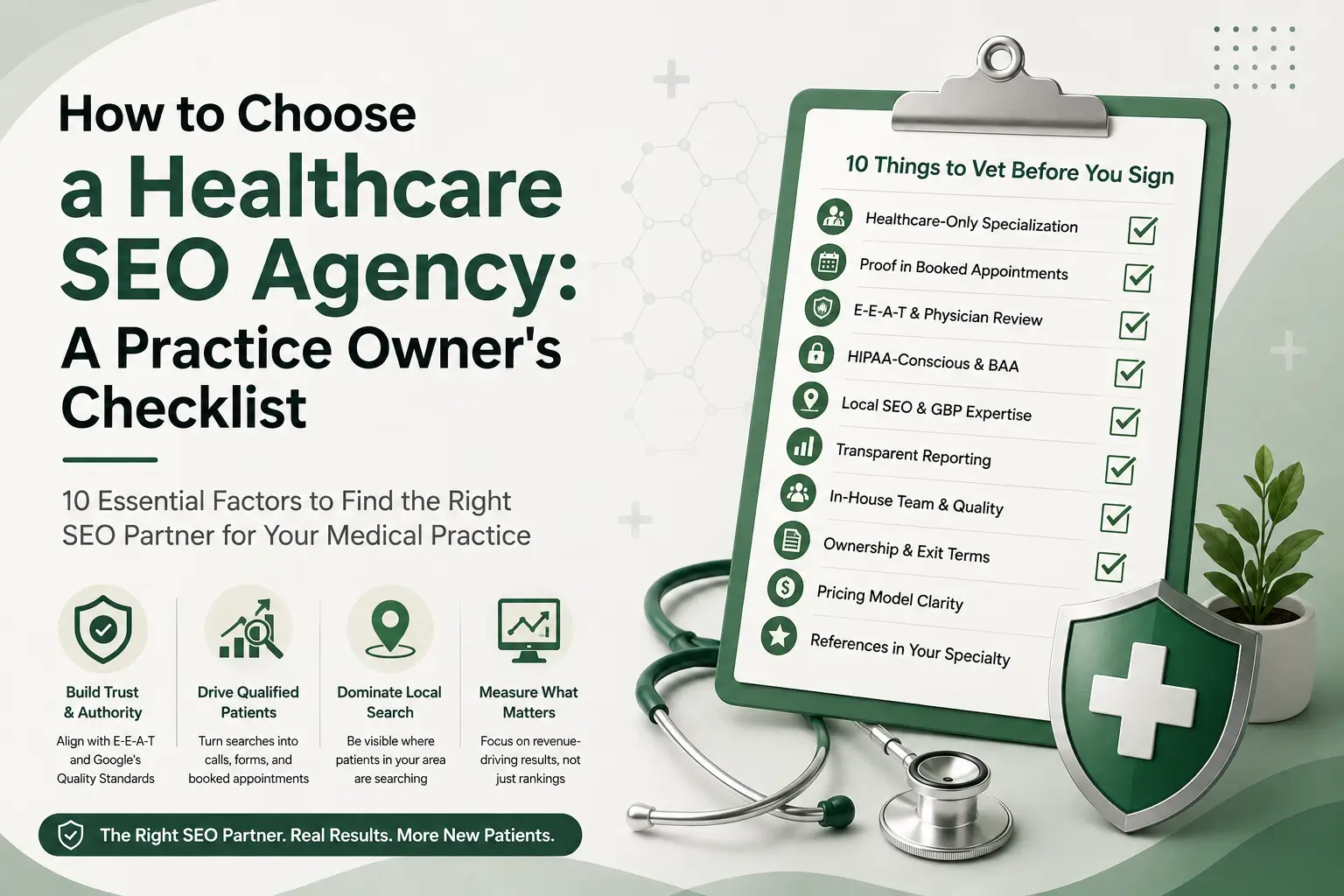
The Practice Owner’s Checklist: 10 Things to Vet Before You Sign
1. Healthcare-only specialization
Ask directly what percentage of the agency’s client base is medical, dental, or healthcare-adjacent. An agency splitting attention across restaurants, law firms, and e-commerce brands hasn’t built the institutional knowledge that HIPAA obligations and physician-credentialing workflows require.
2. Proof measured in booked appointments
Rankings and traffic are easy to show and easy to inflate. Ask for evidence that ties organic search performance to actual new-patient inquiries: call tracking, form conversions, or scheduled consults.
3. A documented E-E-A-T process
Ask exactly how content gets reviewed. Who writes it? Which licensed provider signs off before it publishes? Content without a real clinical review step is a liability under Google’s medical content standards, regardless of how well it’s written.
4. HIPAA-conscious data handling and a signed BAA
Any agency that manages your contact forms, chatbots, or scheduling widgets is potentially handling protected health information. If they can’t produce a Business Associate Agreement (BAA) or explain how patient data is encrypted and segmented from marketing analytics tools, treat that as a compliance red flag, not a minor gap.
5. Local SEO and Google Business Profile expertise
Most new-patient searches are hyper-local. Ask how they approach Google Business Profile optimization, NAP (Name, Address, Phone) consistency across directories, and location-specific pages for multi-office practices.
6. Transparent, attribution-based reporting
You should be able to log in and see which keywords, pages, and campaigns are generating calls and bookings, not receive an opaque monthly PDF. Ask for a sample report before signing.
7. In-house team vs. outsourced execution
Ask who specifically writes, optimizes, and reports on your account, and whether they’re employees or subcontracted freelancers. Offshore, uncredentialed writers introduce clinical-accuracy risk with every published page.
8. Contract length, ownership, and exit terms
Clarify upfront: Do you own the content, backlinks, and data if you cancel? What’s the notice period? Healthcare SEO compounds over time, so a reasonable initial commitment (often 6-12 months) is normal, but you should never lose your own content or rankings history if you leave.
9. Pricing model clarity
Understand exactly what you’re buying before comparing quotes. A one-time technical audit, an ongoing content and local SEO retainer, and a performance-based arrangement are structured, and priced, very differently.
10. References and portfolio in your specialty
A dermatology practice and a multi-location orthopedic group have different SEO needs. Ask for references or case examples from practices similar to yours in specialty and market size, not just logos on a website.
Questions to Ask Every Healthcare SEO Agency Before You Sign
- What percentage of your current clients are healthcare practices?
- Who reviews clinical content before it publishes, and what are their credentials?
- Can you provide a sample HIPAA Business Associate Agreement?
- How do you attribute new patients specifically to organic search?
- Who writes and executes the work: in-house staff or contractors?
- What happens to our content, rankings, and data if we cancel?
- Can I see a live reporting dashboard before I commit?
- What’s your average timeline to measurable results for a practice like mine?
What to Expect in Your First 90 Days With a New Healthcare SEO Agency
A reputable healthcare SEO agency should be able to walk you through what the first three months look like before you ever sign a contract. If they can’t, that’s worth asking about directly.
Weeks 1 to 2: Onboarding and audit The agency should run a full technical and content audit of your site, review your Google Business Profile and directory listings, and confirm how patient-facing forms currently handle data. This is also when a BAA should be signed if one is needed.
Weeks 3 to 6: Foundation work Expect fixes to technical issues, schema markup implementation, and a content plan built around your actual service lines and locations. You should receive a documented plan, not just a verbal summary, showing what will be published and when.
Weeks 7 to 12: First content and reporting cycle Physician-reviewed content should start publishing, local SEO work should be underway, and you should receive your first performance report. Early on, this report will likely show technical and foundational progress rather than a flood of new patients. Be cautious of any agency claiming significant new-patient volume this early for a competitive specialty or a brand-new site.
Asking an agency to walk through this timeline during the sales process is one of the simplest ways to separate a team with a real process from one improvising as they go.
Red Flags: Signs a “Healthcare SEO Agency” Is Actually a Generalist in Disguise
- They can’t explain E-E-A-T, YMYL, or HIPAA without prompting
- They promise page-one rankings in 30 days for competitive medical keywords
- Reporting consists only of ranking screenshots, with no reference to appointments or calls
- They can’t name who specifically writes or reviews your content
- No mention of a BAA when discussing forms, chat widgets, or booking tools
- Vague answers about content ownership after contract termination
Expert Tips
- Request a live walkthrough of an existing client’s dashboard (with names redacted) rather than a sales deck; it tells you more about actual reporting transparency than any pitch.
- Ask how the agency would handle a multi-location or multi-provider structure if that applies to you; the answer reveals whether they understand location-page architecture or just template one page per office.
- If pricing seems unusually low relative to competitors, ask specifically what’s excluded. Content volume, technical audits, and link building are common places corners get cut.
Common Mistakes Practice Owners Make When Hiring
- Choosing based on price alone, without comparing what’s actually included in each proposal
- Skipping the BAA conversation until after a compliance issue surfaces
- Judging success by rankings instead of new-patient volume
- Not asking who does the actual work, assuming the person who sold you the contract is the person executing it
- Signing long contracts without clear exit and ownership terms
- Ignoring specialty fit and hiring a healthcare-adjacent agency with no experience in your specific field
FAQs
What’s the difference between a healthcare SEO agency and a general marketing agency?
A healthcare SEO agency builds its process around YMYL content standards, E-E-A-T requirements, and HIPAA-conscious data handling: areas a general marketing agency typically hasn’t developed specific expertise in.
Do I need a HIPAA Business Associate Agreement with my SEO agency?
If the agency manages any tool that could collect patient information, such as contact forms, chat widgets, or booking systems, you should have a signed BAA in place before work begins.
How much does a healthcare SEO agency typically cost?
Pricing varies based on scope of services, practice size, number of locations, and competitive intensity in your specialty and market. Rather than comparing sticker price alone, evaluate cost against what a new patient is worth to your practice over time.
How long does it take to see results from a healthcare SEO agency?
Timelines depend on your starting point. An established site with existing rankings typically sees movement faster than a brand-new domain. Be cautious of any agency promising fast rankings for highly competitive medical keywords.
Should I hire a healthcare SEO consultant or a full agency?
A solo consultant can work well for narrowly scoped tasks, but a full agency generally offers more capacity for ongoing content production, technical work, and reporting infrastructure, particularly for multi-location practices.
What proof of results should a medical SEO agency provide?
Ask for evidence connecting organic search performance to actual booked appointments, through call tracking or form-conversion data, rather than ranking reports alone.
Can I do medical practice SEO myself instead of hiring an agency?
Basic tasks like Google Business Profile updates are manageable in-house, but the combination of clinical content standards, technical auditing, and compliance requirements is specialized enough that most practices find outside help produces faster, safer results.
What happens to my website content if I cancel my contract with an SEO agency?
This should be defined in your contract before you sign. You should retain ownership of content, backlinks built, and performance data regardless of who created them.
Is SEO for doctors different from SEO for other medical specialties like dental or aesthetic medicine?
Core principles overlap, but competitive intensity, compliance nuances, and patient search behavior vary by specialty, which is why specialty-relevant references matter when vetting an agency.
How do I know if an SEO company for doctors is legitimate versus a generalist rebranding itself?
Ask specific questions about E-E-A-T, HIPAA/BAA handling, and physician content review processes. Vague or evasive answers on these topics are a reliable warning sign.
Conclusion
Choosing a healthcare SEO agency is less about finding the cheapest proposal and more about finding a partner who understands the compliance, content, and trust requirements unique to medical marketing. Run every candidate through this checklist: specialization, appointment-based proof, E-E-A-T process, HIPAA handling, transparent reporting, and clear contract terms. Doing so will help you filter out generalist vendors before they cost you time, rankings, or compliance exposure.
Call to Action
Ready to evaluate a healthcare-focused SEO partner against this checklist? Talk to MedOnTop about what a specialized approach to medical practice SEO looks like for your practice.