
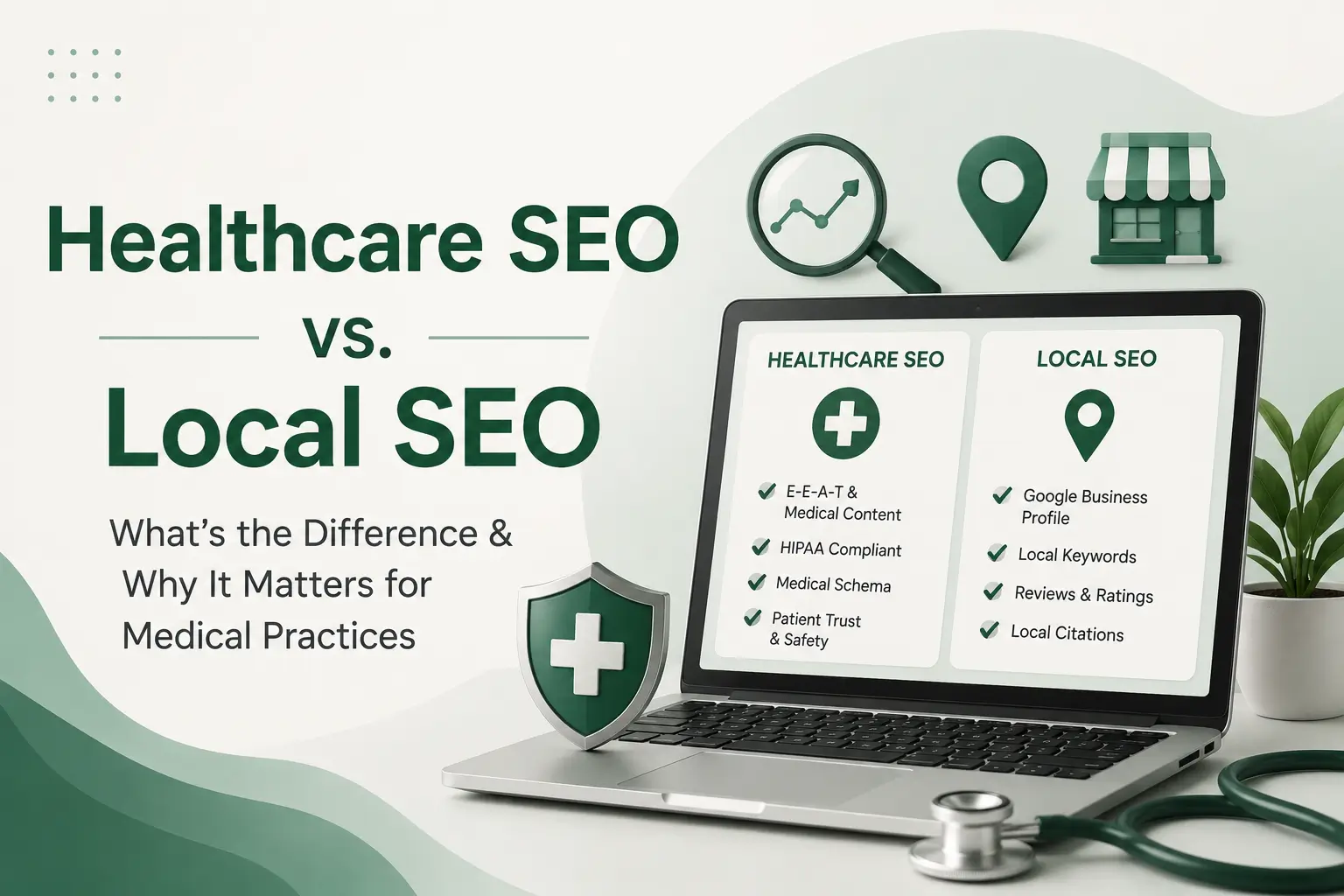
Healthcare SEO is local SEO plus a stricter compliance and trust layer. Both optimize Google Business Profiles, reviews, and local keywords, but healthcare SEO must also satisfy Google’s YMYL (Your Money or Your Life) standards, demonstrate E-E-A-T through credentialed authors, protect patient data under HIPAA, and use medical-specific schema markup. These are requirements a standard local business never has to meet.
Key Takeaways
- Healthcare SEO is a specialized subset of local SEO, not a separate discipline. The local tactics still apply, but they’re layered with medical-specific requirements.
- Google classifies medical content as YMYL (Your Money or Your Life), meaning accuracy and credentialed authorship carry more ranking weight than for a typical local business. See our full breakdown of E-E-A-T optimization.
- HIPAA affects SEO execution directly: tracking pixels, contact forms, and call tracking all need healthcare-specific configuration.
- Schema markup for healthcare (Physician, MedicalOrganization, MedicalWebPage) goes beyond the LocalBusiness schema a standard local SEO campaign would use.
- Patient search behavior differs from consumer search behavior. Symptom-based, urgency-driven, and trust-sensitive language should shape content and CTAs.
Introduction
Every local business wants to show up when someone nearby searches for what they offer. A medical practice is no different. Patients search “pediatrician near me” the same way they’d search for a plumber or a coffee shop. On the surface, local SEO for a clinic looks like local SEO for anyone else: optimize your Google Business Profile, collect reviews, build local citations, and publish location-relevant content.
But healthcare operates under rules that a landscaping company or a retail store never has to think about. Google treats medical content as higher-stakes, patients search with more urgency and more anxiety, and federal privacy law shapes what your website is even allowed to track. Understanding healthcare SEO vs. local SEO means understanding which parts of the local SEO for healthcare playbook carry over unchanged and which parts need to be handled differently or risk hurting your rankings, your compliance standing, or both.
Is Healthcare SEO Different from Local SEO?
Yes. Healthcare SEO includes everything standard local SEO does, such as Google Business Profile optimization, local citations, reviews, and location-based keywords, but adds requirements unique to medical practices: YMYL content standards, demonstrable E-E-A-T from licensed professionals, HIPAA-aware technical setup, and healthcare-specific schema markup. Standard local SEO tactics that ignore these layers can stall rankings or create compliance exposure for a medical practice.
Healthcare SEO vs. Local SEO: Side-by-Side Comparison
| Factor | Standard Local SEO | Healthcare SEO |
| Google Business Profile | Business category, hours, photos | Same, plus medical-specific categories (e.g., “Family Practice Physician” vs. generic “Business”), provider-level profiles for individual clinicians |
| Content authorship | Any writer, keyword-focused | Requires credentialed authorship or medical review (“Medically Reviewed By”) to satisfy E-E-A-T |
| Content standards | Readability and keyword targeting | YMYL scrutiny: accuracy, sourcing, and avoiding unsubstantiated claims (FTC guidelines apply) |
| Tracking & analytics | Standard pixels (Meta, Google Ads) installed as-is | Pixels must be configured to avoid transmitting Protected Health Information (PHI); HIPAA-compliant CRMs for forms |
| Reviews | Encourage reviews broadly, review-gating sometimes used | Encourage reviews, but review-gating and testimonial handling carry platform and compliance risk |
| Schema markup | LocalBusiness, Organization | MedicalOrganization, Physician, MedicalWebPage, FAQ |
| Link building | Local directories, general business links | Local directories plus healthcare-specific sources: medical associations, .gov/.edu health sources, professional directories |
| Keyword intent | Purchase or convenience-driven | Often symptom-based and anxiety-driven (“pain in knee” before “patellar tendonitis”) |
| Call tracking | Dynamic number insertion, standard call recording | Same tools, but recordings and storage must meet compliance standards for patient conversations |
Why Google Treats Healthcare Content Differently: YMYL and E-E-A-T
Google classifies medical websites under YMYL, or Your Money or Your Life, a category reserved for topics where inaccurate information could cause real harm: health, finance, and safety. A wrong answer about a recipe is a bad dinner. A wrong answer about a drug interaction or a symptom can be dangerous. Because of that, Google holds YMYL content to a stricter accuracy and trust bar than it does for most local businesses.
That standard is enforced primarily through E-E-A-T: Experience, Expertise, Authoritativeness, and Trustworthiness. For a healthcare practice, this shows up concretely as the following:
- Author bios that state real credentials: licenses, board certifications, years in practice
- A visible medical review process, often shown as a “Medically Reviewed By” tag
- Citations to authoritative sources like the CDC, NIH, or peer-reviewed research rather than generic blog references
- A practice reputation that extends beyond the website: directory listings, professional affiliations, mentions in credible healthcare sources are part of a broader reputation management strategy
A generalist SEO strategy built around keyword volume and link quantity can actually underperform in healthcare, because Google is specifically looking for the credibility signals above, not just backlink counts.
HIPAA and SEO: Where Healthcare Marketing Gets Technical
Standard local SEO leans on tracking to understand user behavior and retarget visitors. In healthcare, tracking has legal boundaries. The Health Insurance Portability and Accountability Act (HIPAA) restricts how patient information, including behavioral data like which condition-related pages someone viewed, can be shared with third parties.
Practical implications for a healthcare SEO strategy:
- Tracking pixels (Meta, Google Ads) need configuration to avoid passing along Protected Health Information, not a simple copy-paste install
- Contact and appointment-request forms should route into HIPAA-compliant systems, not a default, unencrypted form plugin
- Call tracking, commonly used in local SEO, needs compliant storage if patient calls are recorded
- Review handling: filtering or gating negative reviews before they post publicly can violate platform policies around testimonial authenticity, a risk that’s more scrutinized in healthcare marketing
None of this changes the goal of local SEO. It changes the implementation, and it’s a layer a generalist agency may not know to account for.
Patient Search Behavior vs. Consumer Search Behavior
A person searching for a new pair of running shoes and a person searching for “chest pain when I breathe” are not in the same headspace. Consumer search is often driven by preference or convenience. Patient search is frequently driven by urgency, anxiety, or pain, and that changes both keyword strategy and content tone.
A few concrete differences:
- Vocabulary gap: Patients search for symptoms (“pain in knee”), not diagnoses (“patellar tendonitis”). Content needs to bridge everyday language and clinical terms.
- Trust triggers differ: A consumer looks for discounts. A patient looks for insurance acceptance, board certifications, and years of experience.
- Content must serve two states at once: frantic research (symptom-checking) and ready-to-act urgency (booking). A high-pressure “Buy Now” CTA that works in retail can feel out of place; something like “Schedule a Consultation” fits the context better, the kind of adjustment covered under conversion rate optimization for healthcare sites.
Google Business Profile: Same Tool, Different Setup
Google Business Profile optimization is central to both healthcare and standard local SEO. Accurate NAP (name, address, phone), photos, hours, and reviews all matter either way. Where healthcare differs is in the details:
- Category selection matters more precisely: choosing a specific medical category (e.g., “Pediatric Dentist”) rather than a generic “Business” or “Health” label
- Provider-level profiles: larger practices often need individual profiles for each clinician in addition to the practice-wide listing
- Review responses need to stay within HIPAA boundaries, such as responding to a negative review without confirming someone is a patient
Healthcare Schema Markup
Schema markup helps search engines and AI systems understand and extract content accurately, which matters more as more answers come from AI Overviews and chat-based assistants rather than a list of blue links, a shift we cover in more depth under AI search optimization. Standard local SEO typically uses LocalBusiness schema. Healthcare sites should layer in:
- MedicalOrganization or Physician schema to identify the practice or provider clearly
- MedicalWebPage schema for condition or treatment content, which can include review status and audience
- FAQPage schema for patient questions, improving eligibility for featured snippets and AI-generated answers
Expert Tips
- Treat your author bios as ranking assets, not filler. List real credentials, not just a name and photo.
- Build a lightweight medical review workflow (even a single physician reviewer) before publishing clinical content.
- Audit your tracking setup with whoever manages your CRM or EHR integration. Don’t assume a marketing agency has configured pixels for compliance.
- Write for the symptom search, not just the treatment keyword, to capture patients earlier in their research.
Common Mistakes
- Applying a generic local SEO playbook (review gating, aggressive retargeting, keyword-stuffed content) without adjusting for compliance risk
- Publishing clinical content without any credentialed review process
- Using vague, unsubstantiated claims (“our treatment cures back pain”) instead of accurate, defensible language
- Treating Google Business Profile as a “set and forget” listing rather than an ongoing, category-specific asset
- Skipping schema markup entirely, missing out on featured snippet and AI Overview eligibility
FAQs
Is healthcare SEO the same as local SEO?
No, though they overlap heavily. Healthcare SEO includes standard local SEO tactics, such as Google Business Profile, citations, and reviews, plus additional requirements around YMYL content standards, E-E-A-T, HIPAA-aware tracking, and medical schema markup.
Do I need a medical professional to review my website content?
It’s strongly recommended. Google’s quality standards for YMYL content favor pages reviewed or authored by credentialed professionals, and a visible review process supports both trust and rankings.
Can I use the same Google Ads or Meta tracking pixels as any other business?
Not without configuration. Standard pixel installations can transmit data that counts as Protected Health Information under HIPAA, which creates legal exposure for a healthcare practice.
What schema markup should a medical practice use?
Beyond the standard LocalBusiness schema, healthcare sites typically benefit from MedicalOrganization or Physician schema, MedicalWebPage schema for clinical content, and FAQPage schema for patient questions. See our schema markup guide for specifics.
Does review gating work for medical practices the way it does for other local businesses?
It carries more risk. Filtering which reviews get requested or displayed can conflict with platform policies on testimonial authenticity, and healthcare marketing draws more scrutiny on this than most industries.
Why does Google hold medical websites to a higher standard?
Google classifies health-related content as YMYL (Your Money or Your Life) because inaccurate information can cause real harm, so it weighs accuracy, sourcing, and credentialed expertise more heavily than it does for lower-stakes topics.
Should I target symptom keywords or diagnosis keywords?
Both, but don’t neglect symptom-based searches. Patients often search for how they feel (“pain in knee”) before they know the clinical term (“patellar tendonitis”), and that’s frequently where research begins.
Is national SEO ever relevant for a healthcare practice?
Yes, for telehealth providers, multi-location systems, or practices building broader thought leadership. For a single-location practice serving a community, local SEO remains the priority.
How does HIPAA affect my contact and appointment forms?
Standard form plugins often store submissions in unencrypted databases. Healthcare practices should use forms that route into encrypted, HIPAA-compliant systems, especially if any health-related details are collected.
What’s the biggest mistake practices make when treating healthcare SEO like standard local SEO?
Assuming tactics transfer directly without adjustment, particularly around tracking, testimonial handling, and content authorship, which can create compliance risk even if it doesn’t immediately hurt rankings.
Conclusion
Healthcare SEO isn’t a different strategy from local SEO. It’s local SEO with a compliance and credibility layer that reflects what’s actually at stake when someone searches for medical care. The Google Business Profile work, the citations, the reviews, and the location-based content all still matter. What changes is the standard those efforts need to meet: credentialed authorship, YMYL-level accuracy, HIPAA-aware technical setup, and schema markup built for medical content. Practices that treat their website like any other local business risk stalling in a highly regulated, high-trust category where generic tactics often fall short.
Call to Action
If your practice’s current SEO approach hasn’t accounted for YMYL, HIPAA, or medical schema, it may be leaving both rankings and compliance protection on the table. MedOnTop can help you build a healthcare SEO strategy that meets these standards from the ground up.