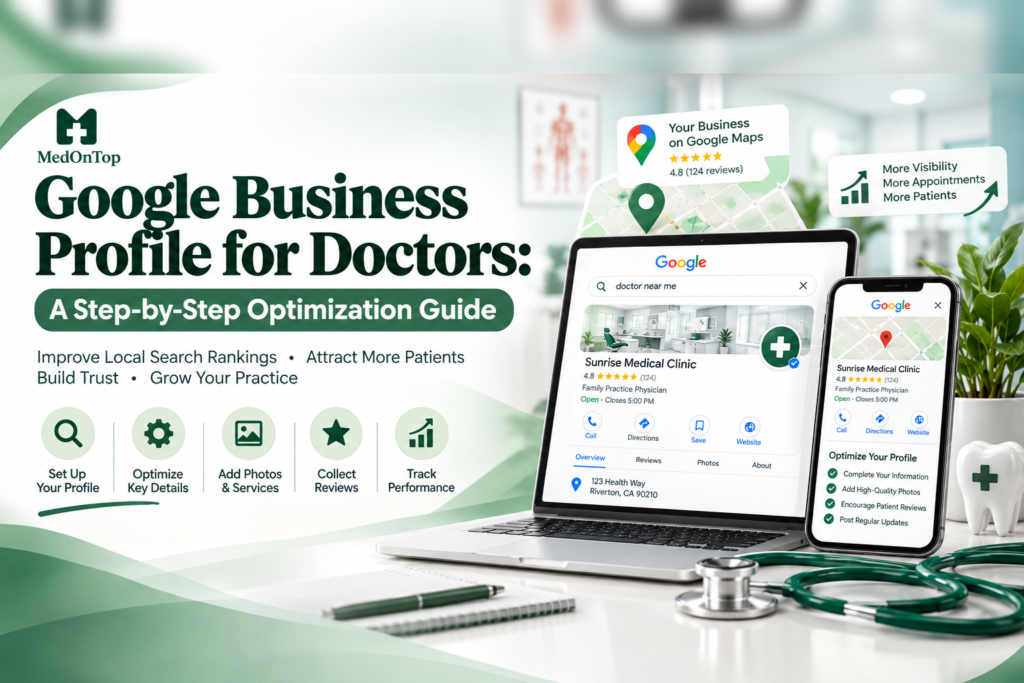

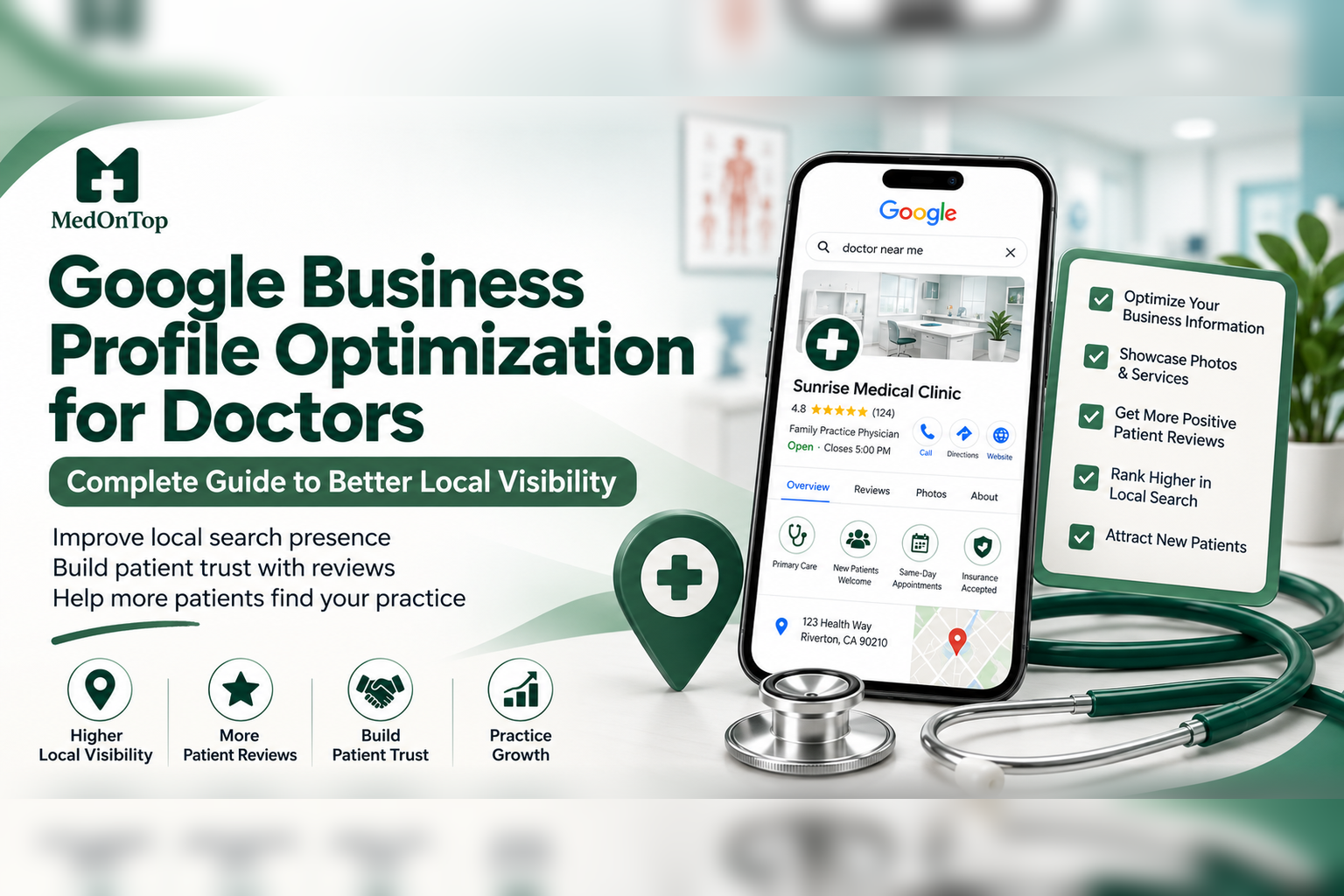
Google Business Profile optimization helps doctors improve how their practices appear in Google Search and Maps when nearby patients look for care. A properly managed profile gives Google accurate information about your specialty, location, services, hours, reputation, and relevance while giving prospective patients the details they need before making contact.
For medical practices, optimization goes far beyond filling out a business name and phone number. Effective Google Business Profile optimization requires accurate categories, complete services, trustworthy reviews, strong local signals, useful photos, consistent information, and ongoing monitoring. This guide explains each of those areas and shows how doctors can build stronger local visibility without sacrificing professionalism or patient privacy.
Why Google Business Profile Matters for Doctors
Healthcare searches frequently carry strong local intent. Someone searching for a dermatologist, pediatrician, cardiologist, dentist, psychiatrist, physical therapist, or urgent care clinic usually wants a provider within a practical distance.
Google often responds to those searches with local results and map listings before traditional organic website results.
That makes your Google Business Profile one of the most visible digital assets attached to your practice.
A prospective patient may use it to check your location, office hours, reviews, photos, phone number, directions, website, services, and other practice information without first visiting your website.
This is why local SEO for doctors cannot depend on website optimization alone. Your website and Google Business Profile should reinforce each other.
A strong profile can help a practice become more relevant for appropriate local searches, while a neglected or inaccurate listing can create confusion even when the practice has an excellent website.
What Is Google Business Profile Optimization?
Google Business Profile optimization is the process of improving the accuracy, completeness, relevance, credibility, and ongoing management of a practice’s Google listing.
For doctors, that means presenting information in a way that accurately represents the real-world practice and helps both Google and potential patients understand:
| Profile Element | What It Communicates |
| Primary category | The main type of medical practice |
| Secondary categories | Additional relevant practice classifications |
| Address and service area | Where the practice operates |
| Hours | When patients can contact or visit |
| Services | Types of care or procedures provided |
| Reviews | Patient sentiment and reputation signals |
| Photos | What the location and practice look like |
| Website link | Where users can learn more |
| Phone number | How patients can contact the office |
Optimization should never involve inventing services, adding misleading keywords to a business name, creating fake locations, or manipulating reviews.
The goal is to make the profile as complete and useful as possible while accurately representing the medical practice.
Start With Accurate Practice Information
The foundation of Google Business Profile optimization for doctors is accuracy.
Your practice name should reflect the genuine name used by the business rather than being expanded with unnecessary keywords purely for rankings.
Your address, phone number, website, and office hours should also remain current.
This matters especially for medical practices because inaccurate information can create more than an SEO inconvenience. A patient could drive to an outdated address, call a disconnected number, or arrive when the clinic is closed.
Doctors with multiple offices should review every location independently. Each valid location needs accurate information that reflects what actually exists at that address.
Consistency should also extend beyond Google. Your practice name, address, and phone information should broadly align with information on your website and legitimate third-party listings.
This consistency forms an important part of local SEO for healthcare because search engines need confidence that they are associating online information with the correct real-world organization.
Choose the Right Primary and Secondary Categories
Categories are among the most influential fields available within a Google Business Profile.
The primary category should describe the core nature of the practice as precisely as possible.
A specialist should generally choose the most accurate available specialty category rather than automatically selecting a broad category simply because it sounds more inclusive.
Secondary categories can then describe other legitimate aspects of the practice.
For example, a medical organization might provide several related services, but categories should still reflect what the business genuinely is rather than every phrase for which it hopes to rank.
Category selection should be reviewed periodically because Google may add, remove, or modify available categories.
For multi-specialty organizations, category planning requires extra care. Different departments and eligible practitioner listings may need to be handled differently depending on how the organization operates.
Accuracy should always come before keyword coverage.
Complete Your Medical Services
Your services section gives Google and patients more context about what the practice provides.
Instead of leaving it empty, add genuine medical services that patients commonly search for and that are actually available at your location.
Descriptions should remain straightforward. Use terminology that patients understand alongside clinically accurate wording where appropriate.
A dermatology clinic, for example, may list services relating to acne care, skin examinations, psoriasis management, or other treatments genuinely offered by the practice.
Avoid turning service descriptions into blocks of repetitive SEO keywords.
Good medical practice local SEO connects search language with useful information. The profile should sound like a medical organization explaining its services, not a page built for a search engine crawler.
Your website should also contain supporting information about major services. That creates a clearer relationship between your business profile, your location, and the medical topics covered on your site.
Write a Clear Business Description
The business description gives potential patients a quick picture of the practice.
Use it to explain your specialty, who you serve, major areas of care, and any relevant distinguishing information such as multiple physicians or particular clinical focuses.
Keep the wording factual and patient-friendly.
You do not need to repeat the city or specialty in every sentence. Keyword-heavy descriptions tend to read poorly and rarely make a practice feel more trustworthy.
A useful description answers a simple question: “What should someone know about this medical practice before deciding whether to learn more?”
That mindset produces better content than trying to squeeze every possible local keyword into a limited space.
Build a Strong Review Strategy Without Creating Privacy Problems
Reviews are highly visible in healthcare searches. They can affect how prospective patients perceive a medical practice before making contact.
Doctors should therefore have a consistent process for inviting genuine feedback.
However, healthcare review management requires more care than review management for many ordinary businesses.
Public responses should never casually reveal or confirm private medical information.
Even when a reviewer openly discusses a diagnosis, appointment, procedure, or treatment, the practice should be cautious about confirming that person’s status or discussing care publicly.
A safer response usually remains general, professional, and focused on directing sensitive concerns to an appropriate private communication channel.
An effective review process should:
- Ask for genuine feedback without telling patients what rating to leave.
- Avoid incentives that could compromise authenticity or violate applicable rules.
- Respond professionally without disclosing protected information.
- Monitor reviews for legitimate concerns, spam, and inappropriate content.
Good review management supports reputation, but patient confidentiality must remain the priority.
Add High-Quality, Authentic Photos
Photos make a medical listing more tangible.
Patients may want to know what the building looks like before arriving, where the entrance is, what the reception area looks like, or who works at the practice.
Useful images can include the exterior, reception area, waiting room, appropriate treatment spaces, physicians, and staff where permission has been obtained.
Authentic photos are generally more helpful than generic stock imagery.
They also reduce uncertainty. A clear exterior photograph, for example, can make it easier for a first-time patient to identify the correct building.
Update images when the office changes rather than allowing years-old photographs to represent the current practice.
Any healthcare photography should also respect privacy. Never publish an image containing identifiable patient information without the appropriate authorization.
Keep Hours and Contact Information Current
Incorrect hours are one of the quickest ways to frustrate prospective patients.
Update standard office hours whenever they change and review special hours around holidays, temporary closures, training days, or unusual schedules.
Your phone number should connect users to the appropriate practice contact point.
The website link should lead to the correct website and, where appropriate, booking functionality should lead users to a legitimate scheduling destination.
Small details matter because Google Business Profile optimization is partly about removing friction.
A person who finds your practice should not have to hunt through several websites to determine whether the office is open or how to request an appointment.
Strengthen the Website Behind Your Profile
A Google Business Profile does not operate in isolation.
Your medical website helps Google understand the practice, its specialty, its providers, services, and geographic relevance.
For stronger local SEO for medical practices, your site should clearly identify each genuine practice location and provide useful information about the services available there.
Location pages should not be thin copies with only a city name changed.
Each important location should contain genuinely useful information, such as office details, local contact information, relevant providers, services, directions, and other location-specific context where appropriate.
Professional healthcare SEO services often treat the business profile and website as parts of the same local search ecosystem rather than separate marketing projects.
That approach helps create a more consistent picture of the practice across search results.
Build Local Authority Beyond Google Business Profile
Google also encounters information about medical practices elsewhere on the web.
Accurate listings, professional profiles, relevant directories, local organizations, healthcare platforms, and legitimate mentions can all help establish a clearer digital footprint.
Links can also contribute to a website’s authority, but quality matters considerably more than collecting large numbers of irrelevant links.
For medical organizations, local SEO link building should focus on credible and contextually relevant opportunities rather than automated directories or questionable link schemes.
The best signals usually come from genuine relationships, useful resources, professional associations, community involvement, reputable publications, and other legitimate sources.
Use Google Posts Thoughtfully
Google Posts can be used to communicate timely information associated with a practice.
Possible topics include changes to office availability, new physicians, expanded services, educational resources, seasonal information, or relevant practice announcements.
Posts should have a genuine purpose.
Publishing repetitive keyword-heavy posts simply to create activity does not make the profile more useful.
Medical practices should also be careful with promotional language. Claims about treatments, outcomes, or services should be accurate and consistent with applicable healthcare advertising requirements.
Think of posts as short updates for prospective patients rather than miniature SEO landing pages.
Monitor Questions, Profile Changes, and User-Generated Information
A Google Business Profile is not necessarily static.
Information may change, users may suggest edits, new questions may appear, and features available within the profile can evolve.
That makes ongoing monitoring essential.
Someone at the practice or its marketing partner should periodically review major profile fields, especially:
- Name, address, phone number, website, and hours
- Categories and services
- New reviews and public questions
- Photos and other visible information
This is especially important for practices that have recently moved, rebranded, added locations, merged with another group, or changed providers.
A profile that was correct six months ago may not be completely accurate today.
Understand Local Ranking Beyond Keywords
Doctors sometimes approach Google My Business for doctors with a simple question: “Which keywords should I add?”
That is too narrow.
Local search visibility depends on a broader combination of factors. Google generally describes local results around relevance, distance, and prominence.
You cannot optimize away physical distance. A medical practice located on one side of a metropolitan area will not automatically become the most relevant nearby option for every person across the entire region.
You can, however, strengthen relevance and prominence.
Accurate categories, detailed services, a well-structured website, positive authentic reviews, consistent practice information, local authority, and useful content all help Google better understand the organization.
This is why sustainable local SEO is different from stuffing city names into a profile.
Google Business Profile and AI Search Visibility
Search behavior is expanding beyond traditional blue links. Patients can encounter healthcare information through AI-generated search experiences, conversational interfaces, maps, local results, and other discovery surfaces.
That does not make traditional local optimization obsolete.
It makes clear, structured, trustworthy information even more valuable.
A strong website, consistent business information, recognizable medical entities, transparent provider details, useful content, and credible references can help search systems understand who a practice is and what it does.
Practices thinking beyond traditional rankings may benefit from aligning local search work with AI search optimization so their online information remains understandable across evolving discovery experiences.
The priority remains the same: accurate information first, optimization second.
Common Google Business Profile Mistakes Doctors Should Avoid
Some profile problems are surprisingly simple but can weaken local visibility or create a poor patient experience.
Common mistakes include:
- Adding keywords to the practice name that are not part of the real business name.
- Selecting broad or inaccurate categories instead of the most appropriate medical specialty.
- Leaving services, photos, or important profile fields incomplete.
- Allowing outdated office hours, addresses, phone numbers, or website links to remain live.
- Responding to reviews with language that may expose or confirm sensitive patient information.
- Creating duplicate, fake, or otherwise ineligible listings simply to cover more geographic areas.
Optimization should make a real practice easier to understand and find. It should never manufacture a business presence that does not exist.
How to Measure Google Business Profile Performance
Optimization should be evaluated over time rather than judged solely by where the practice appears in one search from one device.
Local results can vary based on a searcher’s location and other contextual factors.
Monitor meaningful business outcomes as well as visibility.
Useful indicators include profile interactions, calls, website visits, direction requests, booking activity where measurable, review growth, search visibility across important areas, and the quality of enquiries reaching the practice.
Do not focus exclusively on impressions.
A smaller increase in highly relevant local searches that leads to qualified appointment enquiries can matter more than a large increase in views from people who are unlikely to use the practice.
How Often Should Doctors Update Their Google Business Profile?
There is no useful “set it once and forget it” schedule.
Basic practice information should be corrected whenever something changes.
Reviews and questions should be monitored regularly. Photos, services, and descriptions can be reviewed periodically, while categories should be checked as the practice evolves or Google changes available options.
A useful routine is to treat the listing as an active part of practice operations.
| Task | Recommended Approach |
| Hours and contact details | Update whenever they change |
| Reviews | Monitor regularly |
| Questions | Check regularly |
| Photos | Refresh as the practice changes |
| Services | Review when clinical offerings change |
| Categories | Reassess periodically |
| Performance | Review consistently over time |
Regular maintenance prevents small inaccuracies from quietly becoming persistent patient-experience problems.
Frequently Asked Questions
What is Google Business Profile optimization for doctors?
It is the process of improving and maintaining a doctor’s Google listing so it accurately communicates the practice’s specialty, location, services, hours, contact information, reputation, and other relevant details to Google and prospective patients.
Does a Google Business Profile help doctors rank locally?
A well-maintained profile can support local visibility because Google uses business information and other local signals to understand the relevance and prominence of a practice. Rankings also depend on factors outside the profile, including location and broader web authority.
What category should a doctor choose on Google Business Profile?
Choose the most specific primary category that accurately describes the main practice. Relevant secondary categories can be added where they genuinely apply. Avoid selecting categories simply because they contain desirable keywords.
How should doctors respond to negative Google reviews?
Responses should remain professional and avoid confirming patient status or discussing treatment, diagnoses, appointments, billing details, or other potentially sensitive information. Sensitive concerns are generally better moved to an appropriate private communication channel.
Can doctors add multiple locations to Google Business Profile?
Eligible practices with genuine staffed locations may manage separate profiles where appropriate. Each location should accurately represent the real business operating there. Fake virtual locations should not be created simply to rank in additional cities.
How long does Google Business Profile optimization take to work?
There is no universal timeframe. Results depend on factors such as competition, proximity, existing profile quality, reviews, website strength, local authority, and the extent of changes needed. Progress should be measured over time rather than promised by a fixed date.
Is Google Business Profile enough for medical practice local SEO?
No. The profile is important, but strong medical practice local SEO also depends on the practice website, accurate business information across the web, relevant content, reputation, authority, technical SEO, and other local search signals.
Build a Google Business Profile Patients Can Trust
Effective Google Business Profile optimization is not about finding shortcuts to the Map Pack. It is about giving Google and prospective patients a clear, accurate, trustworthy picture of your medical practice.
Start with precise business information. Choose appropriate categories. Explain your services clearly. Keep hours current. Publish authentic photos. Build genuine reviews carefully. Strengthen the website supporting the profile, and continue monitoring the listing as the practice changes.
Those fundamentals create a stronger foundation for medical SEO services, local search visibility, and patient discovery without relying on questionable tactics or exaggerated promises.
If your practice has an incomplete profile, declining local visibility, duplicate listings, inconsistent information, or uncertainty about how its local presence is structured, a professional review can identify the areas worth addressing first. A measured approach to optimization can help make your practice easier to find while keeping accuracy, privacy, and patient trust at the center of the strategy.