
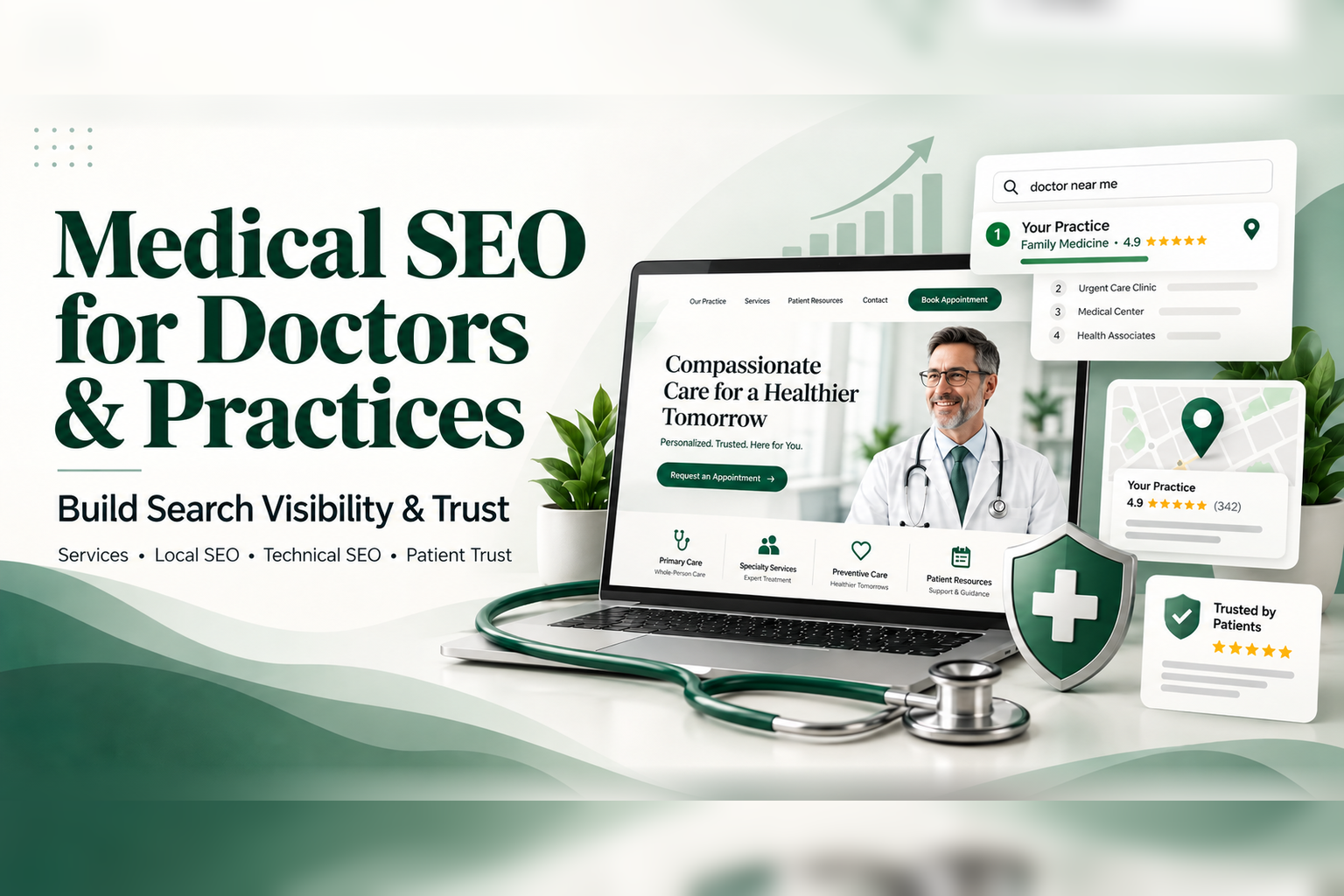
Medical SEO is the process of improving a healthcare website and its wider search presence so patients can find accurate, relevant information when they look for doctors, treatments, specialties, or nearby care. For medical practices, it connects patient search intent with useful pages, trustworthy provider information, and clear next steps. A strong strategy can combine website optimization with local SEO for healthcare to help the right services appear where patients are actively searching.
Unlike generic SEO, medical SEO operates in a high-trust environment. Patients may be making decisions about symptoms, providers, procedures, or ongoing care, so content quality, authorship, accuracy, privacy, and a clear distinction between education and medical advice matter. This guide explains how SEO for medical practices works, why it matters, how to implement it, and how to measure whether visibility is translating into meaningful patient actions.
What Is Medical SEO?
Medical SEO is a specialized approach to search engine optimization for doctors, clinics, healthcare groups, and medical websites. Its purpose is to help search engines understand a healthcare organization’s services, expertise, location, and content so relevant pages can appear for appropriate patient searches.
The work can span medical website SEO, local optimization, technical improvements, content development, provider authority signals, and conversion pathways such as calls or appointment requests. The strategy should reflect the actual services, locations, providers, and audiences involved.
The central idea is simple: each important patient question or service search should lead to the most useful page, not a generic destination that forces visitors to hunt for answers.
A Simple Medical SEO Example
A patient searching for a dermatologist nearby may want to compare providers, confirm services, review credentials, check location details, and find a way to book.
Patient search → Relevant service or location page → Trust and provider information → Clear next step
Good SEO for healthcare aligns that path while giving search engines clearer context about the practice and its pages.
How Does Medical SEO Work?
Medical SEO works by matching patient intent with useful content and supporting that content with technical, local, and trust signals. The goal is not to make every page rank for every healthcare term. It is to create a logical system in which the right page can be discovered for the right type of search.
Search Intent and Topic Relevance
Patients search differently depending on where they are in the decision process. Some searches are informational. Others are service-focused, local, or highly specific to a specialty.
A medical SEO strategy maps those needs to appropriate pages. Educational questions may belong in medically reviewed resources, while appointment-oriented searches are usually better served by specialty, treatment, provider, or location pages.
| Search intent | Useful page type | Main patient need |
| Learn about a condition or procedure | Educational article or guide | Clear, accurate information |
| Find a service | Specialty or treatment page | Understand available care |
| Find a nearby provider | Location or provider page | Proximity, credentials, access |
| Take action | Contact or booking page | Simple next step |
Content Quality and Medical Trust
Healthcare content needs more than keyword coverage. It should clearly identify what is being explained, who the information is for, and where professional evaluation may be necessary. Pages should avoid overstating outcomes or turning general information into personalized diagnosis.
Provider credentials, authorship, medical review where appropriate, update dates, and transparent organizational information can help users judge reliability. E-E-A-T signals work best when they reflect real expertise rather than decorative labels.
Local Search Signals
Many medical searches have local intent, even when the user does not type a city name. Accurate practice information across location pages and business profiles helps search systems connect services with geographic relevance.
For multi-location practices, each location should provide useful, distinct information rather than near-identical pages with only the city changed.
Technical SEO and Site Accessibility
Technical SEO helps search engines crawl, understand, and index medical websites efficiently. Important areas include mobile usability, page speed, internal linking, crawlable navigation, secure pages, indexation controls, structured data, and clear site architecture.
Technical health also affects patients. A slow appointment page or broken form can waste the visibility earned through content and local optimization.
Why Do Doctors and Healthcare Practices Need Medical SEO?
Medical SEO helps practices reach patients at the moment they are actively seeking information or care. The value comes from connecting search demand to useful, credible pages rather than simply increasing raw traffic.
A practice may offer the right service but remain difficult to discover because its website uses vague page titles, has thin location pages, lacks provider context, or does not answer common questions before booking. SEO addresses those gaps by improving relevance and discoverability.
It can also strengthen the patient journey. Someone who lands on a focused service page can understand what the service covers, who provides it, where it is available, and what to do next. That is more useful than sending every search visitor to the homepage.
Medical SEO can reduce dependence on paid visibility over time because useful organic pages may continue attracting qualified searchers while they remain accurate and competitive. Rankings and search behavior still change, so ongoing review matters.
How to Build a Medical SEO Strategy
A useful strategy begins with the current state of the practice, not with a list of keywords. The website, specialties, locations, providers, audience, and patient journey should shape the work.
Step 1: Assess the Current Search Presence
Audit which pages are indexed, which services have dedicated pages, whether location information is accurate, how the site performs on mobile, and whether important content is easy to reach.
Look for duplication, thin service pages, outdated medical information, broken internal links, confusing navigation, slow templates, and pages competing for the same topic.
Step 2: Map Patient Intent to Services and Topics
Group search needs around real services, specialties, locations, providers, and patient questions. The aim is to understand which searches indicate learning, comparison, local discovery, or readiness to contact a practice.
Keyword research supports this step, but it should not dictate awkward writing. Terms such as medical SEO, SEO for healthcare, medical website SEO, and advanced SEO for doctors should be covered naturally within useful content.
Step 3: Build the Right Site and Content Structure
Create clear relationships between service pages, provider pages, location pages, educational content, and contact pathways. Each important page should have a distinct purpose.
Internal links should help users and search engines move between related topics. An educational article can lead to a relevant service page, while a location page can connect to providers and specialties available there.
Step 4: Optimize, Measure, and Improve
Refine page titles, headings, on-page copy, internal links, local signals, structured data, and technical performance. Then monitor how search visibility and user behavior change.
SEO is iterative. Content may need updating as services change, patient questions evolve, or search results become more competitive.
Medical SEO Best Practices
Effective medical SEO combines discoverability with credibility. Optimizing only for rankings can create pages that attract clicks but fail patients once they arrive.
Write for Patient Questions, Not Keyword Density
Use the language patients use, but explain the topic in clinically responsible terms. Important keywords should appear naturally in titles, headings, copy, and supporting elements. Repetition for its own sake makes pages harder to read.
Make Expertise Easy to Verify
Show who created or reviewed important healthcare content, especially when a page discusses conditions, procedures, risks, or treatment considerations. Provider biographies should present real credentials and specialties without inflating expertise.
Keep important pages current. A visible update process is more meaningful than generic trust statements with no supporting information.
Strengthen Local Relevance
Keep names, addresses, phone information, hours, and service details consistent. Build location pages with real distinctions, including providers, specialties, contact options, and patient access information relevant to that location.
A broader healthcare SEO consulting approach can help connect local search, content, technical SEO, and site architecture instead of treating them as unrelated projects.
Protect User Experience and Privacy
Make pages easy to navigate on mobile, keep forms focused, and avoid design that blocks important medical information. Analytics, forms, chat tools, call tracking, or advertising technologies that may interact with sensitive information should be reviewed against applicable privacy and compliance requirements.
SEO should never require exposing patient information.
How to Measure Medical SEO Performance
Medical SEO performance should be measured across the journey from search visibility to qualified action. No single metric can show whether the strategy is working.
Useful measurements include:
- Search visibility for relevant service, provider, topic, and local queries
- Organic visits to high-value pages rather than traffic alone
- Calls, appointment requests, directions, and other qualified actions
- Local profile visibility and engagement where applicable
- Indexation, crawl health, page speed, and mobile performance
- Conversion paths from educational content to service or contact pages
The useful progression is Visibility → Visit → Relevance → Action.
A rise in impressions can show broader discovery, but it matters more when the right pages are appearing for the right searches. Traffic growth is valuable only if visitors find relevant information and move toward appropriate next steps.
Practices should also segment performance by location, specialty, page type, and intent. A provider profile and an educational article serve different purposes, so they should not be judged by identical metrics.
How Med On Top Supports Medical SEO
Med On Top provides healthcare-focused SEO services, including local SEO and consulting. A coordinated approach can help practices identify where search demand, site structure, content quality, local signals, and technical performance are disconnected.
Rather than treating SEO as isolated page edits, the work can begin with the practice’s services, locations, and patient journey. Priorities can then be organized around the pages and technical improvements that need the most attention.
Practices that want to discuss their current search presence can book a call with Med On Top or use the Med On Top contact page for a direct inquiry. The appropriate scope depends on the existing website, competitive environment, locations, and goals.
Medical SEO FAQs
What is medical SEO?
Medical SEO is search engine optimization adapted to doctors, clinics, healthcare practices, and medical websites. It combines content relevance, local search, technical SEO, provider authority signals, and user experience so patients can discover useful healthcare information and services through search.
How is medical SEO different from general SEO?
The fundamentals are similar, but healthcare requires greater attention to accuracy, medical responsibility, provider credentials, content review, privacy, and trust. Many searches also have strong local or service intent.
How long does medical SEO take to work?
There is no fixed timeline. Results depend on the current website, competition, technical condition, content quality, local market, and scope of changes. Some improvements can be measured quickly, while stronger organic visibility usually requires ongoing work.
Does local SEO matter for doctors?
Yes. Many patients search for care based on proximity, specialty, availability, and provider information. Accurate local details, strong location pages, and a maintained local presence help search engines and patients connect services with the correct location.
What should a medical website optimize first?
Start with technical accessibility, core service pages, provider and location information, and the highest-value patient journeys. If those foundations are weak, publishing more articles may add volume without solving the main discoverability problems.
Can medical SEO guarantee more patients?
No responsible SEO strategy can guarantee rankings, traffic, or patient volume. Search results change, competition varies, and patient decisions depend on many factors. SEO can improve discoverability, relevance, and the path from search to a qualified action, but outcomes should be measured rather than promised.
Build a Search Strategy Patients Can Trust
Medical SEO works best when search visibility and patient trust are treated as the same project. Clear service pages, accurate medical content, strong local signals, accessible technology, and transparent provider information help patients find what they need without forcing the website to chase every possible keyword.
For doctors and healthcare practices, the practical goal is not simply to rank higher. It is to become easier to discover, understand, and evaluate when a patient is searching for relevant care. A well-structured strategy keeps those needs at the center while giving search engines the context they need to interpret the site correctly.
If your website has strong services but weak search visibility, the next step is to identify where the gap actually sits: technical health, local presence, page structure, content quality, or authority signals. Med On Top can help assess those areas and build a focused plan around the practice’s priorities.