

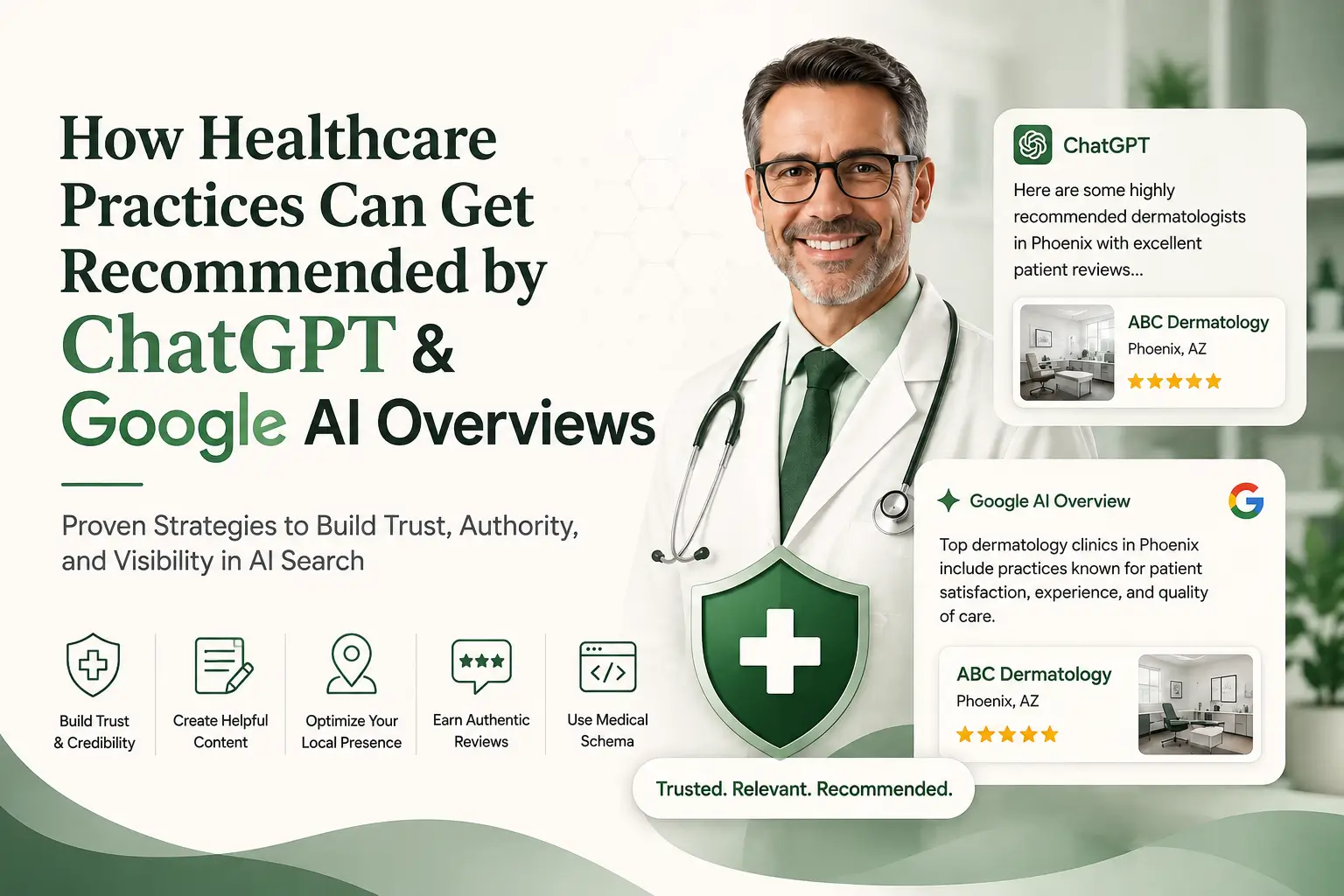
Healthcare practices earn recommendations from ChatGPT and Google AI Overviews by building trust, demonstrating medical expertise, publishing helpful patient-focused content, maintaining accurate business information, earning authentic reviews, implementing structured data, and establishing authority across the web. AI systems recommend practices they recognize as credible, relevant, and consistently trustworthy.
Key Takeaways
- AI search prioritizes trustworthy healthcare practices, not simply the highest-ranking websites.
- Strong E-E-A-T signals help AI systems evaluate medical credibility.
- Helpful, question-focused content increases the likelihood of AI citations.
- Google Business Profile optimization remains essential for local healthcare visibility.
- Consistent practice information across the web strengthens entity recognition.
- Medical schema helps AI understand your services, providers, and locations.
- Patient reviews influence both traditional search and AI-generated recommendations.
- Building topical authority takes consistent publishing and ongoing optimization.
Introduction
The way patients search for healthcare providers is changing rapidly.
Instead of typing short keywords like “dentist near me” or “cardiologist in Dallas,” many people now ask conversational questions such as:
- Which dermatologist has the best reviews in Phoenix?
- Who is the best pediatric dentist for anxious children?
- What orthopedic clinic accepts same-day appointments?
Rather than displaying only a list of blue links, modern AI-powered search experiences, including Google AI Overviews, ChatGPT, Gemini, Perplexity, and Microsoft Copilot, generate direct answers that often recommend specific healthcare providers.
This shift represents one of the biggest changes in digital healthcare marketing in years.
For medical practices, appearing in these AI-generated recommendations can increase visibility, build patient trust, and drive more qualified appointment requests. However, achieving this visibility requires more than traditional SEO tactics.
Today’s AI systems evaluate whether your practice demonstrates expertise, authority, trustworthiness, and relevance before using your content to answer patient questions.
That means healthcare organizations must think beyond keyword rankings and focus on becoming the most reliable source of information within their specialty and local market.
This guide explains exactly how healthcare practices can improve their chances of being recommended by ChatGPT and Google AI Overviews while building long-term authority that benefits both traditional search engines and emerging AI-powered search experiences.
What Does It Mean to Be Recommended by ChatGPT and Google AI Overviews?
Being recommended by AI means your practice has earned enough credibility, authority, and topical relevance for AI systems to confidently reference your business when answering healthcare-related questions.
Unlike traditional search engines that rank web pages, generative AI platforms synthesize information from multiple trusted sources to create a single response. Their goal is to provide users with accurate, helpful, and reliable answers, not simply list websites.
For healthcare providers, this changes the optimization strategy significantly.
Instead of asking:
“How do I rank #1 on Google?”
The more important question becomes:
“How do I become one of the most trustworthy healthcare sources AI can confidently recommend?”
Traditional Search vs AI Search
| Traditional Google Search | AI-Powered Search |
| Ranks webpages | Generates complete answers |
| Focuses heavily on keywords | Focuses on entities, trust, and context |
| Multiple organic listings | Often recommends only a few providers |
| Users compare websites | AI summarizes the research |
| Clicks are the primary goal | Becoming a trusted citation is equally important |
For healthcare practices, this distinction matters because patients increasingly expect immediate answers instead of researching dozens of websites.
If AI consistently recognizes your clinic as an authoritative source, your practice is more likely to be included in these recommendations.
Why This Matters for Healthcare Practices
Healthcare belongs to Google’s Your Money or Your Life (YMYL) category, meaning inaccurate or misleading information can directly affect people’s health and well-being.
Because of this, AI systems apply stricter quality standards when evaluating medical content.
Practices that demonstrate strong clinical expertise, publish accurate educational content, maintain complete provider profiles, earn authentic patient reviews, and present consistent information across trusted platforms are better positioned to earn AI trust.
Simply publishing more content is no longer enough.
The content must answer real patient questions, reflect genuine medical expertise, and provide clear, verifiable information that AI systems can confidently use when generating responses.
In the next section, we’ll explore how Google AI Overviews and ChatGPT actually decide which healthcare practices deserve to be recommended and the trust signals that influence those decisions.
How ChatGPT and Google AI Overviews Choose Healthcare Practices
ChatGPT and Google AI Overviews recommend healthcare practices they consider the most reliable, authoritative, and relevant for a user’s question. Rather than relying on a single ranking factor, they evaluate multiple trust signals across your website and the wider web to determine whether your practice deserves to be cited.
Think of AI as a researcher instead of a search engine.
Instead of simply finding pages containing specific keywords, AI systems gather information from multiple trusted sources, compare them, identify areas of agreement, and generate one comprehensive answer.
For healthcare practices, this means your online presence must consistently demonstrate expertise, accuracy, and trustworthiness wherever your practice appears.
The Six Core Signals AI Uses to Evaluate Healthcare Practices
1. Medical Expertise
Healthcare is one of the most sensitive categories online.
Because medical advice can directly impact patient health, AI systems place greater emphasis on expertise than they do for most other industries.
Your website should clearly demonstrate:
- Physician credentials
- Board certifications
- Medical specialties
- Years of clinical experience
- Professional memberships
- Hospital affiliations
- Continuing education
- Awards and recognitions
Dedicated provider profile pages help establish these credibility signals for both patients and AI systems.
2. Content Quality
AI systems don’t reward content simply because it’s long.
Instead, they prioritize pages that answer patient questions clearly and comprehensively.
High-quality healthcare content should:
- Answer the question immediately.
- Explain medical concepts in plain English.
- Address common follow-up questions.
- Reference accepted medical guidance where appropriate.
- Include practical next steps for patients.
For example, instead of publishing a generic service page titled “Knee Pain Treatment,” create a resource that answers questions such as:
- What causes knee pain?
- When should you see a specialist?
- What treatments are available?
- How is knee pain diagnosed?
- Can knee pain be treated without surgery?
This approach aligns with how patients ask AI tools questions.
3. Online Reputation
Patient reviews have become one of the strongest indicators of real-world trust.
AI systems can evaluate patterns such as:
- Review quality
- Review recency
- Review consistency
- Detailed patient experiences
- Overall reputation
Encourage satisfied patients to leave honest reviews after appointments and respond professionally to all feedback.
Authenticity matters far more than volume.
4. Consistent Business Information
AI compares information across many trusted sources before recommending a healthcare provider.
Important details should remain consistent everywhere, including:
- Practice name
- Address
- Phone number
- Website
- Office hours
- Medical specialities
- Accepted insurance
- Service locations
Inconsistencies reduce confidence and make it harder for AI systems to verify your practice.
5. Website Authority
Authority is built over time through consistent expertise.
Healthcare websites strengthen authority by publishing:
- Educational articles
- Treatment guides
- Frequently asked questions
- Patient resources
- Case studies (when appropriate)
- Preventive care information
- Seasonal healthcare advice
Every helpful article expands your topical authority within your specialty.
6. Technical Accessibility
Even excellent content can be overlooked if AI cannot properly understand your website.
A technically sound healthcare website should include:
- Fast-loading pages
- Mobile-friendly design
- Secure HTTPS connections
- Logical navigation
- Internal linking
- XML sitemap
- Structured data
- Clear page hierarchy
Technical SEO makes your expertise easier for AI systems to interpret.
The Core Ranking Signals That Influence AI Recommendations
Unlike traditional SEO, AI recommendations depend on a combination of authority signals rather than keyword rankings alone.
The following factors work together to increase your likelihood of being recommended.
| Signal | Why It Matters |
| Medical expertise | Demonstrates clinical credibility. |
| Helpful content | Answers patient questions completely. |
| Patient reviews | Builds trust through real experiences. |
| Google Business Profile | Confirms local practice information. |
| Structured data | Helps AI understand your website. |
| Internal linking | Demonstrates topical depth. |
| Consistent citations | Verifies business identity. |
| Provider biographies | Strengthens E-E-A-T signals. |
| Original images | Increase authenticity. |
| Content freshness | Shows your information remains current. |
No single factor guarantees AI visibility.
Instead, practices that consistently perform well across multiple trust signals become stronger candidates for AI-generated recommendations.
Build E-E-A-T: The Foundation of Healthcare AI Visibility
Short Answer
Experience, Expertise, Authoritativeness, and Trustworthiness (E-E-A-T) form the foundation of AI visibility for healthcare websites.
Because healthcare content falls into Google’s Your Money or Your Life (YMYL) category, AI systems apply higher standards before recommending medical practices.
Experience
Show evidence that your practice has real-world clinical experience.
Examples include:
- Years in practice
- Patient success stories
- Before-and-after galleries (where appropriate)
- Educational events
- Community outreach
- Clinical achievements
Experience demonstrates that your advice comes from real patient care rather than theoretical knowledge.
Expertise
Every provider page should clearly communicate professional qualifications.
Include:
- Medical degrees
- Certifications
- Specialty training
- Clinical interests
- Professional organizations
- Published research (if applicable)
This helps establish subject matter expertise.
Authoritativeness
Authority grows when trusted organizations recognize your practice.
Examples include:
- Professional associations
- Hospital affiliations
- Local healthcare partnerships
- Industry awards
- Speaking engagements
- Media mentions
- Educational collaborations
The more trusted sources that reference your practice, the stronger your authority becomes.
Trustworthiness
Trust extends beyond clinical expertise.
Patients and AI systems look for signals such as:
- Secure website
- Transparent contact information
- Privacy policies
- Clear appointment process
- Genuine patient reviews
- Accurate medical information
- Updated provider profiles
These elements collectively demonstrate that your practice is reliable and patient-focused.
Create Patient-Focused Content AI Wants to Cite
One of the biggest mistakes healthcare websites make is writing primarily for search engines instead of patients.
AI systems favor content that mirrors real conversations.
Instead of targeting only keywords like
- Orthopedic surgeon Chicago
- Dentist Austin
- Cardiologist Miami
Develop content that answers complete questions patients naturally ask, including the following:
- How do I know if I need a knee replacement?
- What happens during a root canal?
- How much does LASIK surgery cost?
- Can urgent care treat a broken finger?
- When should I see a dermatologist instead of my primary care doctor?
Each article should begin with a concise answer before expanding into detailed explanations, practical advice, and next steps.
This structure makes content easier for patients to understand while increasing the likelihood that AI systems will extract and cite your answers in future responses.
Optimize Your Google Business Profile for AI Recommendations
Short Answer
A complete and actively managed Google Business Profile (GBP) is one of the strongest local trust signals for Google AI Overviews and other AI-powered search experiences. It helps AI verify your practice’s legitimacy, specialties, location, and reputation.
Your Google Business Profile is no longer just a local SEO asset; it’s part of your digital identity.
When someone asks:
- “Who is the best pediatrician near me?”
- “Recommend a cosmetic dentist in Houston.”
- “Find an urgent care clinic open today.”
Google’s AI may rely on your GBP alongside your website and other trusted sources to generate recommendations.
Best Practices for Healthcare Practices
Ensure your profile includes:
- Accurate practice name
- Primary and secondary healthcare categories
- Complete address and phone number
- Website URL
- Business hours
- Appointment booking link
- Healthcare services
- Insurance information (where appropriate)
- High-quality photos
- Updated provider information
Regularly publishing updates and responding to patient reviews also demonstrates that your practice is active and engaged.
Earn High-Quality Patient Reviews That Build AI Trust
Short Answer
Authentic, recent, and detailed patient reviews strengthen your online reputation and provide independent trust signals that both search engines and AI systems can evaluate.
Reviews do far more than improve star ratings.
They help answer questions AI systems may consider, such as:
- Do patients trust this practice?
- Does this clinic consistently provide quality care?
- Is this provider experienced in a specific treatment?
Encourage Reviews Ethically
A sustainable review strategy includes:
- Asking satisfied patients after appointments
- Sending follow-up review requests
- Making the review process simple
- Responding professionally to every review
- Never purchasing or fabricating reviews
Quality always outweighs quantity.
A thoughtful review describing compassionate care, clear communication, and successful treatment carries more value than dozens of generic five-star ratings.
Use Healthcare Schema Markup to Help AI Understand Your Practice
Short Answer
Structured data helps search engines and AI systems interpret your website more accurately by providing machine-readable information about your practice, providers, services, and locations.
Think of schema markup as translating your website into a language AI systems understand more efficiently.
Recommended Schema Types
Healthcare practices should consider implementing the following:
| Schema Type | Purpose |
| MedicalOrganization | Describes your healthcare organization |
| Physician | Identifies individual providers |
| MedicalClinic | Defines your clinic type |
| Dentist | For dental practices |
| Organization | Establishes business identity |
| LocalBusiness | Supports local visibility |
| Service | Explains healthcare services |
| FAQPage | Marks up patient FAQs |
| BreadcrumbList | Improves site hierarchy |
| Review | Highlights verified patient feedback |
While schema alone won’t guarantee AI recommendations, it makes your information easier to interpret and connect across different systems.
Build Topical Authority Instead of Chasing Keywords
Many healthcare websites create isolated blog posts targeting individual keywords.
AI systems increasingly reward comprehensive expertise.
Rather than publishing disconnected articles, organize content into topic clusters.
Example: Orthopedic Practice
Pillar Page
Complete Guide to Knee Pain Treatment
Supporting articles:
- Common Causes of Knee Pain
- ACL Injuries Explained
- Meniscus Tear Symptoms
- Knee Replacement Recovery
- Physical Therapy After Surgery
- Arthritis Treatment Options
- When to See an Orthopedic Surgeon
Together, these resources demonstrate deep expertise within a single medical topic.
The more comprehensive your coverage becomes, the more likely AI systems are to recognize your practice as an authoritative source.
Entity SEO: Help AI Recognize Your Practice as a Trusted Healthcare Brand
Short Answer
Entity SEO focuses on establishing your practice as a recognizable organization rather than simply optimizing individual webpages.
Modern AI models increasingly understand entities: people, organizations, locations, and medical specialties.
Instead of asking,
“Which page ranks highest?”
AI often asks,
“Which healthcare organization is most trusted for this topic?”
To strengthen entity recognition:
- Use your practice name consistently.
- Create detailed provider profiles.
- Maintain accurate information across directories.
- Publish expert-authored content.
- Earn mentions from reputable healthcare organizations.
- Keep branding consistent across every platform.
These signals help AI associate your practice with your medical specialties and geographic service areas.
Create AI-Friendly Content That Is Easy to Quote
AI systems often extract concise explanations directly from trusted content.
Improve citation potential by using:
Definitions
Start sections with direct answers.
Example:
What is a sports medicine physician?
A sports medicine physician specializes in diagnosing, treating, and preventing injuries involving muscles, bones, joints, tendons, and ligaments.
Numbered Steps
Break complex topics into logical sequences.
Example:
How to prepare for your first dermatology appointment:
- Gather your medical history.
- List your current medications.
- Prepare questions.
- Bring previous test results.
- Arrive early for paperwork.
Publish Content That Reflects Real Patient Questions
Healthcare content should mirror how people naturally ask AI tools questions.
Instead of creating articles around isolated keywords, build resources around patient intent.
Examples include:
- What should I expect during my first chiropractic visit?
- Can sinus infections go away without antibiotics?
- Is Invisalign suitable for adults?
- What are the early symptoms of carpal tunnel syndrome?
- When should my child see a pediatric specialist?
Every answer should begin with a concise summary before providing additional context, treatment options, and guidance on when patients should seek professional care.
This format improves user experience while making your content easier for AI platforms to reference accurately.
Advanced GEO Strategies to Increase AI Recommendations
Generative Engine Optimization (GEO) extends beyond traditional SEO by helping AI systems understand, trust, and reference your healthcare practice when answering patient questions.
While SEO focuses on ranking webpages, GEO focuses on becoming a trusted source of information.
Build a Recognizable Brand Entity
AI models are more likely to recommend organizations they recognize consistently across the web.
Strengthen your digital footprint by maintaining accurate information on:
- Your website
- Google Business Profile
- Healthcare directories
- Professional association websites
- Hospital profiles
- Social media channels
- Local business listings
Consistency reinforces your practice as a legitimate healthcare entity.
Publish Original Insights
Many healthcare websites repeat information already available elsewhere.
Differentiate your practice by publishing original content, such as
- Frequently asked patient questions
- Clinical insights from your providers
- Preventive care guides
- Community health initiatives
- Seasonal healthcare advice
- Treatment decision guides
- Practice-specific educational resources
Original expertise gives AI systems a stronger reason to reference your content.
Keep Your Content Fresh
Medical guidance evolves.
Review important pages regularly to ensure they remain
- Accurate
- Up to date
- Easy to understand
- Consistent with current clinical standards
- Relevant to patient needs
Fresh content signals ongoing expertise.
Common Mistakes That Prevent AI Recommendations
Even well-designed healthcare websites can miss valuable opportunities.
Avoid these common mistakes:
Publishing Content Only for Keywords
Write for patient intent, not search engines alone.
Ignoring Provider Expertise
Every physician, dentist, therapist, or specialist should have a detailed profile demonstrating qualifications and experience.
Inconsistent Practice Information
Different phone numbers, addresses, or business names reduce trust.
Thin Service Pages
Avoid pages with only a few paragraphs.
Each service page should answer:
- What is the condition?
- Who needs treatment?
- Symptoms
- Diagnosis
- Treatment options
- Recovery expectations
- Frequently asked questions
Neglecting Reviews
Outdated or limited reviews weaken credibility.
Maintain a consistent process for requesting honest patient feedback.
Forgetting Technical SEO
Broken pages, slow loading times, poor mobile usability, and indexing issues can reduce AI confidence in your website.
Conclusion
Artificial intelligence is reshaping how patients discover healthcare providers.
Rather than simply ranking websites, AI platforms evaluate expertise, trustworthiness, reputation, and topical authority before recommending a practice.
For healthcare organizations, success requires a holistic strategy that combines helpful content, strong E-E-A-T signals, structured data, local SEO, consistent branding, and an exceptional patient experience.
Practices that invest in becoming authoritative educational resources will be better positioned to earn visibility in Google AI Overviews, ChatGPT, and future AI-powered search experiences.
While no strategy can guarantee an AI recommendation, following the principles outlined in this guide will significantly improve your practice’s credibility and discoverability over time.
Frequently Asked Questions
Can ChatGPT directly recommend my healthcare practice?
ChatGPT may reference or recommend practices when it has sufficient trustworthy information from authoritative sources. Consistent branding, quality content, and strong online reputation improve your likelihood of being mentioned.
Is traditional SEO still important?
Yes. Traditional SEO provides the foundation that supports AI visibility. Fast websites, structured content, quality backlinks, and helpful information remain essential.
Do patient reviews influence AI recommendations?
Authentic patient reviews contribute to your overall reputation and help establish trust, particularly for local healthcare searches.
How long does it take to improve AI visibility?
Results vary depending on your existing authority, competition, and publishing consistency. Building trust is a long-term investment rather than a quick fix.
Does schema markup guarantee AI recommendations?
No. Schema improves how search engines understand your website, but it works alongside content quality, authority, and reputation.
What type of healthcare content performs best?
Educational, patient-focused content that clearly answers common medical questions tends to perform well in both traditional search and AI-generated responses.
Should every provider have their own profile page?
Yes. Detailed provider biographies strengthen expertise and trust signals while helping patients learn about your medical team.
How often should healthcare websites publish new content?
Consistency is more important than volume. Publishing high-quality educational content regularly while updating existing pages helps maintain authority.
Can new healthcare practices compete with established clinics?
Yes. By focusing on niche expertise, excellent patient experience, accurate local SEO, and consistently helpful content, newer practices can steadily build authority.
What’s the difference between SEO and GEO?
SEO focuses on improving visibility in traditional search results. GEO (Generative Engine Optimization) focuses on increasing the likelihood that AI systems reference and recommend your practice when generating answers.