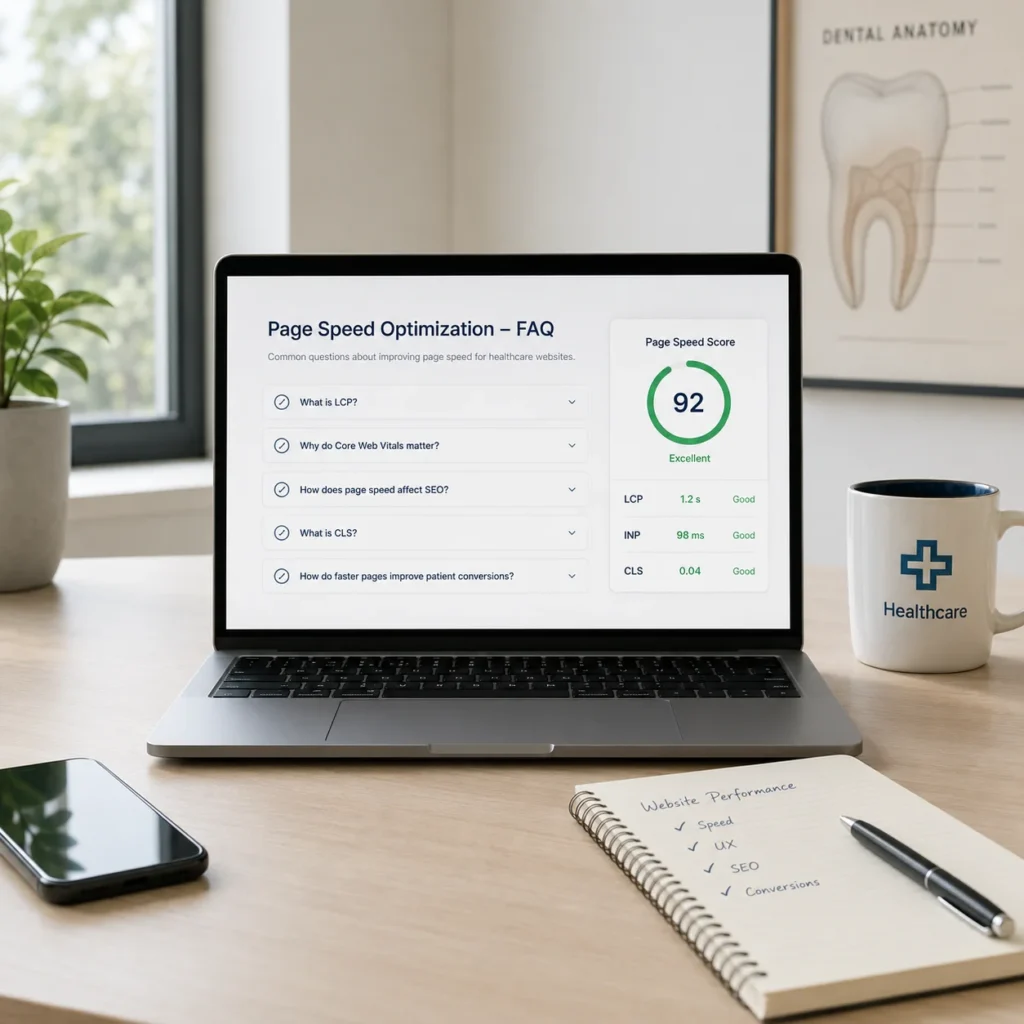
PAGE SPEED OPTIMIZATION FOR HEALTHCARE WEBSITES
Page Speed Optimization for Medical and Dental Websites
Slow healthcare websites lose patients and rankings at the same time. Google uses Core Web Vitals as a direct ranking signal, penalizing pages that load slowly, respond sluggishly to user interaction, or shift layout unexpectedly. Patients who click on a slow-loading healthcare website leave within seconds and call a competitor whose site loads faster.
Our page speed optimization program for healthcare websites delivers measurable improvements to your LCP, INP, and CLS scores on both mobile and desktop. We identify and fix the specific performance bottlenecks slowing your site down, improve your PageSpeed Insights scores, and ensure Google rewards your practice with the rankings your content and authority deserve.
- Core Web Vitals
- LCP and INP Fixes
- Server Response
- Google PageSpeed 90+

PAGE SPEED OPTIMIZATION SERVICES FOR HEALTHCARE
Speed Optimization Services for Medical and Dental Websites
Core Web Vitals Audit and Remediation
Image Optimization and Next-Gen Format Conversion
Render-Blocking Resource Elimination
Identification and elimination of render-blocking JavaScript and CSS files that delay your page’s First Contentful Paint, through script deferral, async loading, critical CSS inlining, and removal of unused third-party scripts that slow initial page rendering without contributing to patient experience
Server Response Time Optimization
E-E-A-T conteAnalysis and improvement of Time to First Byte (TTFB) through server configuration review, database query optimization, PHP version upgrades, object caching setup, and hosting environment assessment to ensure your server responds to patient requests as fast as possiblent that ranks and converts
Caching Configuration and CDN Setup
Implementation of browser caching rules, server-side caching through WP Super Cache, W3 Total Cache, or server-level caching, and Content Delivery Network configuration to serve your healthcare website assets from servers closest to your patients for maximum load speed
JavaScript and CSS Minification
Minification and combination of JavaScript and CSS files to reduce the number and size of network requests required to load your healthcare website pages, reducing total page weight and improving both load speed and Core Web Vitals scores across all devices
Third-Party Script Audit and Management
Full audit of every third-party script running on your healthcare website including analytics, chat widgets, review platforms, booking tools, and ad pixels, with performance impact assessment and recommendations for deferral, replacement, or removal of scripts causing disproportionate speed degradation
WordPress and Plugin Performance Optimization
For WordPress-based healthcare websites, full performance optimization of theme code, plugin conflicts, database overhead, post revision cleanup, autoload option management, and query optimization that commonly cause slow load times on medical and dental practice sites
WHY PAGE SPEED MATTERS FOR HEALTHCARE SEO
A Slow Healthcare Website Costs You Rankings and Patients Every Day
Google’s Page Experience update made Core Web Vitals a confirmed ranking factor for all search results. Healthcare websites scoring in the Poor or Needs Improvement range for LCP, INP, or CLS receive a ranking penalty that compounds over time as faster competitors pull ahead. This penalty applies regardless of how strong your content, backlinks, or local SEO signals are.
Beyond rankings, page speed directly impacts patient conversion rates. Research consistently shows that a one-second delay in mobile page load time reduces conversions by up to 20 percent. For a healthcare practice receiving 500 monthly website visitors, a two-second speed improvement can translate directly into dozens of additional appointment requests per month without changing any other aspect of your SEO or marketing.
Free Page Speed Audit for Your Healthcare Website
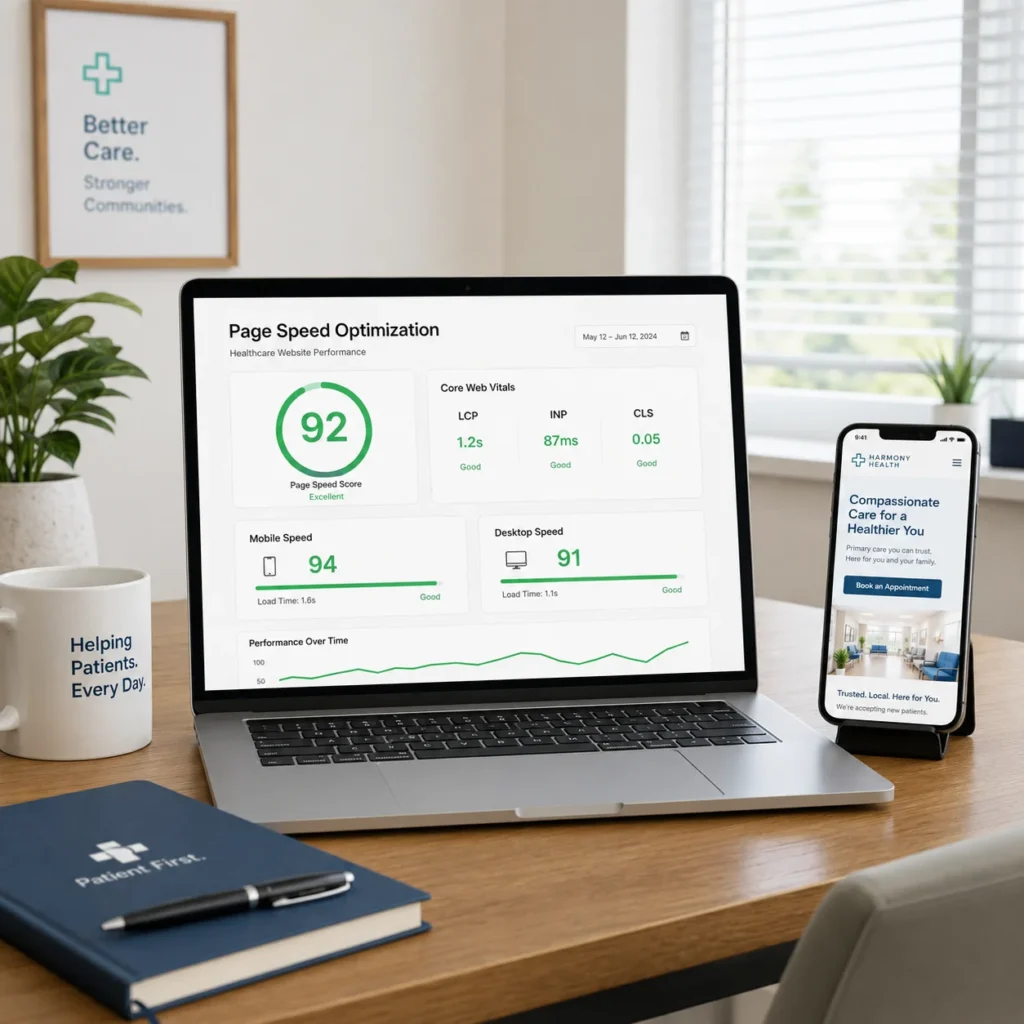
We run a full PageSpeed Insights and Core Web Vitals diagnostic on your practice website, identifying every performance bottleneck that is hurting your scores on mobile and desktop. You receive a prioritized report showing your current LCP, INP, and CLS scores, how they compare to your top competitors, and exactly which fixes will have the greatest impact on your rankings and patient conversion rate.
Core Web Vitals Are a Direct Google Ranking Factor
Google's Core Web Vitals measure three specific aspects of page experience. LCP (Largest Contentful Paint) measures how quickly your main content appears. INP (Interaction to Next Paint) measures how fast the page responds when a patient taps or clicks. CLS (Cumulative Layout Shift) measures whether page elements jump around unexpectedly as the page loads. Pages scoring Good on all three metrics receive a ranking boost in competitive search results. Pages scoring Poor on even one metric are actively penalized. For healthcare practices competing in markets where multiple providers have similar content quality and backlink profiles, Core Web Vitals scores can be the decisive ranking differentiator.
Speed Affects Patient Trust and Bounce Rate
Patients searching for healthcare providers make instant trust judgments based on their first experience with your website. A slow-loading site signals to patients that your practice may not be well-managed or technologically up to date. Studies show that 53 percent of mobile users abandon a website that takes more than three seconds to load. High bounce rates from slow page speed also send negative engagement signals to Google's algorithm. When patients repeatedly click on your listing and immediately leave because your site loads slowly, Google interprets this as a sign that your page is not satisfying the search intent, which compounds the direct Core Web Vitals ranking penalty with an indirect user signal penalty.
Speed Impacts Every SEO Channel Simultaneously
Page speed optimization amplifies the return on every other SEO investment your practice makes. Faster pages rank better in organic search, perform better in Google Ads with higher Quality Scores and lower cost-per-click, convert more voice search and mobile traffic into appointments, and deliver better patient experiences that generate more positive reviews. Fixing your page speed is the only SEO improvement that benefits your rankings, your conversion rate, your ad performance, and your patient satisfaction scores simultaneously. It is typically the highest-ROI technical SEO fix available to healthcare practices with slow-loading websites.
OUR PAGE SPEED OPTIMIZATION PROCESS
How We Speed Up Your Healthcare Website
OUR PAGE SPEED OPTIMIZATION PROCESS
OUR PAGE SPEED OPTIMIZATION PROCESS
Full Speed Diagnostic and Baseline Measurement
We audit page speed, Core Web Vitals, and load times, identify performance issues, and prioritize fixes to improve website speed and search rankings.
Critical Fixes for Biggest Speed Gains
We prioritize image optimization, lazy loading, caching, CDN, faster servers, and script improvements to boost PageSpeed, Core Web Vitals, and overall website performance.
Deep Optimization for Good Core Web Vitals Scores
We optimize JavaScript, CSS, fonts, third-party scripts, layout stability, and CMS settings to achieve strong Core Web Vitals on mobile and desktop.
Verify, Monitor, and Maintain Speed Performance
We verify improvements with PageSpeed and real user data, then monitor Core Web Vitals monthly to prevent performance issues from affecting rankings.
WHAT IS INCLUDED
Everything in Our Healthcare Page Speed Program
Our program covers every layer of page speed optimization from server configuration and caching through image formats, script management, and ongoing monitoring.
Core Web Vitals Audit and Fixes
Full LCP, INP, and CLS diagnostic on mobile and desktop with prioritized remediation targeting each failing metric until all scores reach the Good threshold that Google uses as a positive ranking signal.
Image Optimization and Lazy Loading
Compression and conversion of all images to WebP or AVIF format, implementation of lazy loading for off-screen images, and proper dimension specification to eliminate the CLS score damage caused by unsized images.
Render-Blocking Script Elimination
Audit and remediation of all render-blocking JavaScript and CSS including third-party scripts, unused plugin assets, and non-critical stylesheets that delay First Contentful Paint and inflate Total Blocking Time scores.
Caching and CDN Configuration
Full caching stack setup including browser caching, server-side object caching, and CDN configuration to deliver your healthcare website assets from edge locations nearest to your patients for maximum speed.
Server Response Time Improvement
TTFB analysis and optimization through server configuration tuning, database query review, PHP upgrade recommendations, and hosting environment assessment to reduce the time your server takes to respond to the first patient request.
Monthly Speed Monitoring Reports
Monthly reporting on your Core Web Vitals field data scores, PageSpeed Insights lab scores on mobile and desktop, any new performance regressions detected, and the remediation actions taken to maintain your speed optimization results.
HEALTHCARE PAGE SPEED CONSIDERATIONS
Page Speed Optimization for Healthcare Has Unique Requirements
Healthcare websites have specific elements and constraints that affect page speed optimization strategy and require expertise beyond general web performance work.
- Medical image galleries, before-and-after photo sections, and provider headshots are among the most common sources of poor LCP scores on healthcare websites and require specialized compression and lazy loading treatment
- Third-party booking widgets, telehealth integration scripts, and patient portal login tools are frequent sources of render-blocking and Total Blocking Time issues that must be managed without breaking critical patient-facing functionality
- Review widgets from Healthgrades, Google, and Zocdoc add third-party script weight that must be evaluated for performance impact and managed with async loading or native replacement solutions
- WordPress-based healthcare websites running Elementor, Divi, or other page builder plugins require specific optimization approaches to overcome the CSS bloat and JavaScript overhead these builders introduce
- Google Ads landing page Quality Score is directly tied to page speed. Healthcare practices running paid search benefit from speed optimization through lower cost-per-click and higher ad positions in addition to organic ranking improvements
RELATED SERVICES
Build on Page Speed with These Services
FREQUENTLY ASKED QUESTIONS
Page Speed Optimization for Healthcare Websites: FAQs
What PageSpeed Insights score should a healthcare website aim for?
Google’s PageSpeed Insights scores range from 0 to 100 and are categorized as Poor (0-49), Needs Improvement (50-89), and Good (90-100). Healthcare websites should aim for scores of 90 or above on both mobile and desktop. Most unoptimized medical and dental websites score between 30 and 60 on mobile, which is in the Poor or Needs Improvement range.
More important than the overall score is the status of the three Core Web Vitals metrics: LCP, INP, and CLS. Each needs to be in the Good range on mobile to receive Google’s page experience ranking signal. A site can score 85 overall but still have one failing Core Web Vitals metric that triggers a ranking penalty, so individual metric status matters more than the total score.
How long does page speed optimization take to improve rankings?
Initial PageSpeed Insights score improvements are visible immediately after fixes are deployed. Core Web Vitals field data improvements, which are what Google’s ranking algorithm actually uses, take 28 days to update in Google Search Console because they are based on real user data collected over a rolling 28-day window.
Ranking improvements tied to Core Web Vitals gains typically appear within 4 to 8 weeks of the field data showing Good scores. The impact is most pronounced in competitive healthcare markets where multiple providers have similar content quality and backlink profiles, because speed becomes a differentiating ranking factor in those tightly contested positions.
Will page speed optimization break my healthcare website's design or functionality?
When done correctly, page speed optimization improves performance without breaking design or functionality. Our process includes thorough testing of every change in a staging environment before deployment to your live website. We verify that booking widgets, contact forms, patient portal links, and all other patient-facing tools continue to work correctly after every optimization change.
The most common risk area is third-party script management. When scripts are deferred or replaced for performance reasons, we confirm that the deferred loading does not cause the script to fail or create visible delays in functionality that patients depend on. We document every change and maintain rollback capability for any fix that produces unexpected side effects.