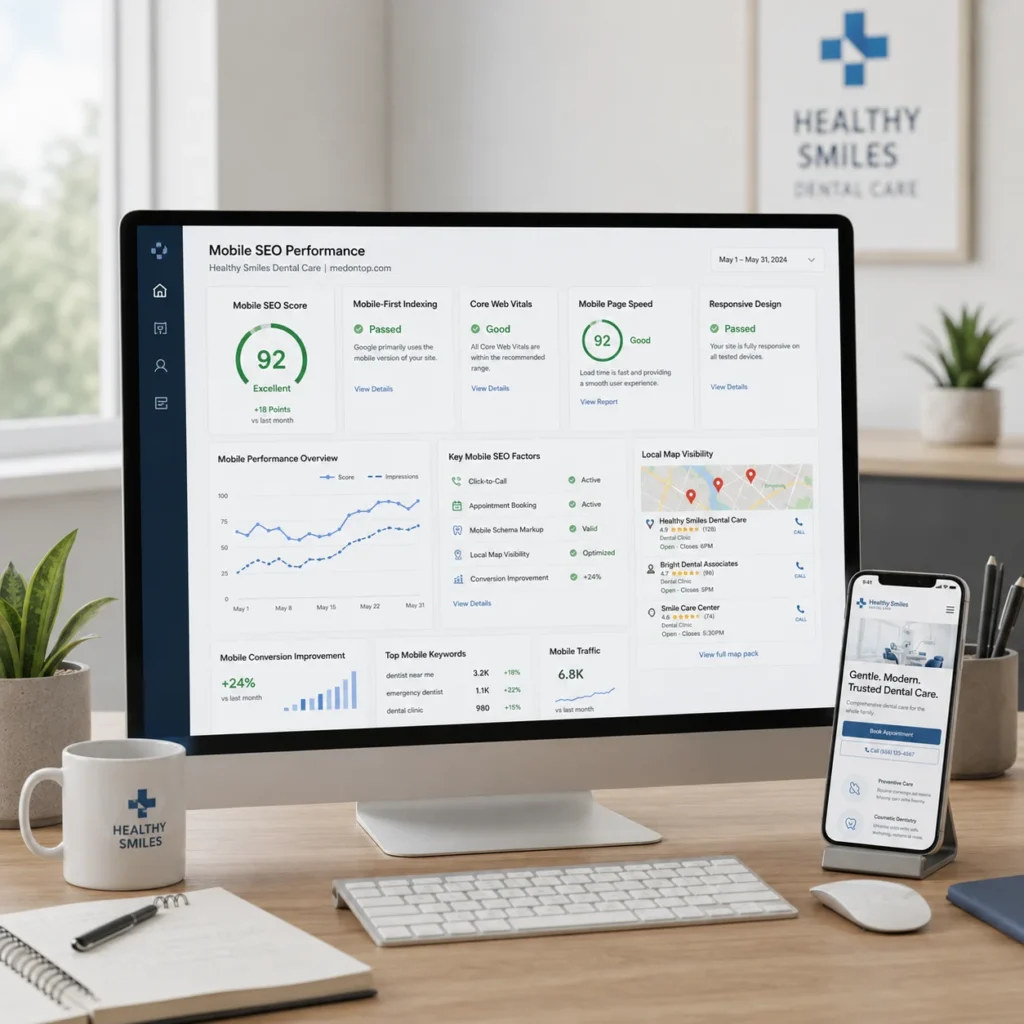
MOBILE SEO FOR HEALTHCARE PRACTICES
Mobile SEO for Doctors That Turns Mobile Searches into Booked Patients
Over 70 percent of healthcare searches now happen on mobile devices. Patients search for providers on their phones while commuting, during lunch breaks, and in urgent moments when they need immediate care. If your website is slow, hard to navigate on a small screen, or not optimized for mobile-first indexing, Google penalizes your rankings across every device.
Our mobile SEO program for healthcare practices fixes every technical and content issue that holds your mobile rankings back. We optimize your site for Google’s mobile-first index, improve Core Web Vitals on mobile, and ensure that patients who find you on their phone can book an appointment in seconds without friction.
- Mobile-First Indexing
- Core Web Vitals
- Mobile SEO for Doctors
- Mobile Conversion Optimization
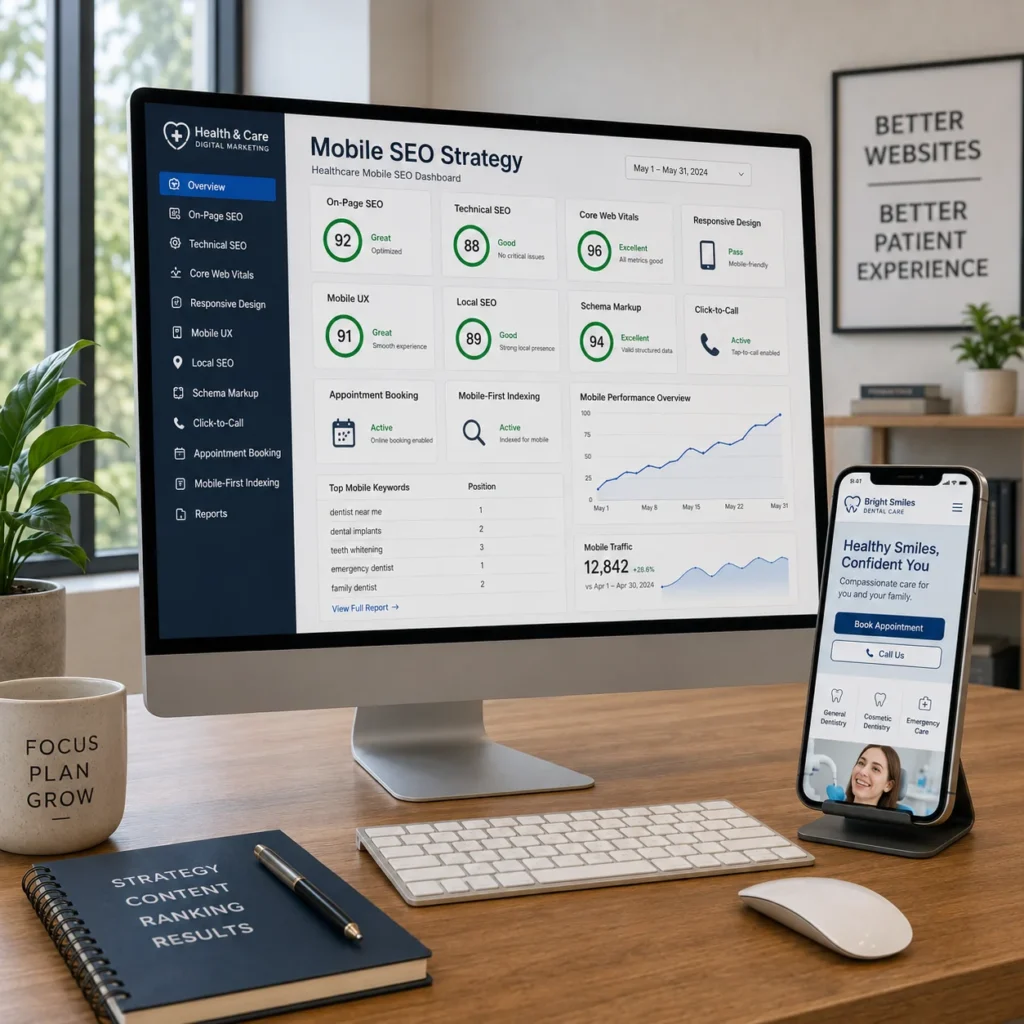
MOBILE SEO SERVICES FOR HEALTHCARE
Mobile SEO Services Built for Medical and Dental Practices
Every service in our mobile SEO program targets the specific performance, usability, and ranking factors that determine how well your healthcare website competes on mobile search.
Mobile-First Index Audit and Optimization
Complete audit of your website’s mobile-first indexing status including content parity between desktop and mobile versions, structured data rendering on mobile, internal link accessibility on small screens, and meta tag consistency across device types that Google’s mobile crawler evaluates
Core Web Vitals Optimization for Mobile
Technical remediation of Largest Contentful Paint (LCP), Interaction to Next Paint (INP), and Cumulative Layout Shift (CLS) scores specifically on mobile devices, where Core Web Vitals performance is measured separately and carries direct ranking weight in Google’s algorithm
Responsive Design Audit and Fixes
Review and remediation of responsive design issues including text that is too small to read without zooming, tap targets that are too close together, content that extends beyond the viewport, and layout elements that break on smaller screen sizes used by healthcare patients
Mobile Page Speed Optimization
Targeted improvement of mobile page load times through image compression and next-gen format conversion, render-blocking resource elimination, server response time reduction, lazy loading implementation, and mobile-specific caching configuration for healthcare website hosting environments
Mobile UX and Appointment Funnel Optimization
Audit and improvement of the complete patient journey on mobile from search result click through to appointment booking, identifying every friction point including hard-to-tap buttons, non-mobile-friendly forms, missing click-to-call functionality, and map and directions accessibility
Click-to-Call and Mobile Contact Optimization
Implementation of prominently placed click-to-call phone links, mobile-optimized contact forms, one-tap appointment request buttons, and Google Maps integration optimized for mobile patients who need to contact or navigate to your practice immediately
Mobile Schema and Structured Data
Verification and optimization of schema markup rendering on mobile, ensuring that rich results including star ratings, FAQ dropdowns, and business information display correctly in mobile search results and drive higher click-through rates from mobile patients
Mobile Competitor Benchmarking
Comprehensive analysis of how your top local competitors’ websites perform on mobile search including page speed scores, Core Web Vitals grades, mobile usability ratings, and mobile ranking positions, with a gap analysis identifying every mobile SEO advantage you are currently missing
WHY MOBILE SEO MATTERS FOR HEALTHCARE RANKINGS
Google Ranks Your Site Based on Mobile Performance First

Free Local SEO Visibility Score
See how you rank across your full service area, not just one ZIP code.
Free Mobile SEO Audit for Your Healthcare Website
We run a full mobile SEO diagnostic on your practice website covering Core Web Vitals scores, mobile usability issues, page speed on mobile, mobile-first index status, and mobile conversion friction points. You receive a prioritized report showing exactly what is hurting your mobile rankings and what to fix first for maximum ranking impact.
Mobile-First Indexing and Content Parity
One of the most common and damaging mobile SEO mistakes healthcare websites make is having different content on their desktop and mobile versions. When important service descriptions, provider credentials, schema markup, or internal links are present on desktop but missing or truncated on mobile, Google's mobile-first crawler sees an incomplete page and ranks it accordingly. Content parity is the foundation of mobile-first SEO. Every piece of content, every structured data element, and every internal link that exists on your desktop pages must also be fully present and accessible on your mobile version. We audit and correct every parity gap that is suppressing your mobile and desktop rankings simultaneously.
Core Web Vitals Are a Direct Ranking Factor
Google's Core Web Vitals are measured separately for mobile and desktop, and mobile scores are typically significantly worse for healthcare websites that have not been specifically optimized. LCP measures how quickly your main content loads on mobile. INP measures how fast the page responds to patient taps. CLS measures whether page elements shift unexpectedly as the page loads on a mobile screen. Healthcare websites with poor Core Web Vitals scores on mobile consistently rank below competitors with better scores, even when their content quality and backlink profiles are comparable. Fixing Core Web Vitals on mobile is one of the highest-ROI technical SEO investments a healthcare practice can make.
Mobile UX Drives Patient Conversions
Ranking on mobile is only half the equation. A mobile-optimized healthcare website also needs to convert visiting patients into appointment requests and phone calls. If your click-to-call button is hard to find, your appointment form is difficult to fill out on a small screen, or your practice address does not link to Google Maps, patients will leave and call a competitor instead. Our mobile conversion optimization identifies and fixes every usability barrier between a patient landing on your mobile site and completing a booking action. This turns the mobile traffic your SEO earns into actual patient appointments rather than high bounce rates that further damage your rankings.
OUR MOBILE SEO PROCESS
How We Optimize Your Healthcare Website for Mobile Search
Our Local SEO Process
Our Local SEO Process
Mobile SEO Audit and Baseline Scoring
We audit mobile SEO, Core Web Vitals, usability, speed, indexing, and conversions, then compare competitors to identify improvements for better mobile performance and rankings.
Technical Mobile Fixes and Core Web Vitals Remediation
We optimize images, scripts, fonts, caching, and server performance to improve Core Web Vitals and deliver faster, better mobile experiences and rankings.
Mobile Content, UX, and Conversion Optimization
We improve mobile design, forms, click-to-call, content consistency, location access, and schema to enhance usability, conversions, and mobile search performance.
Monitor, Measure, and Maintain Mobile Performance
We monitor mobile Core Web Vitals, rankings, and conversions, proactively fixing new issues to maintain strong mobile performance and search visibility.
WHAT IS INCLUDED
Everything in Our Healthcare Mobile SEO Program
Our mobile SEO program addresses every technical, content, and conversion layer that determines how well your practice ranks and converts patients on mobile devices.
Core Web Vitals Optimization
Full LCP, INP, and CLS remediation on mobile with targeted fixes for each failing metric, verified through Google Search Console and PageSpeed Insights until all scores reach the Good threshold Google rewards with ranking advantages.
Mobile Page Speed Improvements
Image compression, next-gen format conversion, lazy loading, render-blocking elimination, and caching optimization specifically targeting mobile load time, where healthcare patients are least tolerant of slow-loading pages.
Responsive Design Audit and Fixes
Identification and remediation of all responsive design failures including small tap targets, horizontal scrolling, oversized images, illegible font sizes, and layout elements that break on mobile screen sizes.
Mobile Content Parity Audit
Review of all desktop page content against their mobile versions to identify and fix missing service descriptions, truncated provider bios, absent schema markup, and broken internal links that harm mobile-first indexing.
Click-to-Call and Mobile Contact Setup
Implementation of properly linked click-to-call phone numbers, one-tap appointment buttons, mobile-optimized contact forms, and Google Maps deep links so patients can reach your practice in one tap from any page on mobile.
Monthly Mobile SEO Reporting
Monthly reporting on mobile Core Web Vitals scores, mobile keyword ranking movements, mobile traffic and conversion rate trends, and any new mobile usability issues detected in Google Search Console requiring attention.
HEALTHCARE MOBILE SEO CONSIDERATIONS
Mobile SEO for Healthcare Is Different from Other Industries
Mobile SEO requirements for healthcare websites go beyond general best practices due to the regulatory, conversion, and trust factors specific to the medical context.
- Google's mobile-first index evaluates YMYL healthcare content with heightened scrutiny. Mobile pages with missing provider credentials, incomplete service information, or absent contact details perform worse than desktop-equivalent pages in healthcare verticals
- Click-to-call functionality is a direct revenue driver for healthcare practices. Patients with urgent medical needs who find your mobile site expect to reach your practice in a single tap. Missing or hard-to-find phone links lose these high-intent patients immediately
- Click-to-call functionality is a direct revenue driver for healthcare practices. Patients with urgent medical needs who find your mobile site expect to reach your practice in a single tap. Missing or hard-to-find phone links lose these high-intent patients immediately
- HIPAA compliance extends to mobile UX. Analytics tools and session recording software configured for mobile must exclude health-related form field data from capture to avoid PHI exposure through mobile tracking implementations
- Local map and directions integration is especially critical on mobile. Patients searching for your practice on their phone expect a single tap to open Google Maps with turn-by-turn directions to your location
- Mobile page speed directly impacts your Google Ads Quality Score as well as organic rankings. Healthcare practices running paid search campaigns receive better ad positions and lower cost-per-click when their mobile landing pages load fast
Local SEO for Healthcare
Related Services
FREQUENTLY ASKED QUESTIONS
Mobile SEO for Healthcare Practices: FAQs
What is mobile-first indexing and how does it affect healthcare websites?
Mobile-first indexing means Google uses the mobile version of your website as the primary version for determining your search rankings for all queries on all devices. If your mobile site has less content, slower load times, or missing structured data compared to your desktop site, those deficiencies directly suppress your rankings even for desktop searches.
For healthcare websites, this means your mobile pages need to contain your complete service descriptions, full provider bios with credentials, all internal links, and complete schema markup. Any content that exists only on your desktop version is effectively invisible to Google’s ranking algorithm under mobile-first indexing.
What Core Web Vitals scores does a healthcare website need to rank well on mobile?
Google classifies Core Web Vitals scores as Good, Needs Improvement, or Poor. For LCP, Good is under 2.5 seconds. For INP, Good is under 200 milliseconds. For CLS, Good is under 0.1. Pages scoring in the Good range receive a ranking advantage over pages scoring in the Needs Improvement or Poor range for otherwise comparable queries.
Most healthcare websites that have not been specifically optimized for mobile performance score in the Needs Improvement or Poor range for at least one Core Web Vitals metric on mobile. Fixing these scores is one of the fastest ways to recover mobile rankings that are being suppressed by technical performance issues rather than content or authority deficiencies.
How much of healthcare patient search traffic comes from mobile devices?
Industry data consistently shows that 70 to 75 percent of local healthcare searches are conducted on mobile devices. For urgent care, emergency dental, and same-day appointment queries, mobile share is even higher because these searches happen in real-time situations where patients are away from a desktop computer.
This means that a healthcare practice with poor mobile SEO performance is effectively invisible to the majority of the patients searching for their services. Investing in mobile SEO optimization directly addresses the primary channel through which most new patients discover and evaluate healthcare providers in local search today.