ON-PAGE SEO FOR HEALTHCARE
On-Page SEO for Healthcare Practices
Off-page authority and technical infrastructure set the ceiling for how well your healthcare website can rank. On-page SEO determines whether you actually reach it. Every service page, condition page, and location page on your website is either actively working to attract patient search traffic or quietly losing ground to competitors who have taken the time to optimize theirs. On-page SEO closes that gap by aligning your content, structure, and signals with exactly what Google needs to rank healthcare pages with confidence.
Our on-page SEO program for healthcare practices goes far beyond keyword placement. We build page architectures that satisfy Google’s YMYL standards, demonstrate E-E-A-T through structured content signals, answer the specific questions patients type into search, and convert that organic traffic into appointment requests. Every optimization decision is rooted in what actually moves rankings for medical and dental websites in competitive local markets.
- YMYL-Compliant Content
- E-E-A-T Signals
- Patient Intent Optimization
- Transparent Reporting

FULL ON-PAGE SEO SERVICES FOR HEALTHCARE PROVIDERS
Complete On-Page SEO Services for Healthcare Websites
From keyword research and title tag optimization to E-E-A-T content architecture and internal linking strategy, our on-page SEO services are designed from the ground up for the YMYL category where content quality requirements are the strictest.
Healthcare Keyword Research
Title Tag and Meta Description Optimization
E-E-A-T Content Architecture
Service and Condition Page Writing
Location Page Optimization
Internal Linking Architecture
Header and Content Structure Optimization
Schema Markup for Rich Results
WHY ON-PAGE SEO MATTERS FOR HEALTHCARE WEBSITES
Why Healthcare Websites Lose Rankings Without On-Page SEO

Free Local SEO Visibility Score
See how you rank across your full service area, not just one ZIP code.
Free On-Page SEO Audit for Your Healthcare Website
We will analyze your top 10 service and location pages across 40-plus on-page signals including keyword targeting, title tag optimization, content depth, E-E-A-T signals, internal linking, and schema coverage, then deliver a prioritized fix list with projected ranking impact for each page.
YMYL On-Page Standards for Medical and Dental Content
Healthcare content sits in Google's Your Money or Your Life category, where the algorithm applies its strictest quality filters before deciding how much organic traffic to send your pages. YMYL on-page optimization means more than keyword density. It means provider credentials visibly displayed on every relevant page, clinical sources cited for factual claims, content depth that matches or exceeds what is already ranking for your target keywords, and a site architecture that signals to Google you are a legitimate, established healthcare practice. We apply every one of these standards to each page we optimize or create for your practice.
Patient Intent Mapping and Keyword Architecture
Patients search in very specific ways when they are looking for a healthcare provider. They search by symptom before they search by procedure. They search by location before they search by specialty. They search questions before they search practice names. Our on-page keyword strategy maps the full patient search journey for your specialty and service area, then builds a page architecture that captures traffic at every stage. A dental practice targeting implants needs pages that rank for tooth loss symptoms, missing tooth options, implant costs, implant recovery, and implant providers in the city, not just one generic implants page.
E-E-A-T Content Signals Built Into Every Page
Google's quality raters evaluate healthcare pages for Experience, Expertise, Authoritativeness, and Trustworthiness before those pages qualify for prominent YMYL rankings. Every page we optimize includes structured E-E-A-T signals: provider credential callouts, clinical training and board certification displays, practice history and patient volume indicators, verified review counts, and content that demonstrates genuine clinical depth rather than generic health information. These signals are not just user-experience features. They are on-page ranking factors that distinguish authoritative healthcare content from the low-quality medical content Google's algorithm is specifically designed to filter out.
OUR ON-PAGE SEO PROCESS
Our On-Page SEO Process for Healthcare
Our Local SEO Process
Our On-Page SEO Process for Healthcare
On-Page Audit and Opportunity Mapping
We audit every page for keywords, metadata, content quality, E-E-A-T, internal links, schema, and headings, then prioritize pages with the highest ranking potential.
Keyword Research and Content Strategy
We research target keywords, semantic terms, and patient questions, then build internal linking strategies to create strong topical authority across your website.
Content Creation and Optimization
Our healthcare team creates optimized content with SEO titles, headings, E-E-A-T, FAQs, and strong calls to action to increase rankings and patient conversions.
Schema Implementation and Ongoing Monitoring
We add schema markup, track rankings, click-through rates, and engagement, then continuously optimize pages to stay competitive with search and algorithm updates.
WHAT IS INCLUDED IN OUR ON-PAGE SEO PROGRAM
What's Included in Our On-Page SEO Program
Keyword Research and Mapping
Complete patient intent keyword research for every specialty, service, condition, and location your practice covers, mapped to specific pages and organized into topical clusters that build site-wide authority.
Title Tag and Meta Description Optimization
Keyword-optimized, click-tested title tags and meta descriptions for every service, condition, and location page, written to improve both page rankings and organic click-through rates from Google results.
Service and Condition Page Content
Clinician-reviewed, E-E-A-T-optimized content for every treatment and condition page your practice needs, written to the depth and specificity required to outrank generic competitor pages in your market.
E-E-A-T Credential and Trust Signals
Structured placement of provider credentials, board certifications, practice history, patient volume indicators, and clinical references on every page where Google's quality raters would look for them.
Internal Linking and Site Architecture
Strategic internal link building connecting service pages, condition pages, location pages, and provider bio pages to distribute authority, guide patients through the site, and signal topical depth to Google.
Schema Markup and Rich Result Optimization
FAQPage, MedicalOrganization, Physician, MedicalProcedure, and LocalBusiness schema on every applicable page to qualify for featured snippets, People Also Ask boxes, and AI Overview inclusion.
HEALTHCARE-SPECIFIC ON-PAGE SEO CONSIDERATIONS
Healthcare On-Page SEO Is Different
- YMYL content standards require verifiable clinical depth, not just keyword-rich paragraphs that any generalist copywriter could produce
- Provider credential displays and board certification callouts are on-page E-E-A-T signals that directly influence how Google evaluates your pages' trustworthiness
- Condition and symptom pages must be written to a clinical standard that satisfies both patients looking for answers and Google's medical content quality raters
- HIPAA-aware call-to-action design means capturing appointment intent without embedding tracking scripts that could expose patient data in form submissions
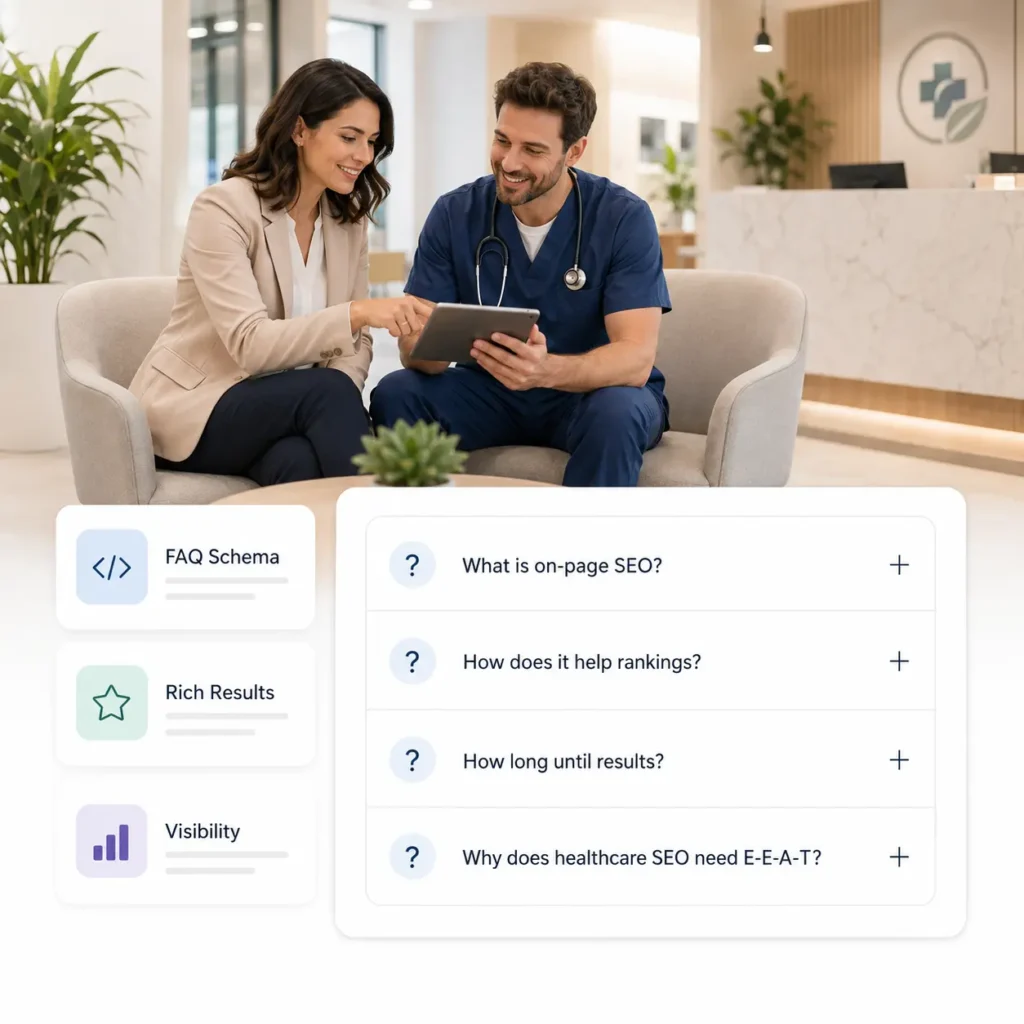
- FAQ schema targeting for healthcare queries earns People Also Ask and AI Overview placements that are disproportionately valuable in the medical search category
RELATED SERVICES
Related Healthcare SEO Services
FREQUENTLY ASKED QUESTIONS
On-Page SEO for Healthcare: FAQs
How is on-page SEO for healthcare different from standard on-page SEO?
How many pages does my healthcare website need to rank well?
How long does it take for on-page optimization to improve my rankings?
On-page changes are among the fastest-acting SEO improvements you can make. Pages that are already indexed but underperforming due to weak title tags, thin content, or missing schema often show ranking movement within 4 to 8 weeks of optimization. Pages that Google has not yet ranked or that require significant content additions typically take 2 to 4 months to reach their target position. The timeline depends on how competitive the target keyword is, how strong your domain authority is currently, and whether your off-page and technical SEO foundations are in place to support the on-page work. We provide monthly ranking reports so you see exactly how each optimized page is performing.